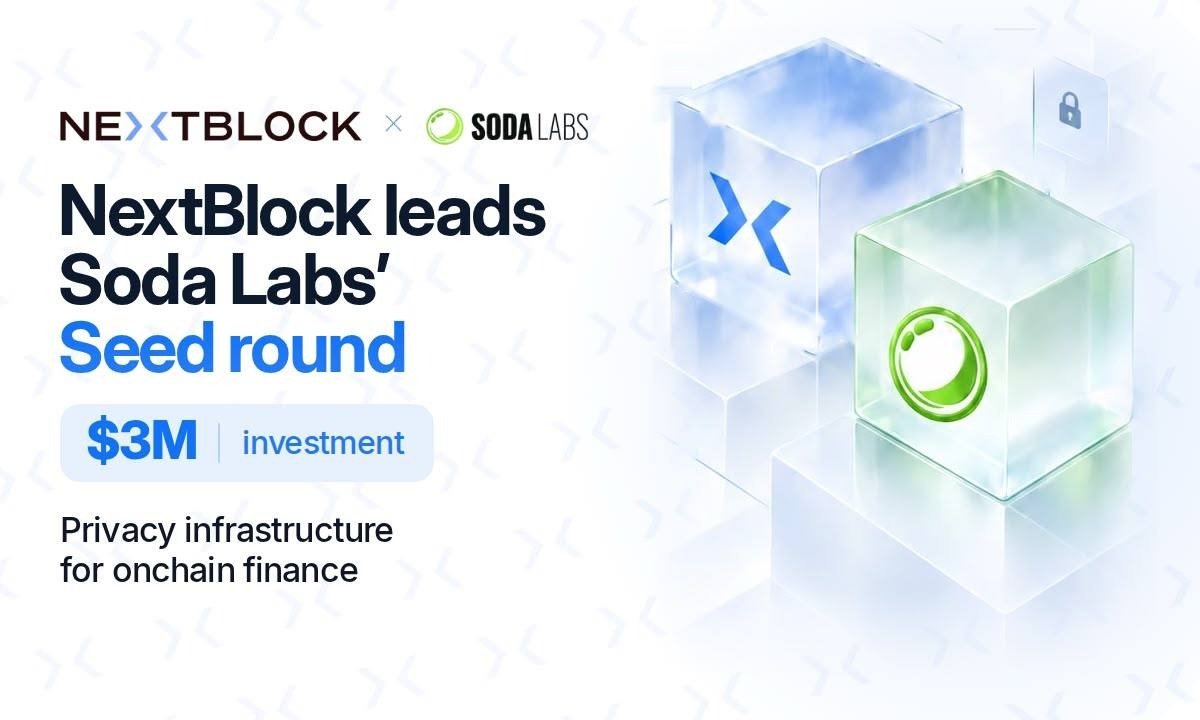
NextBlock has committed $3 million to Soda Labs' seed round, fully funding the closed investment as the startup scales its programmable privacy infrastructure for financial transactions on public blockchains.
Soda Labs has spent two and a half years developing a cryptographic privacy solution that merges garbled circuits with multiparty computation (GC-MPC). The technology relies on established standards like AES and SHA-256 and operates on standard cloud CPUs without requiring specialized hardware.

According to the company, the privacy engine allows applications to execute private computations while staying connected to existing public blockchain networks. This approach aims to address a critical gap: enabling regulated financial activity without exposing sensitive data to all network participants.
Commercial traction and performance
Soda Labs reports that its technology has processed over 100 million transactions on the COTI network, supporting applications such as tokenization platform Zoniqx and perpetuals exchange PriveX. PriveX has handled more than $20 billion in trading volume, while Zoniqx is onboarding issuers across multiple asset classes and jurisdictions.
NextBlock's founder and general partner, Pieter van Poecke, highlighted the practicality of the technology for onchain financial workloads. "Soda already had a working product and paying customers," he said, noting the company's differentiated technical IP and commercial instincts.
Expansion to Soda Bubble
The funding will support Soda Labs' expansion from its Ethereum Layer 2 privacy layer, gcEVM, to Soda Bubble, a chain-agnostic coprocessor designed for programmable privacy. Bubble can process developer-defined workloads from various blockchains without exposing private data publicly or to Soda Labs itself.
The Bubble Validator Network enables participants to mathematically verify that computations involving private data were performed correctly, according to the company. This design aims to provide privacy with controlled disclosure for banks, payment companies, and tokenization platforms.
Benchmarks and network growth
Soda Labs expects to publish updated performance benchmarks in the coming weeks. Its latest testing on Arbitrum measured the full transaction lifecycle on the live network, including encryption, multiparty computation, consensus, and settlement. The company reported a five- to ten-fold improvement over its previously published benchmark.
The garbled-circuit MPC architecture can deliver approximately 10 to 100 times greater throughput and 100 to 1,000 times lower transaction costs than current alternatives, while running on standard cloud CPUs. These results have not yet been publicly released.
Soda Labs is expanding Bubble across EVM ecosystems including Ethereum, Polygon, Arbitrum, and Base, with plans for non-EVM networks like Solana. The new funding will support go-to-market efforts, validator network expansion, team growth, and integrations with financial infrastructure providers.
The company is also working with financial and infrastructure organizations on several undisclosed pilots, aiming to convert them into production deployments over the next 12 to 18 months.
This article is for informational purposes only and does not constitute financial advice.

