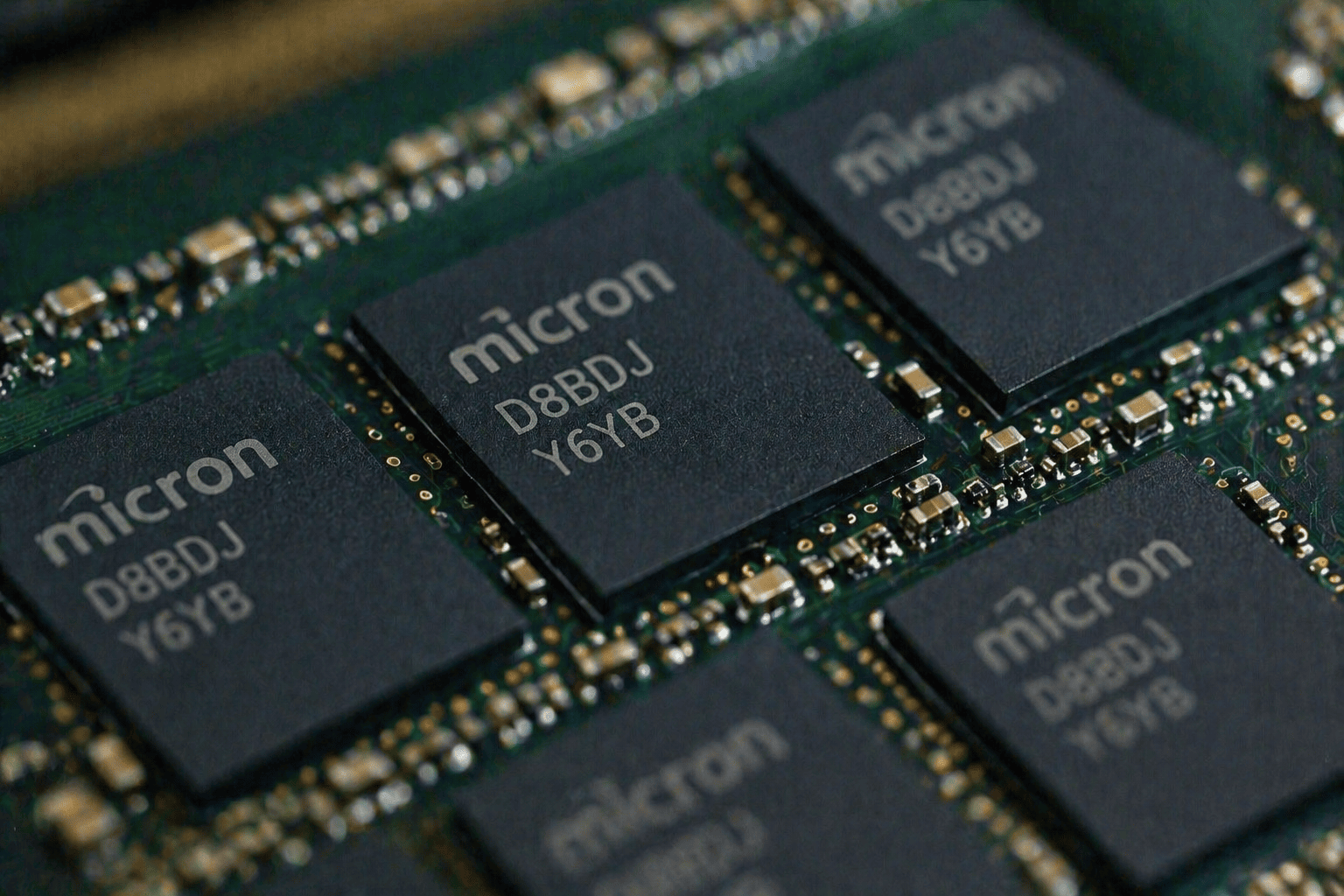
Shares of major memory and storage companies fell sharply on Monday after two developments in China's semiconductor industry heightened investor concerns about competitive pressure and technological self-sufficiency. Micron Technology dropped about 6%, SanDisk lost more than 12%, and US-listed shares of South Korea's SK Hynix declined nearly 9%.
CXMT's blockbuster debut
The selloff was triggered by the stunning market debut of Chinese memory chipmaker ChangXin Technology Group (CXMT) on Shanghai's STAR Market. CXMT shares surged roughly 466% on their first day of trading, making it the most valuable China-listed chipmaker. The listing raised $8.6 billion, which analysts expect will accelerate the company's manufacturing expansion, particularly in commodity DRAM used in smartphones, PCs, and servers.

According to Counterpoint Research, CXMT's share of the global DRAM market nearly tripled over the past year to about 8% in the first quarter. While that remains well below Micron's estimated 22% share, the pace of growth has alarmed investors. Nomura projects CXMT could increase its global DRAM market share from roughly 10% today to about 18% by the end of 2028, supported by a planned expansion of monthly wafer capacity from 280,000 in 2025 to 550,000 by 2028.
Concerns intensified after reports that Apple is testing DRAM chips supplied by CXMT. The possibility that one of the world's largest electronics manufacturers could eventually source memory from a Chinese supplier has raised expectations that CXMT could win higher-profile customers more quickly than previously anticipated. For more context on the IPO's long-term implications, see our analysis of CXMT's IPO risks.
China's DUV lithography breakthrough
The selloff gained further momentum after The Information reported that China has started manufacturing domestically developed immersion DUV lithography machines, while also developing domestic EUV machines, though those remain at a prototype stage. Lithography equipment is the most technologically challenging part of semiconductor manufacturing, and Dutch company ASML has long dominated the global market for advanced systems. ASML stock also plunged 6% on the report.
Chinese chipmakers have relied heavily on ASML's immersion DUV systems after US-led export restrictions blocked access to the company's more advanced EUV machines starting in 2019. Samsung, SK Hynix, and Micron all manufacture advanced DRAM using ASML's EUV systems, allowing them to produce smaller, faster, and more power-efficient chips. Because EUV systems remain out of reach for Chinese producers, they are still several years behind in advanced AI memory products.
Limited near-term threat in AI memory
Some analysts believe the competitive threat to Micron remains limited for now. Milk Road AI analyst Melvin noted that CXMT is likely to compete most aggressively in commodity DRAM for smartphones and PCs, but remains well behind in premium memory technologies. Micron has increasingly shifted its focus toward high-bandwidth memory (HBM), used in AI servers and data centers. According to Melvin, CXMT is at least two generations behind in HBM technology and does not currently pose a significant threat in the rapidly growing AI memory segment. For more on how AI demand is shaping the memory landscape, see our report on China's Kimi K3 AI model.
Meanwhile, SK Hynix has been a key partner for Nvidia in HBM supply, as highlighted in our coverage of the Nvidia-SK Hynix pact. The broader market reaction suggests investors are pricing in a longer-term shift in the competitive dynamics of the memory industry, even if the immediate impact on premium segments is muted.
This article is for informational purposes only and does not constitute financial advice.