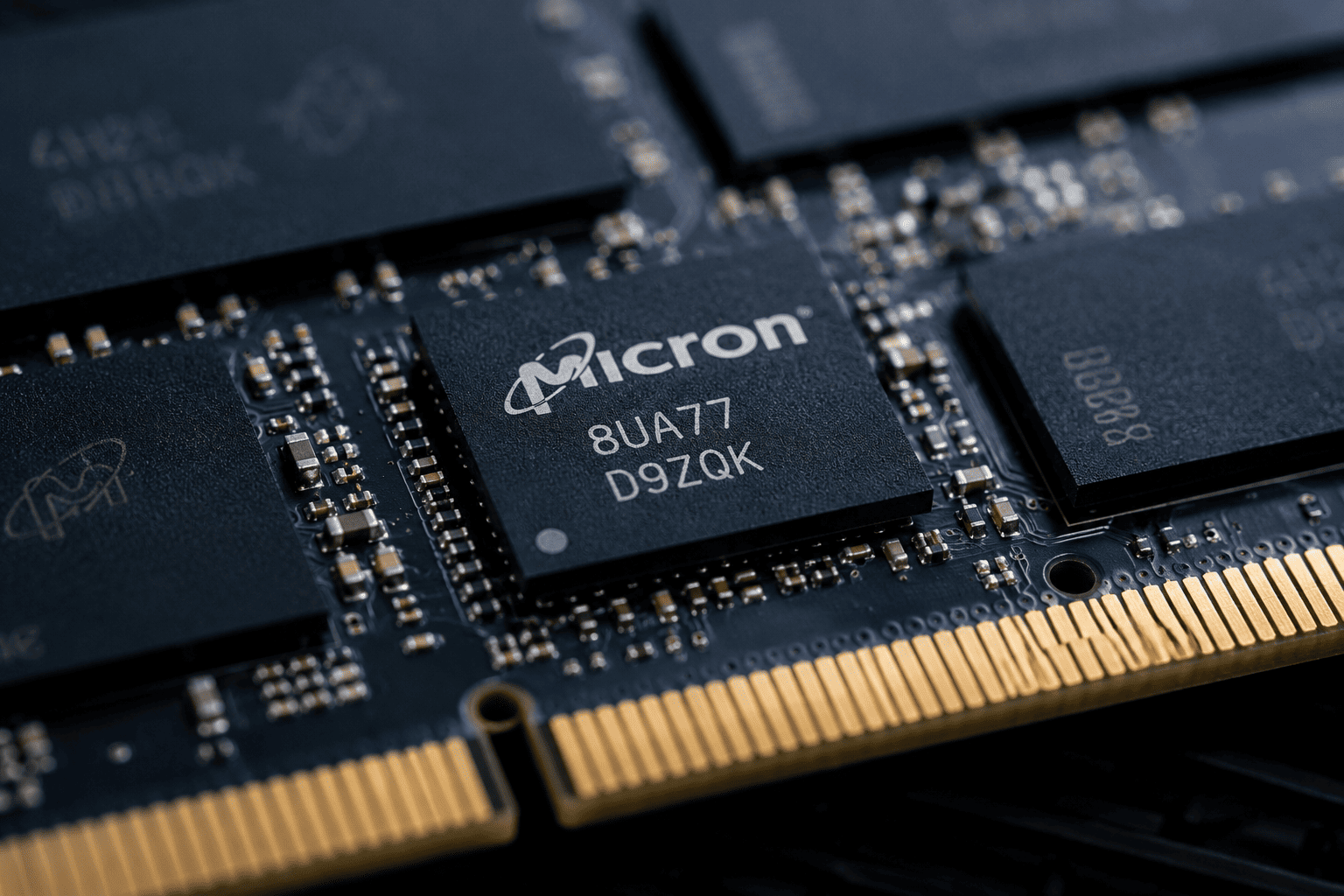
Memory-chip stocks came under renewed selling pressure on Monday after a Reuters report indicated that China's largest DRAM maker, ChangXin Memory Technologies (CXMT), is considering building a second fabrication plant in Beijing. The move is seen as part of a broader push to expand output amid a global semiconductor shortage driven by artificial intelligence spending.
Micron Technology and SK Hynix each fell roughly 6% in early trading before paring losses. Sandisk slipped about 2.5% before turning positive later in the session. Storage names Seagate Technology and Western Digital posted steeper declines of more than 7%. The sell-off occurred even as the broader U.S. market rallied after President Donald Trump called off planned strikes against Iran, easing geopolitical tensions and sending oil prices lower. The Dow Jones Industrial Average gained over 1.1%, the S&P 500 advanced more than 0.7%, and the Nasdaq Composite rose about 1%.

Beijing expansion plan revives supply concerns
Reuters reported, citing two people familiar with the matter, that CXMT is in financing discussions with a technology manufacturing hub backed by the Beijing municipal government to support construction of another memory-chip facility. The proposed investment comes as the company seeks to increase output to capitalize on surging demand for memory chips used in AI servers and data-center infrastructure.
CXMT is currently the world's fourth-largest manufacturer of dynamic random-access memory (DRAM), with an 8% share of the global market during the first quarter, according to Counterpoint Research. That compares with just 3% a year earlier, highlighting the pace of expansion. Despite that growth, the company remains significantly smaller than Samsung Electronics, SK Hynix, and Micron, whose combined market share approached 90% in the first quarter.
Reuters had previously reported that CXMT is already constructing new facilities in Shanghai and Hefei while exploring additional expansion projects in other Chinese cities. Once completed, those projects could double the company's manufacturing capacity to more than 600,000 wafers per month.
IPO and expansion fuel investor worries
Monday's decline follows another bout of weakness in memory-chip stocks last month after CXMT completed the largest mainland Chinese semiconductor initial public offering on record. The company raised 57.92 billion yuan, or roughly $8.6 billion, after pricing shares at 8.66 yuan each, giving it fresh capital to support its aggressive manufacturing expansion plans.
The combination of fresh funding and continued capacity additions has revived investor concerns that China could eventually increase memory-chip supply enough to pressure pricing across the industry. Those worries have periodically weighed on shares of Micron and other memory manufacturers, particularly as investors assess how quickly Chinese suppliers can narrow the technology gap with global leaders. For context, the DRAM ETF has already dropped 33% this year, reflecting persistent oversupply fears.
Analysts say technology gap remains significant
Despite the latest expansion plans, analysts continue to argue that CXMT is unlikely to meaningfully challenge the industry's dominant players in the near term. "Listing doesn't change the outlook for the big three or the industry as demand continues to exceed supply for everyone," David Gibson, senior analyst at MST Financial, said in a CNBC report last month.
A key limitation remains access to advanced semiconductor manufacturing equipment. Because of US-led export restrictions, Chinese memory manufacturers do not have access to the latest extreme ultraviolet (EUV) lithography systems, which are widely viewed as essential for manufacturing cutting-edge memory chips efficiently. Without those machines, Gibson noted, CXMT requires roughly 30% more semiconductor wafers than its global competitors to produce the same amount of memory. That structural disadvantage makes it difficult for the company to match the manufacturing efficiency of Samsung, SK Hynix, and Micron, even as it expands capacity.
Domestic strength, but AI opportunity remains limited
CXMT has established a growing presence within China's domestic electronics industry, supplying memory chips to several Chinese smartphone manufacturers while gradually expanding into the country's PC and server markets. However, analysts say its product lineup remains concentrated in mainstream and mid-range applications rather than the high-performance memory increasingly required for AI workloads.
Ellie Wang, an analyst at TrendForce, previously told CNBC that while CXMT continues to strengthen its domestic position, its capabilities remain relatively limited in high-capacity server memory and advanced products designed for AI servers. That leaves global leaders such as Micron, Samsung, and SK Hynix with a substantial advantage in supplying the rapidly expanding AI infrastructure market, even as Chinese manufacturers continue to build capacity and narrow the gap in conventional memory products. The recent Kospi drop of 4% underscores how sensitive the sector is to such news.
This article is for informational purposes only and does not constitute financial advice.