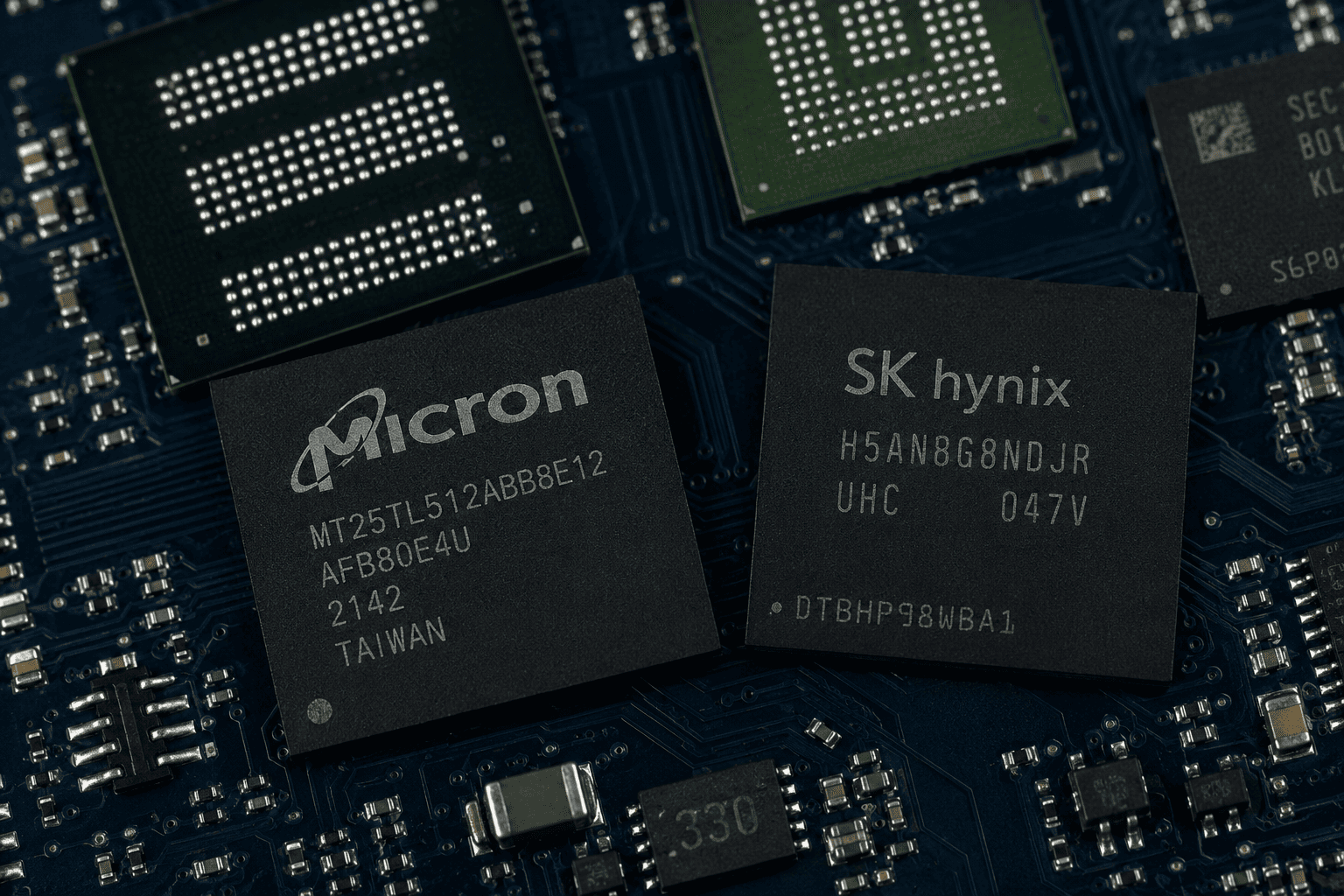
Shares of memory chipmakers and storage companies declined sharply on Thursday, extending a broader semiconductor selloff triggered by Taiwan Semiconductor Manufacturing Co.'s (TSMC) quarterly results. Despite reporting record earnings, TSMC's higher-than-expected capital expenditure guidance and a slight revenue miss prompted investors to reassess the pace of AI-related spending across the industry.
TSMC's Capex Outlook Sparks Caution
TSMC posted its fifth consecutive quarter of record profit, beating analyst estimates. However, the market focused on the company's revised capital expenditure forecast of $60 billion to $64 billion for the year, up from the prior range of $52 billion to $56 billion. The chipmaker also highlighted a planned $100 billion investment to expand manufacturing in Arizona, adding to concerns about rising costs across the semiconductor supply chain. US-listed shares of TSMC fell approximately 1.7% in morning trading.

Memory Stocks Lead Declines
The cautious reaction to TSMC's results weighed heavily on memory and storage stocks. Micron Technology (MU) dropped more than 4%, while SanDisk declined around 8%. Western Digital fell 5%, and Seagate Technology lost over 5% in mid-morning trading after steeper losses at the open. US-listed shares of South Korea's SK Hynix slid about 8%. The weakness was not confined to memory companies; the Philadelphia Semiconductor Index fell more than 2.6%, with AI chipmakers Nvidia, AMD, and Broadcom declining between 1.7% and 3%.
For more on the memory selloff, see our analysis of SanDisk's 35% decline and analyst upside targets.
Investors Question AI Spending Pace
The pullback reflects growing caution around the pace of investment in AI infrastructure, rather than doubts about the technology's long-term potential. Shiraz Ahmed, founder and CEO of Sartorial Wealth Inc., noted that the recent rally in semiconductor stocks appears to be cooling. According to Ahmed, AI demand remains intact, but adoption has yet to become widespread enough to justify the current level of capital expenditure across industries from semiconductors to energy. The combination of rising investment costs and elevated valuations has prompted investors to reassess near-term earnings growth expectations for the sector.
CXMT Adds Pressure on Micron
Micron faces additional headwinds from potential competition from Chinese memory manufacturer ChangXin Memory Technologies (CXMT). The company is reportedly preparing to raise approximately $8.5 billion through a listing on Shanghai's STAR Market, nearly double its initial fundraising target, implying a valuation of roughly $85.5 billion. According to Trefis, the proceeds could provide CXMT with significant resources to expand production of commodity DRAM chips, a core business for Micron. "In the notoriously cyclical memory-chip business, a well-funded new entrant is the oldest ghost in the machine, signaling future supply gluts and potential price wars," Trefis said.
Despite these concerns, Micron's financial performance remains strong, with revenue over the past 12 months increasing 86% year over year and net margins reaching a three-year high of 42%. However, Trefis warned that the memory industry has historically been characterized by cycles of capacity expansion followed by oversupply and falling prices. US export restrictions limiting CXMT's access to advanced chipmaking equipment may reduce the immediate competitive threat to Micron's high-end products, but additional capacity could still pressure pricing in the standard DRAM market.
For context on the broader memory rout, see our coverage of Kioxia's 40% plunge from peak and SK Hynix's 11% tumble.
Automotive Partnerships Offer Long-Term Support
Separately, Micron announced long-term supply agreements with automotive partners, including Qualcomm and Harman, to provide memory and storage components for AI-enabled vehicles. These agreements aim to secure supply as automakers increasingly adopt artificial intelligence features, adding another long-term growth avenue for the company even as investors remain cautious about near-term industry dynamics.
This article is for informational purposes only and does not constitute financial advice.