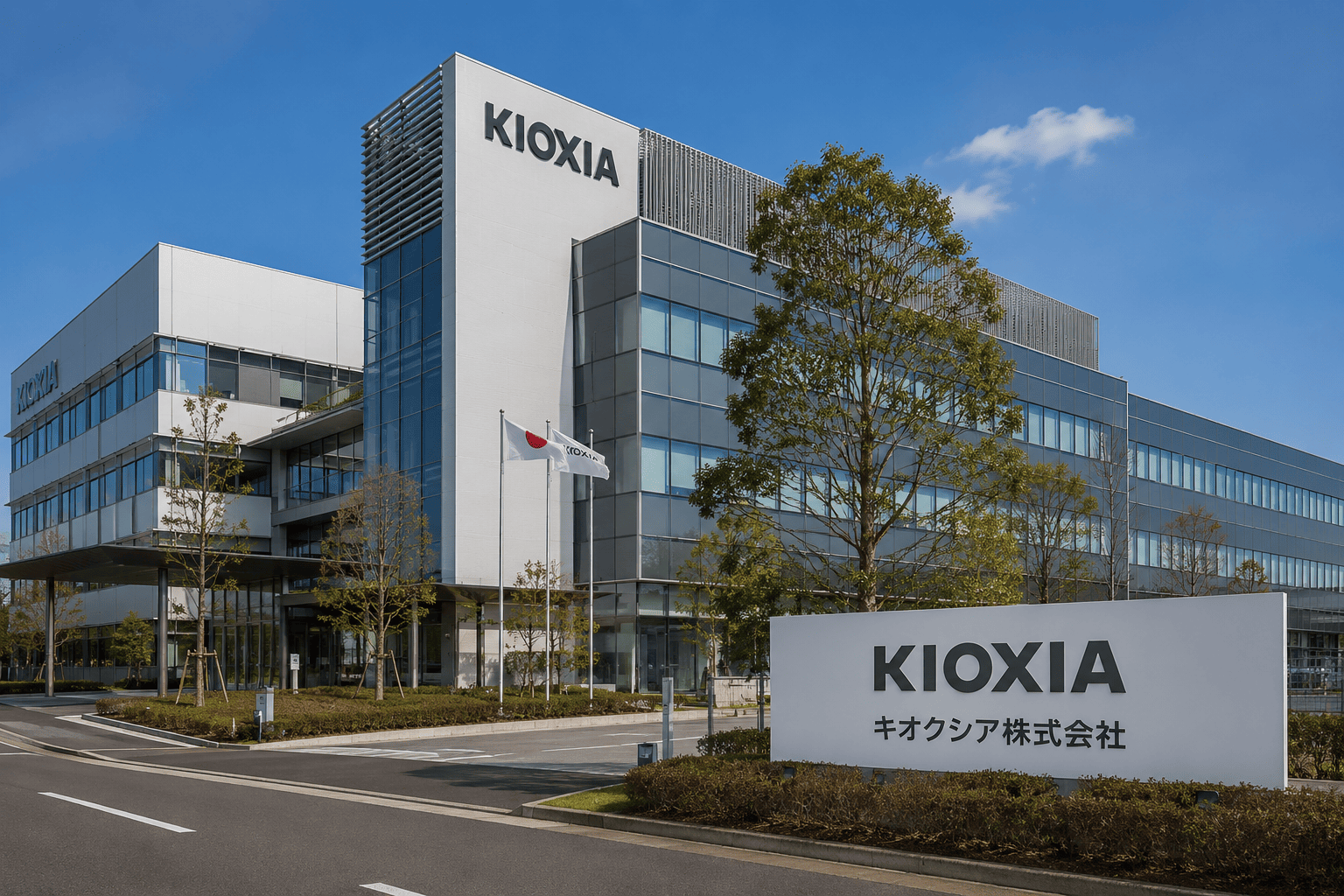
Kioxia Holdings Corporation, Japan's leading memory chip manufacturer, has seen its stock price tumble over 40% from its late-June record high of ¥112,750 to approximately ¥63,100, marking its lowest level since late May. The decline has outpaced the broader Nikkei 225 Index and comes despite the company reporting explosive growth in revenue and profits, fueled by insatiable demand for high-bandwidth memory (HBM) from hyperscale data center operators.
Record Financial Performance Amid the Selloff
Kioxia's fourth-quarter revenue surged 188% year-over-year to ¥1 trillion ($6.8 billion), significantly exceeding the company's guidance range of ¥845 billion to ¥935 billion. Operating profit skyrocketed 1,499% to ¥599 billion, while net income jumped 2,990% to ¥409 billion. Analysts project full-year revenue will reach ¥9.64 trillion, a staggering 9,584% increase, with further growth of 28% expected in the next fiscal year to ¥12.4 trillion.
This performance mirrors the broader memory industry boom. Competitors such as SK Hynix and Micron have also posted record results, with Micron's revenue climbing 300% in its most recent quarter. Samsung Electronics reported substantial earnings growth, with management expressing confidence that the cycle has further room to run. Memory prices continue to rise, and manufacturers are operating at full capacity to meet demand from clients including Apple, Microsoft, and Dell.
Why Is Kioxia Stock Falling?
Despite the robust fundamentals, Kioxia's stock has declined in tandem with other memory names. SK Hynix shares have dropped 38% from their peak, Samsung has fallen 30%, and Micron has retreated from $1,246 to $904. Sandisk has also declined from $2,343 to $1,615.
Several factors are driving the selloff. First, investors are taking profits after memory stocks posted triple-digit gains earlier this year. Morgan Stanley's Mike Wilson recently warned that capital could rotate from semiconductor and memory companies to hyperscalers, which are the primary beneficiaries of AI infrastructure spending.
Second, there is growing concern that memory prices may have peaked or will do so in the near future. While the timing of a potential downturn is uncertain—it could occur this year, in 2027, or later—history shows that stocks that thrive during price upswings often retreat sharply when the cycle turns. This cyclical risk is a key overhang for the sector.
Third, technical factors are weighing on the stock. Kioxia shares have broken below the 50-day exponential moving average and the 38.2% Fibonacci retracement level, suggesting further downside. The next support level is around ¥57,150, according to Murrey Math Lines analysis.
Outlook: Dip or Deeper Decline?
While near-term pressure may persist, some analysts believe the selloff could present a buying opportunity for long-term investors. The structural demand for memory driven by AI, cloud computing, and data center expansion remains intact. Kioxia's strong balance sheet and market position in HBM—a critical component for AI accelerators—provide a solid foundation.
However, investors should remain cautious about the cyclical nature of the memory industry. The recent pullback in stocks like AMD and TSMC highlights the broader volatility in the semiconductor space. The key question is whether the current correction is a healthy consolidation within a secular growth trend or the beginning of a more prolonged downturn.
This article is for informational purposes only and does not constitute financial advice.