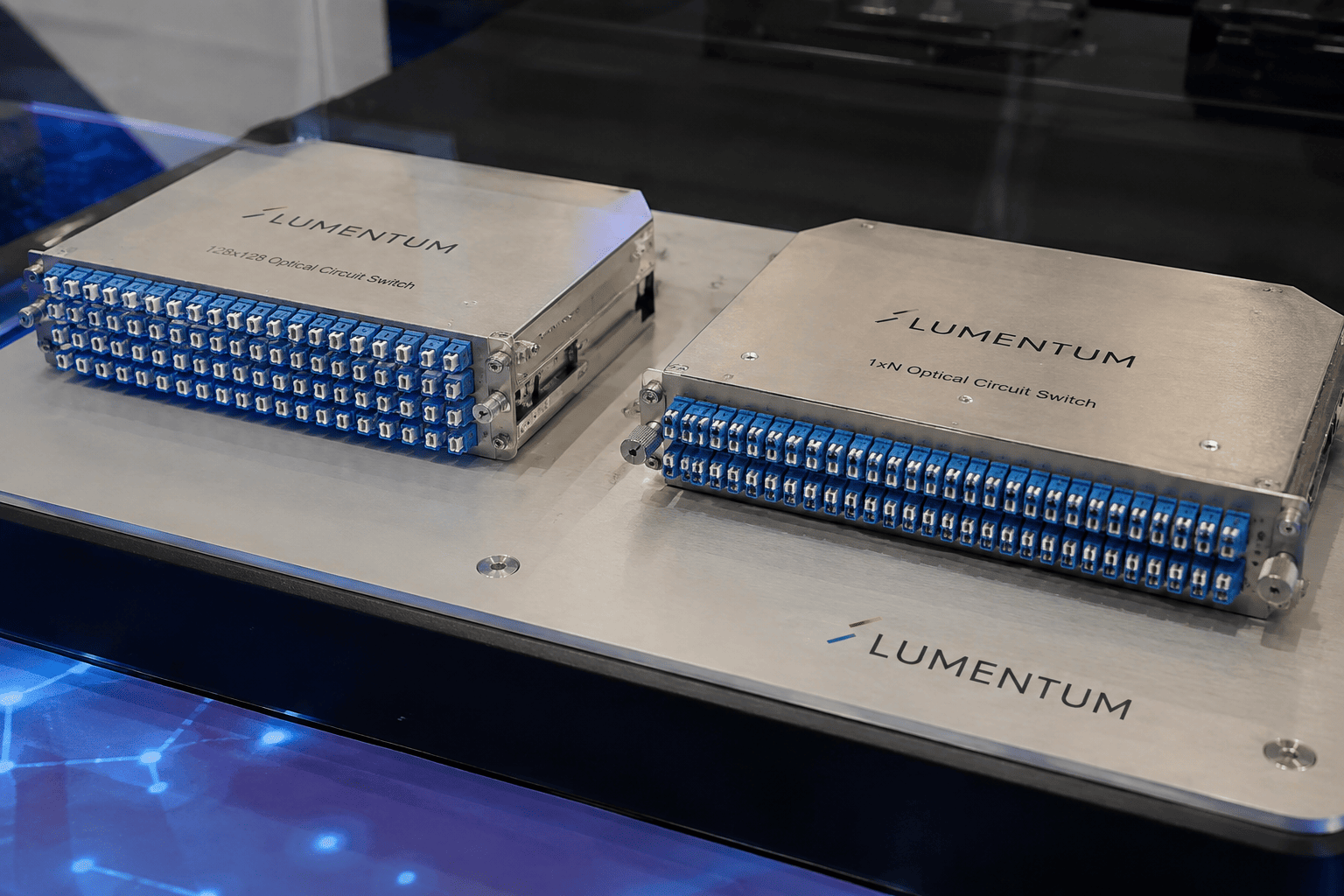
Lumentum Holdings shares climbed roughly 8% in premarket trading Wednesday after the company delivered fiscal fourth-quarter results that beat analyst expectations and issued a robust revenue forecast, underscoring the growing importance of optical networking in the artificial intelligence infrastructure buildout.
The photonics maker reported quarterly revenue of $1.01 billion, comfortably ahead of the $987.9 million consensus estimate, according to LSEG data. Revenue more than doubled from $480.7 million in the same period a year earlier. Adjusted earnings came in at $3.23 per share, topping the average analyst projection of $2.97.

For the current quarter, Lumentum guided revenue in the range of $1.23 billion to $1.28 billion, significantly above Wall Street's expectation of $1.16 billion. The company also projected adjusted earnings per share of $4.05 to $4.35, compared with the $3.61 analysts had modeled.
"As AI compute workloads increase in both speed and bandwidth, data center architects are turning to optical links as a primary means of connectivity," said President and Chief Executive Michael Hurlston. He added that AI demand is accelerating the company's growth trajectory, with the midpoint of first-quarter revenue guidance reaching $1.25 billion, allowing Lumentum to achieve its target operating model more than a quarter ahead of schedule.
The earnings report also lifted sentiment across the sector, with shares of peer Coherent rising more than 5% in premarket trading. Investors have been closely watching Coherent's own earnings test as optics plays gain traction.
Margins reach milestone ahead of plan
Beyond the earnings beat, investors were encouraged by a sharp improvement in profitability. Lumentum's non-GAAP gross margin crossed the 50% mark for the first time, reaching 50.4%. The milestone was achieved earlier than management had originally anticipated and at a lower revenue run rate than previously expected.
The company's components division, its largest business segment, generated revenue of $649.4 million during the quarter, more than double the level reported a year earlier. Lumentum manufactures photonic products, including high-performance lasers and optical components used in AI servers, cloud computing infrastructure, and telecommunications networks. Its recent growth has been supported by products such as 1.6-terabit cloud modules, optical circuit switches, and high-power lasers designed for emerging co-packaged optics systems.
Nvidia partnership strengthens AI position
Investor optimism has also been supported by Lumentum's expanding relationship with Nvidia. Earlier this year, the AI chipmaker invested $2 billion in Lumentum to support the development of advanced optics technology. The company also announced plans in March to build a manufacturing facility in Greensboro, North Carolina, where it will produce lasers for AI data centers, with Nvidia expected to be one of its customers. Production at the facility is scheduled to ramp up in mid-2028.
Hurlston said the company expects to provide additional updates on capacity expansion over the coming quarters as demand continues to increase. Mizuho analyst Vijay Rakesh has previously highlighted Lumentum's role as a key supplier of optical equipment to Nvidia as a major growth driver. The Nvidia AI financing plan has been a key topic for the sector.
Analysts see optics emerging as AI's next growth layer
Lumentum shares have gained more than 112% so far this year, outperforming Coherent, which has risen about 70%, as investors increasingly look beyond AI chips to the broader infrastructure powering next-generation computing. The rally, however, has made Lumentum a highly overvalued company. For example, data shows that the company's trailing price-to-earnings (PE) ratio rose to 147, higher than the technology sector median of 26.
Analysts said the latest results reinforce the growing importance of optical networking within the AI ecosystem. Raymond James reiterated its "Outperform" rating on Lumentum and raised its price target to $1,036 from $1,014 following the earnings report, saying management addressed investor concerns around co-packaged optics (CPO), near-packaged optics (NPO), competitive pressures, gross margin trends, and the outlook for optical circuit switches (OCS), though some uncertainty still remains. The stock closed at $820.59 on Tuesday.
"The key development is that the optics thesis is increasingly visible in reported revenue and operating margins rather than relying only on expectations around future AI demand," said Charu Chanana, chief investment strategist at Saxo. "Memory, power, cooling, and data-center infrastructure have already become important parts of the AI value chain. Optical networking is increasingly another layer worth watching as larger AI systems require greater volumes of data to move quickly and efficiently."
Chanana cautioned, however, that current growth rates may not continue indefinitely, pointing to risks including capacity expansion, rising competition, pricing pressure, slower spending by hyperscale cloud providers, evolving technology standards, and geopolitical restrictions affecting supply chains. "But for investors looking beyond GPUs while still participating in the AI infrastructure buildout, optics is becoming increasingly difficult to ignore," she said.
This article is for informational purposes only and does not constitute financial advice.