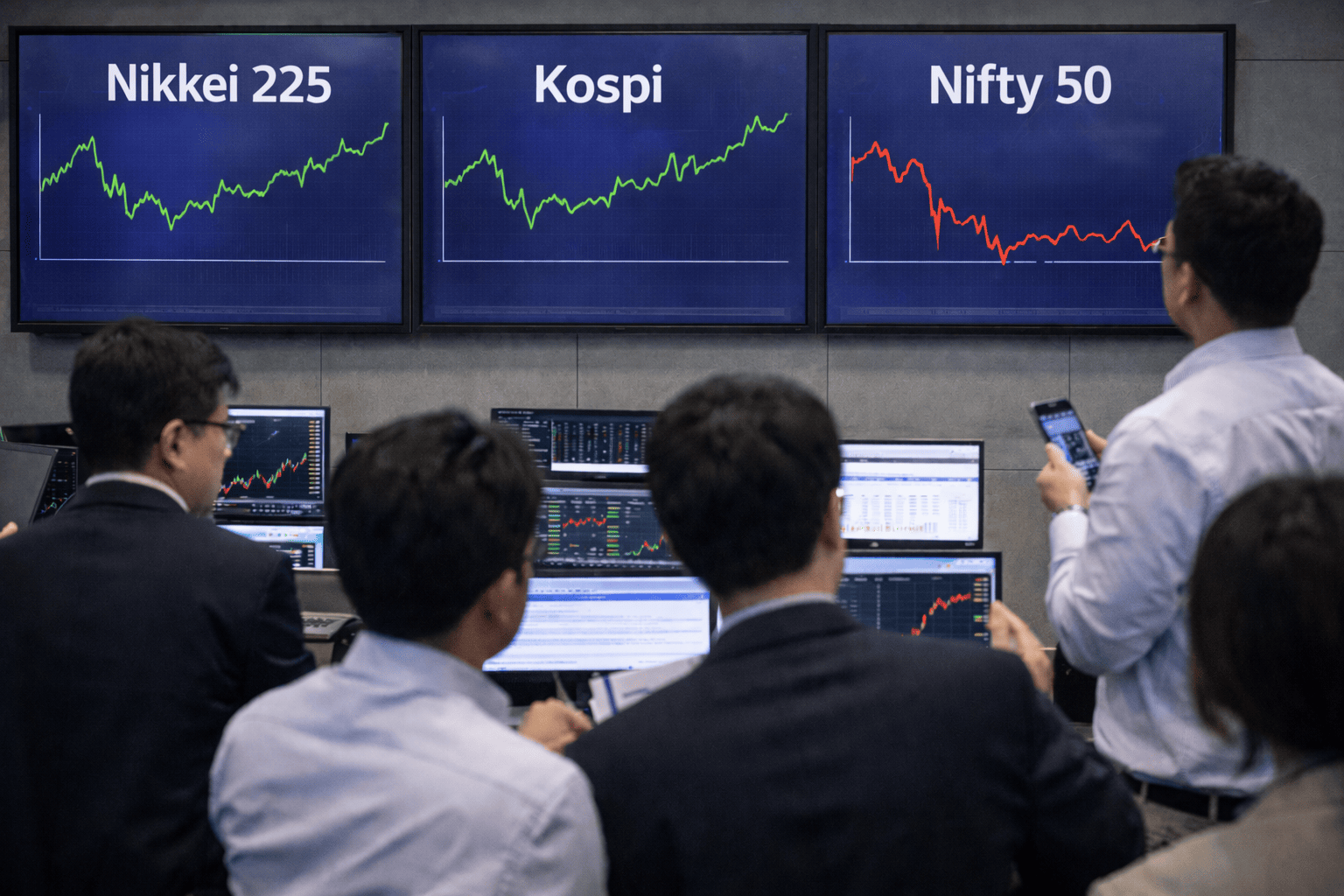
South Korea's benchmark KOSPI index opened sharply higher on Wednesday, buoyed by renewed enthusiasm for AI-related semiconductor stocks, but the gains evaporated within hours as investors sold into strength near the 7,000 level. The index surged 1.94% to 7,153.99 at the open, yet by 11:20 a.m. in Seoul it had trimmed the advance to just 0.08%, trading at 7,023.87.
The early jump followed another record close on the Nasdaq Composite, where consumer AI applications continued to lift chip and data-center stocks. Samsung Electronics, the heavyweight of the KOSPI, remained 1.9% higher, while SK Hynix, which briefly traded above 1.9 million won, was up only 0.1% after giving back most of its gains. The won strengthened to about 1,352.6 per dollar.

Chip rally hits a wall of profit-taking
This pattern of opening strong and fading quickly is becoming a recurring theme. On Tuesday, the KOSPI opened more than 2% higher but closed just 0.15% up at 7,017.91. Wednesday's session followed a similar trajectory, suggesting that investors remain eager to lock in profits even as the broader semiconductor outlook improves.
Foreign investors had bought approximately 140 billion won of KOSPI shares by mid-session, with institutions adding around 700 billion won, while retail investors sold roughly 1 trillion won. This flow reversal is notable because foreigners spent much of September reducing their exposure to Korean equities.
Daishin Securities analyst Lee Kyoung-min told Seoul Economic Daily that an extension of the US-China trade truce, combined with lower tariffs and unchanged semiconductor controls, could give the KOSPI enough support to challenge the upper end of its recent range around 7,200 after the holiday break.
Holding 7,000 is the key test
Kiwoom Securities analyst Han Ji-young noted that resistance around 7,000 remains significant, although the index's ability to hold that level suggests selling pressure at the top of the range is gradually weakening. The repeated pattern of fading rallies indicates that investors are still willing to sell into strength, even as chip stocks continue to benefit from AI-driven demand.
Lower oil prices are providing some support. Brent crude hovered around $99 a barrel as Saudi Arabia restored parts of its East-West pipeline and investors watched for progress in US-Iran diplomacy. Cheaper crude is particularly supportive for energy-importing South Korea because it eases inflation and currency pressure.
Regional markets mixed as Japan stays shut
Japan's cash market remained closed on Wednesday for the Autumnal Equinox holiday, with Tokyo set to reopen on Thursday. Osaka derivatives trading continued, and Nikkei futures slipped about 0.5% in the latest Asian session.
Elsewhere, Taiwan remained supported by semiconductor demand, with a major blue-chip gauge up about 0.8%. In contrast, mainland China and Hong Kong moved lower as investors turned cautious ahead of Thursday's meeting between Donald Trump and Xi Jinping. The Shanghai Composite fell roughly 0.4%, the CSI 300 lost 0.5%, and the Hang Seng dropped about 0.9%.
The KOSPI's struggle to sustain gains above 7,000 underscores the delicate balance between improving chip fundamentals and persistent profit-taking. While foreign buying has returned, the market's inability to hold early advances suggests that the 7,000 level remains a battleground for now.
This article is for informational purposes only and does not constitute financial advice.

