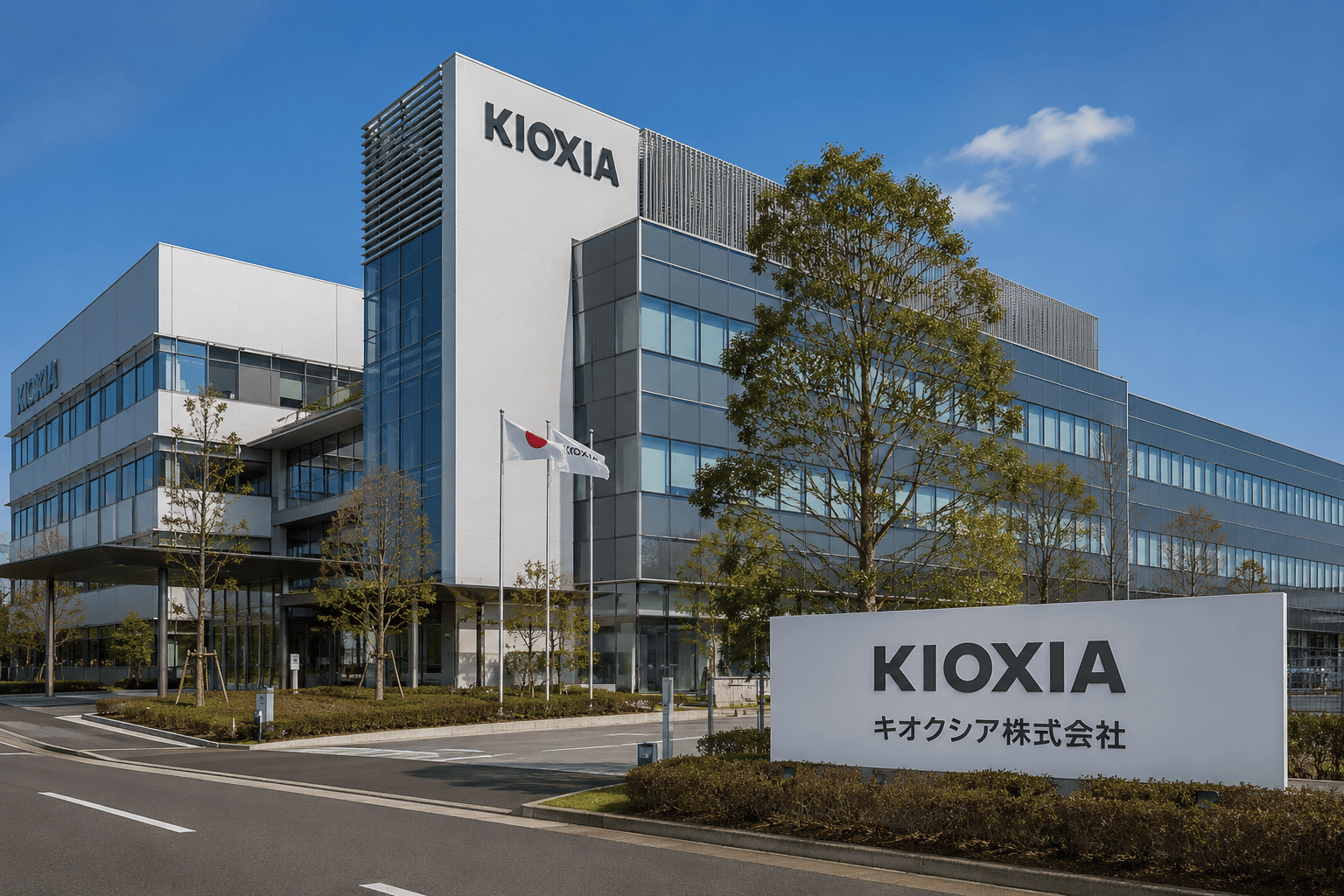
Kioxia Holdings shares have tumbled into bear market territory, losing more than half their value from the 2025 peak. The stock now trades around ¥50,780, down roughly 54% from its high, as the broader memory chip sector faces renewed selling pressure.
Memory sector sell-off drags Kioxia
The decline mirrors weakness across the memory industry, with peers like Micron, SanDisk, Samsung Electronics, and SK Hynix all retreating. The DRAM ETF, which tracks major memory makers, has fallen over 27% from its yearly high. Investors are wary of the industry's historical boom-and-bust cycles, where surging demand and pricing eventually reverse, hitting revenues hard.

Kioxia experienced this firsthand in 2023, when revenue dropped to $9 billion from $11.7 billion the prior year. Similar downturns affected Micron and SK Hynix. The current pullback suggests the market is pricing in another cyclical downturn, even as AI-driven demand remains robust.
Long-term deals provide some support
Bulls point to recent long-term supply agreements that could cushion the downside. SanDisk, a key partner, has signed deals with eight major customers, potentially generating over $90 billion in revenue. Kioxia and SanDisk jointly develop NAND technology, with SanDisk's flash memory supply largely coming from their Japanese joint venture. The two companies have committed to investing $31 billion in Japan, underscoring their long-term commitment.
These agreements may help stabilize pricing and demand, but they have not been enough to halt the stock's slide. The market appears focused on near-term risks rather than multi-year visibility.
Strong recent results, but technicals weaken
Kioxia's latest quarterly results were impressive. Revenue surged 415% year-over-year to ¥1.78 trillion, with profit jumping over 400% to ¥842 billion. The growth was driven by higher memory volumes and prices, particularly from data center clients. The company has also strengthened its balance sheet, with current assets exceeding ¥2.4 trillion.
Despite these fundamentals, the technical picture has deteriorated. The stock has been trading in a narrow range below its 50-day and 100-day exponential moving averages, indicating bearish control. A bearish pennant pattern has formed, which often precedes a downside breakout. If the stock breaks below the lower trendline, the next support level is seen at ¥35,970, its July low.
Related coverage: YMTC's NAND shipment gains highlight competitive pressures, while Nikkei's bullish flag suggests some tech resilience.
Investors will watch whether Kioxia can hold above the pennant support. A break below could trigger further selling, while a move above the 50-day EMA might signal a reversal. The memory sector's cyclicality remains a key risk, but long-term AI demand could eventually provide a floor.
This article is for informational purposes only and does not constitute financial advice.

