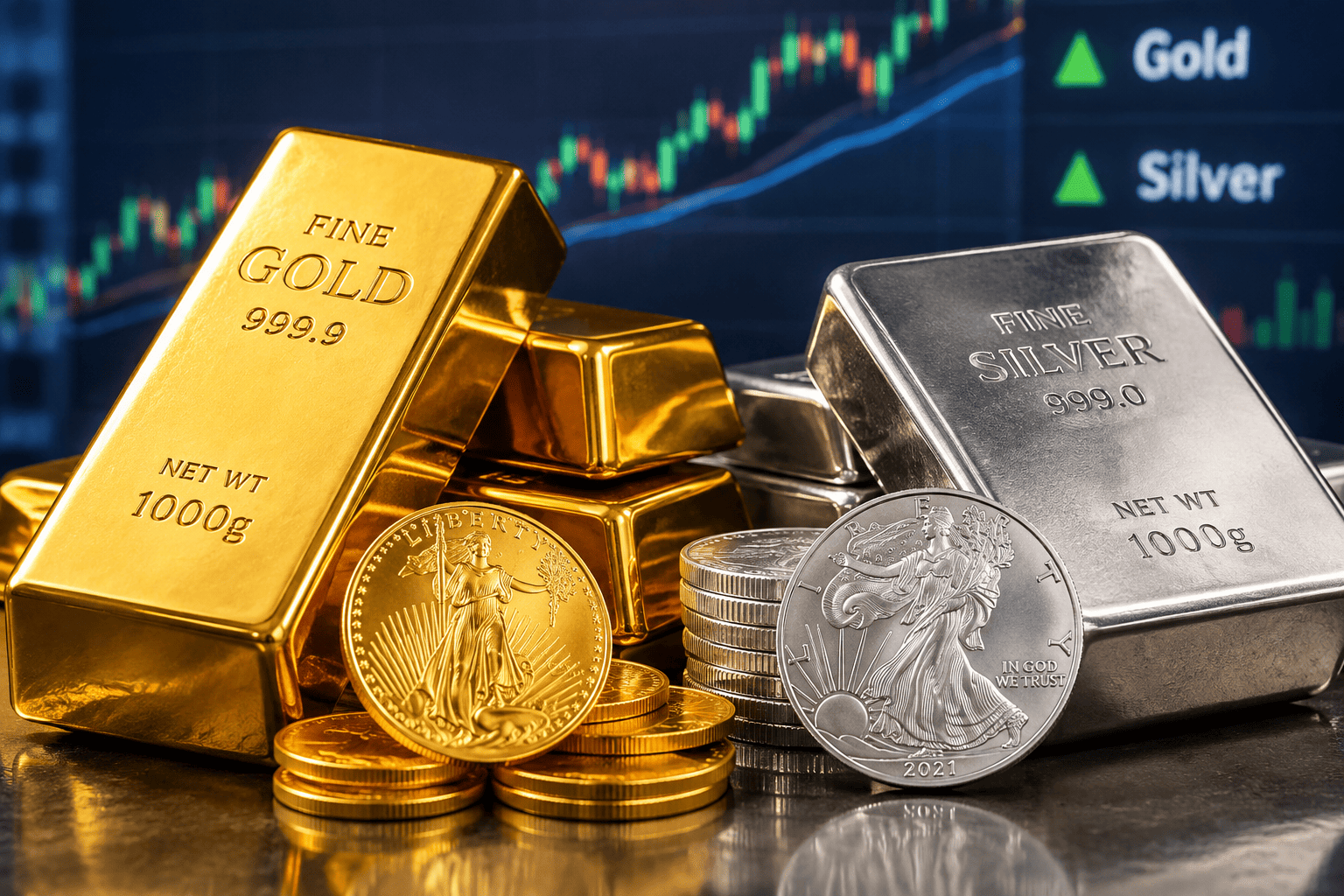
Gold prices edged higher on Wednesday, recovering some ground after a sharp decline, as U.S. Treasury yields retreated and investors positioned ahead of the Federal Reserve's July meeting minutes. Spot gold traded near $4,350 an ounce during Asian hours, following a nearly 2% drop on Tuesday.
The rebound was supported by a pullback in the benchmark 10-year Treasury yield toward 4.70%, while the 30-year yield slipped from levels near a 19-year high. Lower yields reduce the opportunity cost of holding non-yielding bullion, providing a tailwind for the metal.

However, gold remains caught between opposing forces. Softer U.S. economic data has tempered expectations for another rate hike, but elevated oil prices and persistent fiscal concerns continue to keep inflation and long-term borrowing costs elevated. This dynamic leaves the market sensitive to any signals from the Fed.
Fed minutes could reshape rate expectations
The Federal Reserve kept its benchmark rate at 3.5% to 3.75% at its July 28-29 meeting, though three policymakers dissented in favor of an increase. That split makes Wednesday's minutes particularly significant, as investors look for clues on the breadth of support for tighter policy.
According to CME FedWatch, futures pricing still points to a September hold as the most likely outcome, with roughly a two-thirds probability of rates remaining unchanged. Expectations for a hike have eased following softer economic readings.
Kelvin Wong, senior market analyst at OANDA, sees the retreat in rate-hike expectations, combined with concerns over government finances, as supportive for gold. Lower yields generally enhance the appeal of bullion, which pays no interest.
Yet the recent jump in long-dated sovereign yields suggests the relationship is becoming less straightforward. Investors are demanding greater compensation for inflation and fiscal risk, factors that can strengthen demand for gold as a defensive asset.
Technical levels to watch
After Tuesday's selloff, attention is turning to whether gold can rebuild momentum above the $4,390 area. Lukman Otunuga, head of market research at FXTM, notes that a sustained move through that level could open the door toward roughly $4,505.
On the downside, a break below $4,300 could bring support around $4,200 and $4,150 back into focus. Gold remains well below its January record but has recovered strongly during August as weaker U.S. data and softer rate expectations encouraged investors to return to the metal.
The Fed minutes could act as a catalyst in either direction. A more hawkish account could drive yields higher and put bullion under renewed pressure, while evidence that policymakers are becoming less inclined to tighten could reinforce the rebound. For context, see our recent analysis on gold's positioning ahead of the Fed minutes.
Geopolitical risks and inflation
Geopolitics remains another complication for the rate outlook. President Donald Trump said on Tuesday that the U.S. was not holding talks with Iran and maintained that the Strait of Hormuz was open, while Tehran continued to dispute that account.
Oil prices rose again on Wednesday, with Brent trading above $90 a barrel. Persistently expensive energy could keep inflation concerns alive even as other parts of the U.S. economy soften. This dynamic is also reflected in oil price forecasts from major agencies.
Elsewhere, silver traded near $63 an ounce, while platinum gained and palladium was little changed. The divergence leaves traders balancing gold's sensitivity to monetary policy against the stronger industrial-demand component in other precious metals.
This article is for informational purposes only and does not constitute financial advice.