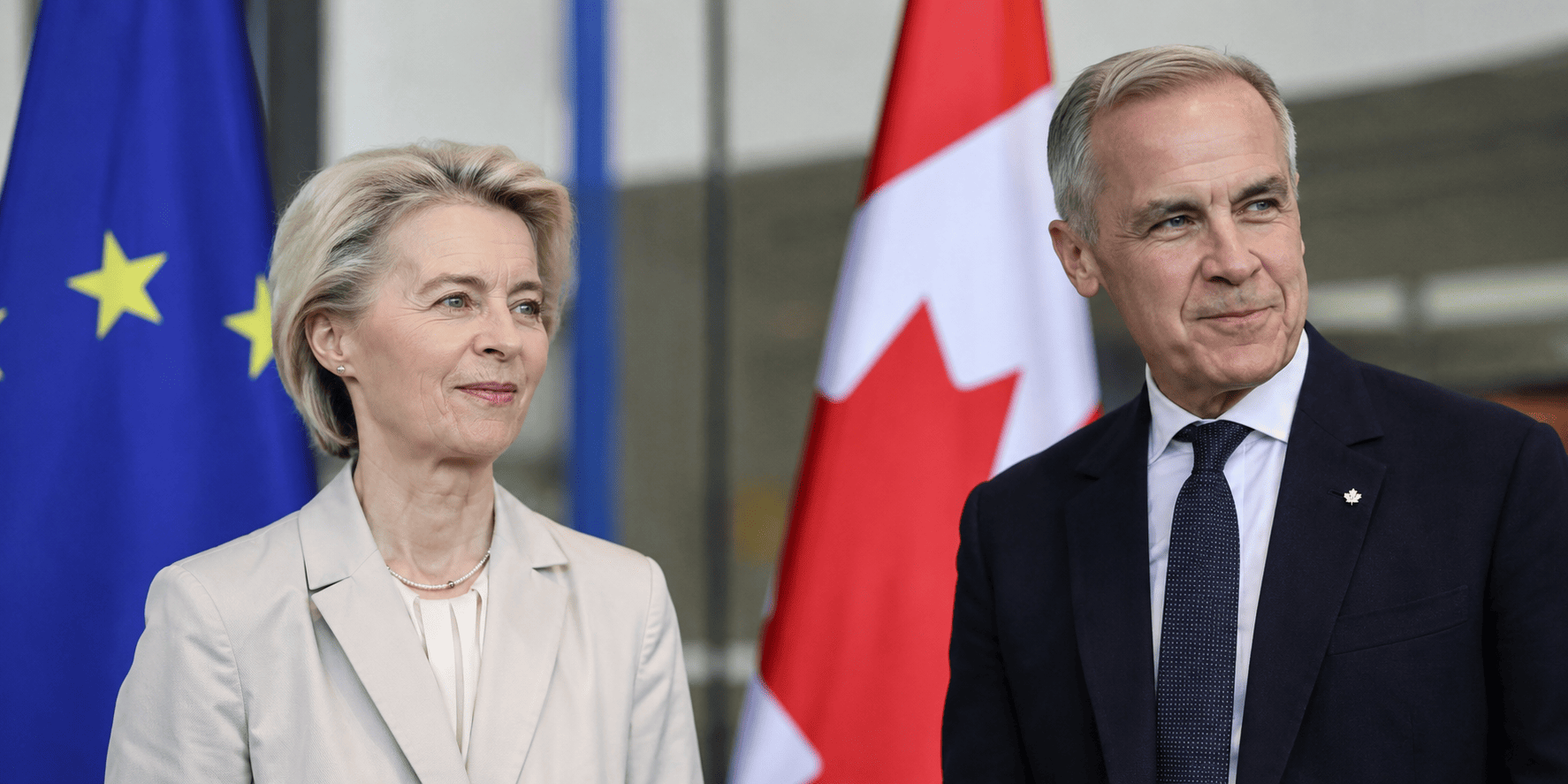
The European Union has floated a groundbreaking proposal to bring Canada into a closer formal relationship, with European Commission President Ursula von der Leyen suggesting Ottawa become the bloc's first associate member. The offer, made directly to Canadian Prime Minister Mark Carney on Wednesday, signals a potential shift in how Brussels engages with non-EU partners and comes as both sides reassess their reliance on the United States.
"I would like to work with you on opening the door for Canada being the first associate member of the EU," von der Leyen said during her annual State of the European Union address. Carney, who was present, received a standing ovation from European lawmakers and is scheduled to address the European Parliament on Thursday.

The proposal stops short of a full EU membership application, and the precise contours of associate membership remain undefined. However, it represents a significant deepening of the existing relationship, which already includes the Comprehensive Economic and Trade Agreement (CETA). Von der Leyen described the goal as creating an "alliance for the future" and establishing "a common prosperity and economic security space."
Beyond trade: defense, tech, and critical minerals
The envisioned partnership would extend well beyond tariff reduction. Von der Leyen highlighted potential cooperation in advanced manufacturing, technology, defense production, the Arctic, energy, critical minerals, batteries, artificial intelligence, quantum computing, cybersecurity, and economic security. "This is a partnership not against anyone else, but for our common strength," she said, emphasizing shared democratic values.
For Canada, the timing is strategic. The US accounts for over 70% of Canadian goods exports, with annual bilateral trade exceeding $300 billion. Recent tariff disputes under President Donald Trump, including collapsed talks and 50% tariffs on $20 billion in goods, have accelerated Ottawa's push to diversify. Carney has previously described Canada's desired relationship with Europe as a "unique security and economic alliance," while ruling out full EU membership.
Existing ties provide a foundation
Canada and the EU already enjoy substantial trade through CETA, with about 90% of goods trading tariff-free, though the agreement awaits full ratification by 10 of the EU's 27 member states. In 2025, bilateral trade reached roughly €130 billion ($150 billion), making Europe Canada's second-largest trading partner by a wide margin. Carney has called Canada "the most European non-European country," reflecting deep cultural and political links.
Associate membership could build on these arrangements, offering a framework for cooperation without the extensive political and legal integration required for full EU membership. Europe has existing models of differentiated relationships, such as Switzerland's bilateral agreements, but Canada's geographic position and US ties would make any arrangement unique.
Europe's own diversification push
The proposal also reflects European interests. European governments are seeking to bolster their economic and defense capabilities amid uncertainty over Washington's approach to NATO and Ukraine. Holger Schmieding, chief economist at Berenberg, called the proposal "a big step," noting Europe is "trying to openly form new partnerships or deepen partnerships with all countries in the world that are sort of like-minded."
The move comes as the US dollar weakens and markets watch for further trade policy shifts. For investors, the potential for deeper Canada-EU integration could have implications for sectors like defense, technology, and critical minerals, though details remain scarce. The proposal is still in its early stages, and any formal agreement would likely take years to negotiate.
Observers note that associate membership could offer Canada a way to hedge against US trade volatility while giving Europe a like-minded partner in North America. However, the practical impact will depend on the specific terms, which have yet to be defined. As Carney prepares to address the European Parliament, the financial community will be watching for signals on how this "alliance for the future" might take shape.
This article is for informational purposes only and does not constitute financial advice.

