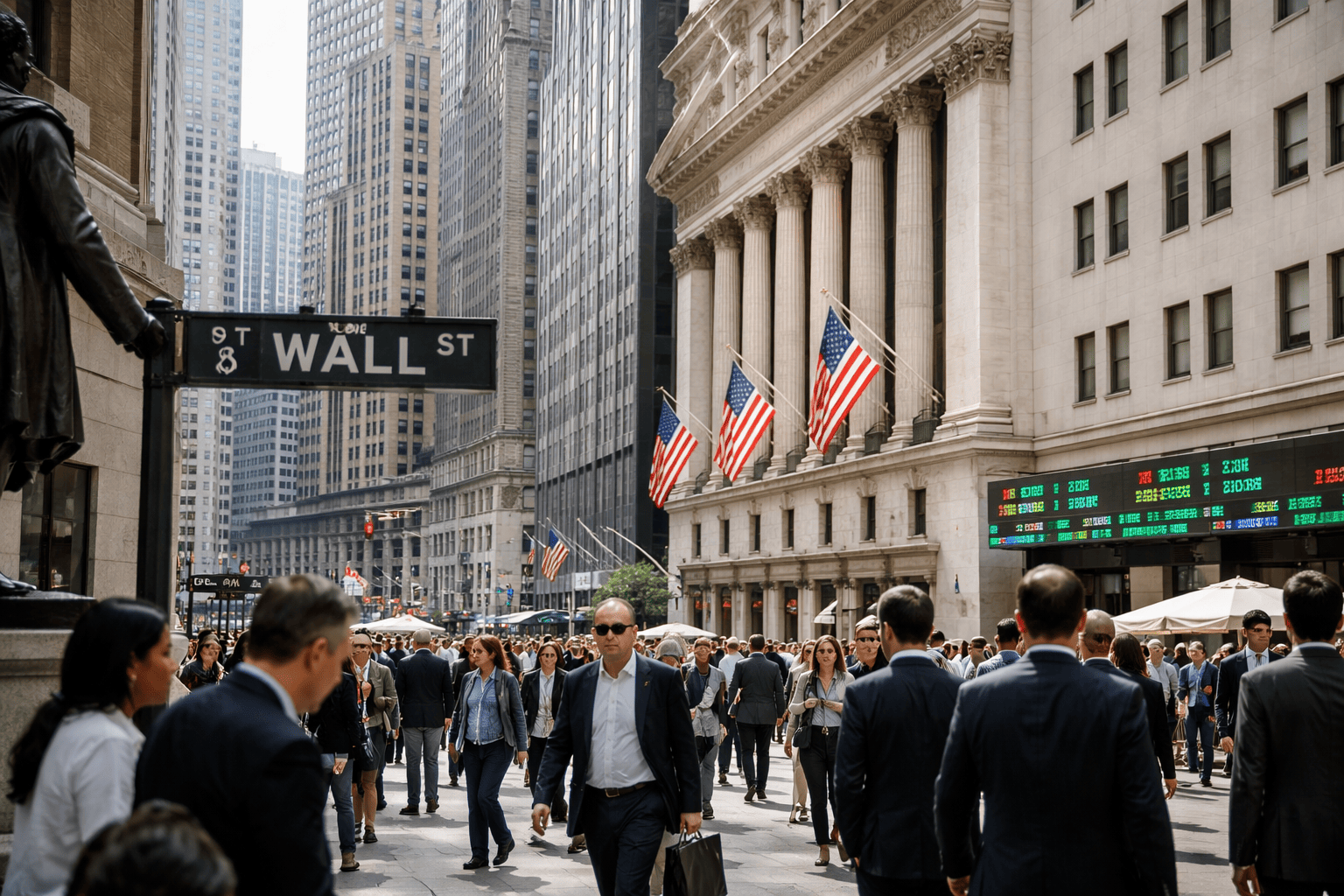
US stock futures turned lower on Wednesday, with the Dow Jones Industrial Average futures dropping 305 points (0.58%), while S&P 500 futures slipped 0.33% and Nasdaq 100 futures lost 0.70%. The decline came as Treasury yields climbed to multi-year highs and oil prices rebounded, challenging a market that had just pushed the S&P 500 and Nasdaq to record highs.
The 30-year Treasury yield briefly touched 5.70%, its highest level since 2002, while the 10-year yield hovered around 5.32%. This sharp rise in long-term borrowing costs has put pressure on equity valuations, particularly for growth stocks that are sensitive to higher discount rates.

Adding to the inflation narrative, Brent crude moved back above $101 a barrel, while West Texas Intermediate (WTI) climbed toward $90. A Gulf of Mexico storm and renewed Houthi attacks on Saudi Arabia have raised supply concerns, with operators already shutting about 9.2% of US Gulf offshore oil production as the storm approached.
Key Events on the Horizon
Investors are now awaiting two major catalysts later in the session. The Federal Reserve will release minutes from its September 15-16 meeting at 2 pm ET, which could reshape the debate over whether the central bank will hike rates again in October or December. Markets currently see about a 78% chance that rates stay unchanged in October, but another increase by December remains largely priced in.
Also on the calendar is a $39 billion 10-year note auction, which will test demand after one of the sharpest bond selloffs in years. A weak auction could push yields even higher, making record equity valuations harder to defend. ING FX strategist Francesco Pesole noted that investors are looking for clearer guidance on which inflation signals would be strong enough to trigger further Fed tightening.
Corporate Movers
In premarket trading, SpaceX slipped about 2% after the Financial Times reported it is seeking roughly $40 billion to fund Nvidia chip purchases. The proposed financing includes about $10 billion in bank loans and $30 billion in investment-grade debt, with Apollo expected to lead the package.
Intel moved in the opposite direction, gaining about 1.3% after CEO Lip-Bu Tan clarified that the chipmaker would remain involved in the Terafab project, easing fears that TSMC would displace it.
Constellation Brands fell about 4.5% despite beating quarterly earnings and sales expectations. Analysts highlighted a 0.6% decline in beer depletions, a cleaner measure of underlying demand, which overshadowed stronger shipment-driven sales.
After the close, Applied Digital and Levi Strauss are set to report earnings. UBS analyst Ryan Gravett told Kiplinger that Applied Digital has built a valuable AI-infrastructure footprint, making its results another test of whether investors are still willing to pay for aggressive data-centre expansion.
This article is for informational purposes only and does not constitute financial advice.

