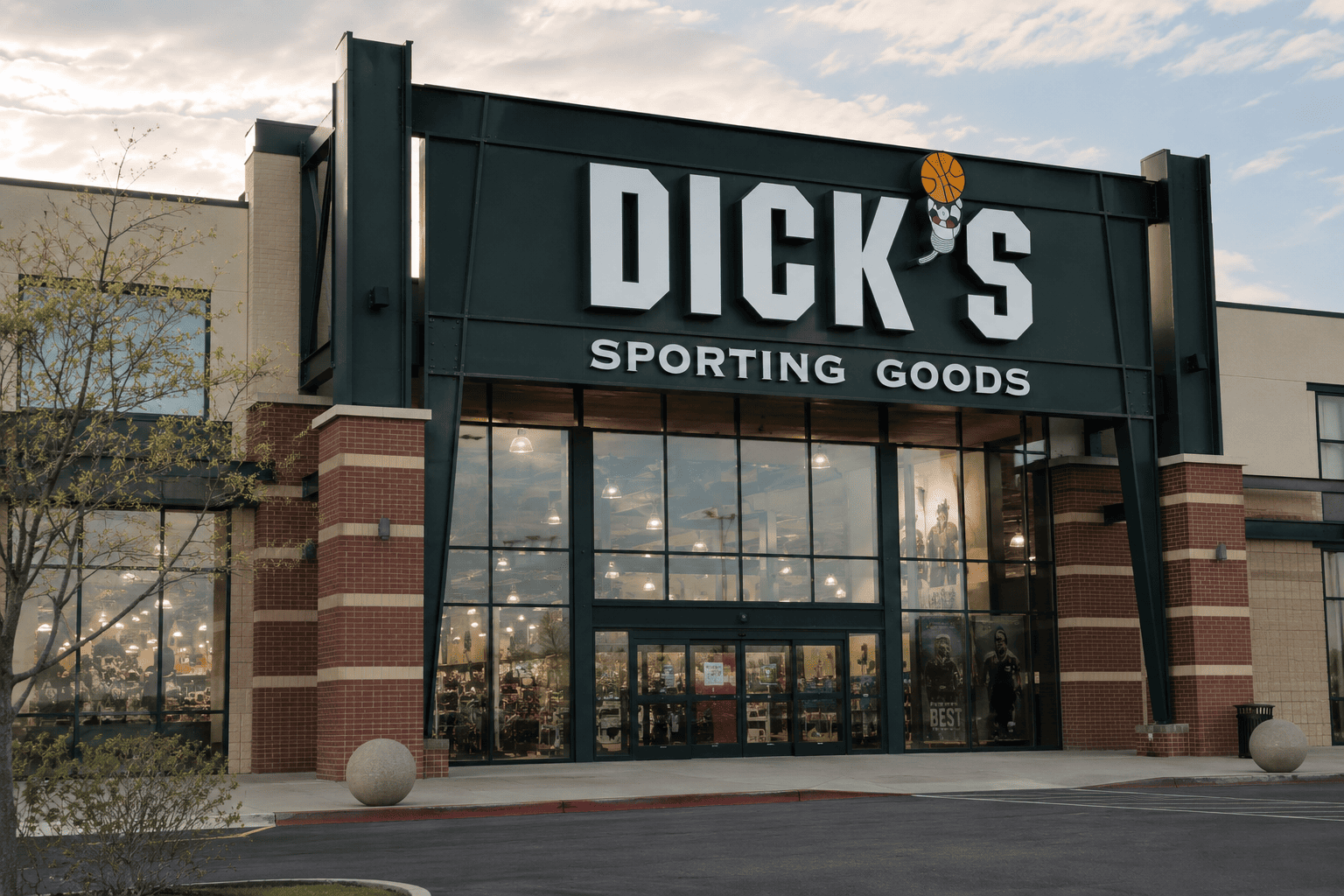
Dick's Sporting Goods (NYSE: DKS) saw its shares tumble approximately 19% in premarket trading Tuesday after the retailer lowered its full-year sales and profit forecasts, following second-quarter results that missed analyst expectations. The disappointing report also weighed on shares of Nike, Adidas, and Puma, suggesting investors viewed the results as a cautionary signal for the athletic apparel industry.
Quarterly results miss estimates
For the quarter ended August 1, Dick's reported adjusted earnings per share of $3.53, below the $3.76 that analysts had anticipated. Revenue climbed to $5.59 billion from $3.65 billion in the prior-year period, but still fell short of the $5.65 billion consensus estimate. Net income came in at $315 million, or $3.50 per share, compared with $381 million, or $4.71 per share, a year earlier. The adjusted figure excludes one-time items, including costs tied to the company's acquisition of Foot Locker.

Guidance cut on cautious outlook
The company now projects full-year net sales of $21.9 billion to $22.2 billion, down from its previous range of $22.1 billion to $22.4 billion. Adjusted earnings per share are expected to be $11 to $12, a significant reduction from the prior forecast of $13.50 to $14.50. Consolidated operating income guidance was also trimmed to $1.45 billion to $1.55 billion, from $1.69 billion to $1.81 billion.
Executive Chairman Ed Stack noted that the second quarter saw fewer product launches, and those that occurred performed below both industry and company expectations. He added that the company is adopting a more cautious stance for the remainder of the year.
Foot Locker integration challenges
The results underscore the difficulties Dick's faces in turning around Foot Locker, which it acquired in 2025 for $2.4 billion. While comparable sales at Dick's namesake stores rose 4.9% during the quarter, driven by broad-based growth and strong World Cup-related demand, Foot Locker experienced a 3.6% decline in comparable sales. Dick's now expects Foot Locker's comparable sales to range from flat to down 2% for the full year, a sharp reversal from its earlier forecast of growth between 1.5% and 3%. The company maintained its outlook for comparable sales growth of 2.5% to 4% at its own stores.
Stack attributed the weakness at Foot Locker to its greater exposure to legacy footwear silhouettes and its heavier reliance on launch and retro products, which have been particularly affected by the promotional environment.
Promotional pressure and consumer caution
The quarter was marked by heavy discounting across athletic footwear and apparel, forcing Dick's to increase promotions to stay competitive. This environment, combined with U.S. consumers deferring big-ticket purchases and prioritizing essentials amid higher food and gasoline costs, has pressured the entire sector. The company also received $59 million in tariff refunds and $2.1 million in related interest income during the quarter, providing some offset.
Dick's has been working to reposition Foot Locker and return it to growth, with the acquisition intended to strengthen its international presence and competitive position. However, the latest results suggest that the turnaround may take longer than initially anticipated.
The broader sportswear market has been grappling with shifting consumer preferences and inventory gluts, and Dick's cautious outlook adds to concerns about the sector's near-term prospects. Investors will be watching for signs of recovery in upcoming quarters, as well as any further updates on the Foot Locker integration.
This article is for informational purposes only and does not constitute financial advice.