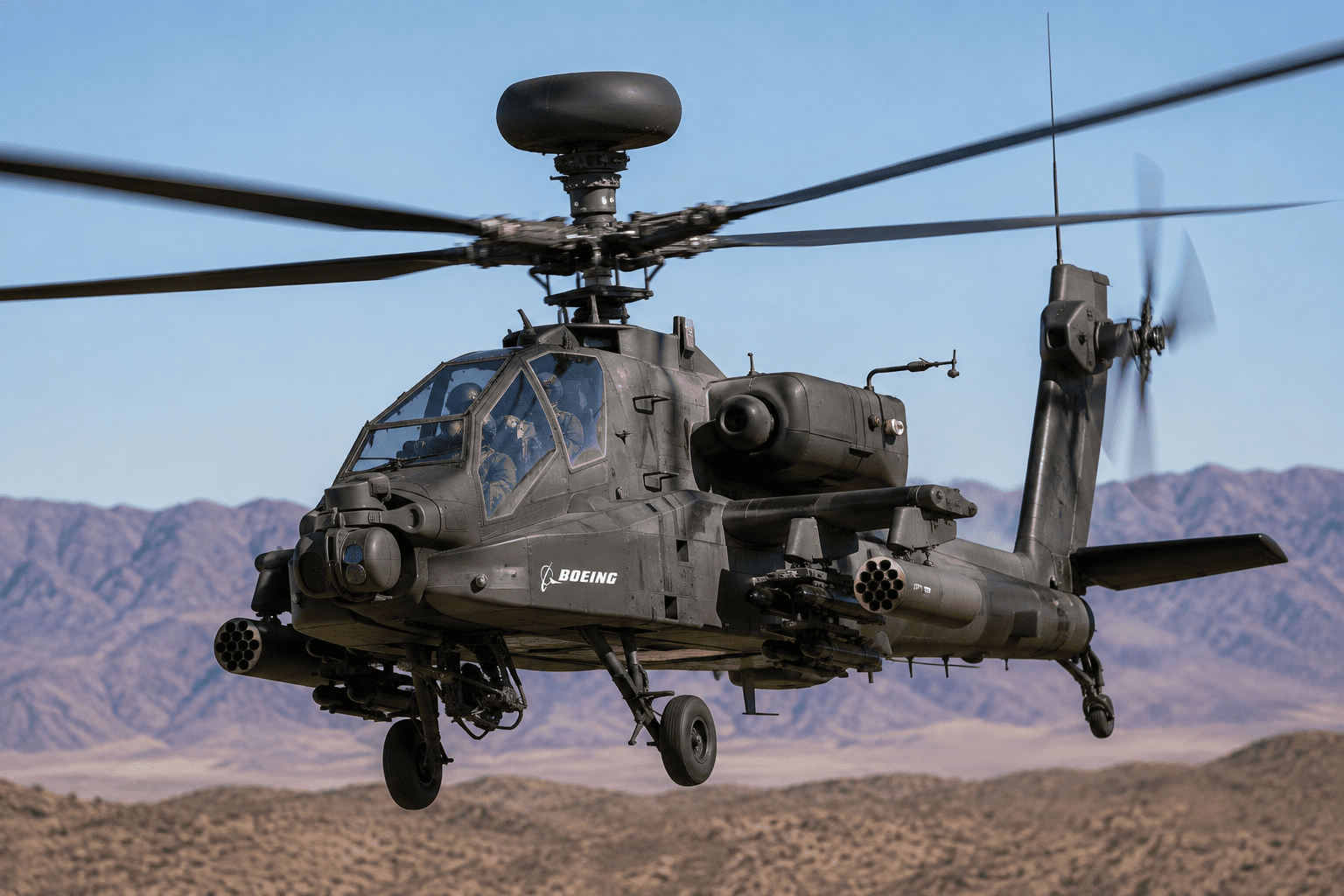
Boeing's stock (BA) declined 2% on Monday after the U.S. Army ordered a temporary grounding of its Apache attack helicopter fleet. The move follows a fatal crash near Fort Hood, Texas, that claimed the lives of two service members. The Army stated the stand-down will remain in effect until investigators determine the root cause of the accident.
Boeing manufactures the AH-64 Apache, a twin-engine attack helicopter that has been in service for over four decades. The company had not issued an immediate statement regarding the grounding. This incident adds another layer of complexity for Boeing's defense segment, which has been striving to stabilize its financial performance amid broader challenges in its commercial aircraft operations.
Army's response and Apache's role
The Army expressed condolences to the families and unit of the fallen aviators, emphasizing the difficulty of the situation. The Apache is a critical asset for the U.S. military and allied forces, with hundreds of units in operation globally. The helicopter is typically crewed by two and can be armed with guns, missiles, and rockets.
The grounding comes at a time when Boeing's defense business is showing signs of recovery. In the second quarter, the segment reported $7.5 billion in sales, a 13% year-over-year increase, though it still recorded a $15 million loss. The division has been grappling with inflation, fixed-price contract pressures, and delivery delays, but losses have narrowed significantly—from $5.4 billion in 2024 to $128 million in 2025.
Defense recovery and commercial reliance
Investors are closely watching Boeing's defense unit as part of the company's overall turnaround. However, the commercial aircraft business remains the primary driver. Boeing delivered 600 aircraft in 2025 and expects to deliver about 670 in 2026, with projections exceeding 800 by 2028. Analysts anticipate free cash flow to improve from roughly $2 billion in 2026 to about $10 billion by 2028, after using approximately $2 billion in cash during 2025.
The Apache grounding introduces near-term uncertainty to a division that has been making progress. While the financial impact may be limited, it underscores the operational risks inherent in defense programs.
Recent developments: 737 Max 7 and Archer deal
In other news, Boeing received FAA certification for the 737 Max 7, the smallest variant in its best-selling Max family. This milestone follows years of regulatory scrutiny and delays related to safety concerns. Southwest Airlines has already-built Max 7 aircraft in inventory, but these will require additional work before entering service, with the carrier not expecting to fly them until next year.
Boeing is also restructuring parts of its business through a deal with Archer Aviation, selling three subsidiaries in exchange for a stake in the electric vertical take-off and landing (eVTOL) aircraft maker. The transaction gives Boeing a 19.75% stake in Archer's Class A shares, along with options to acquire more shares over the next four years. This move aligns with Boeing's strategy to focus on core operations while exploring future mobility solutions.
For investors, the Apache grounding adds a fresh challenge to a defense segment that has been improving, while the commercial delivery outlook remains central to Boeing's broader recovery. The company's ability to navigate these issues will be key to its financial trajectory.
This article is for informational purposes only and does not constitute financial advice.