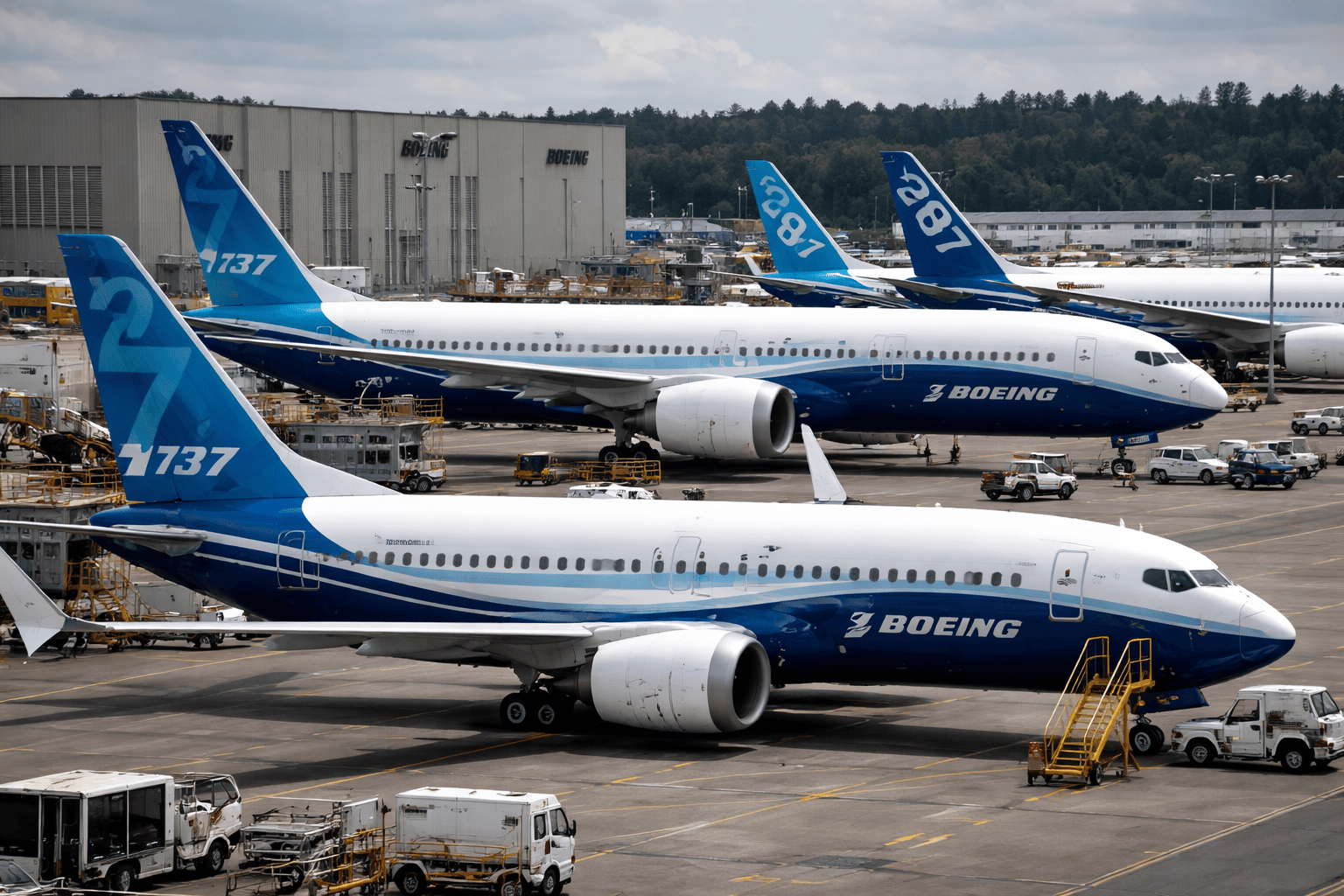
Boeing's stock is losing one of its most anticipated geopolitical catalysts just as investors turn their attention to a more pressing issue: the company's ability to ramp up production and generate cash. Expectations that the US-China summit would yield a fresh commitment for hundreds of jets have diminished, leaving the planemaker to focus on completing an existing order for 200 aircraft.
Despite the fading China catalyst, Boeing's order book remains robust, with a record backlog of $715 billion at the end of June. However, the key question for shareholders is whether Boeing can convert that backlog into deliveries quickly enough to meet Wall Street's cash flow expectations.

China's Role Diminishes
Reports indicate that hopes for a new aircraft purchase announcement during the Trump-Xi talks are fading, with negotiations centered on finalizing the May agreement. US Trade Representative Jamieson Greer noted that about 140 aircraft are in a "good state," with another 10 progressing through documentation. Boeing CEO Kelly Ortberg has also tempered expectations, stating that airlines will announce further orders on their own timelines.
China remains a significant market, and Boeing has largely missed out on major orders since 2017, allowing Airbus to strengthen its position. Another China order would add to an already massive backlog but would not address the production issues that are weighing on analyst estimates.
Production Challenges Persist
Boeing's immediate challenge is stabilizing production. Ortberg said on September 16 that the company was producing toward 47 737s per month but had not yet stabilized at that rate, with wing production being a constraint. The 787 program has stabilized at eight aircraft per month, but engine availability must improve before moving sustainably to ten.
These delays are impacting Wall Street models. Jefferies analyst Sheila Kahyaoglu cut her 2026 free-cash-flow forecast to $2.2 billion from $2.9 billion and reduced her 2027 estimate to $4.8 billion from $6.7 billion, noting that stabilizing 737 production at 47 per month "is taking a bit more time." Jefferies maintained a Buy rating but lowered its price target to $265 from $295.
Morningstar analyst Nicolas Owens framed the issue in a September 21 report, saying Boeing's operational and financial turnaround continues "with every jet it can deliver."
Labor Risk Looms
October brings another operational risk: the contract with the Society of Professional Engineering Employees in Aerospace (SPEEA) expires on October 6. Boeing says negotiations are ongoing and has presented revised offers covering engineers and technical workers. Bank of America analyst Ronald Epstein described the recent selloff as "a bit dramatic," maintaining a Buy rating and $270 target, but identified a potential SPEEA strike as the key near-term risk.
Wall Street has not abandoned the turnaround thesis, but analysts are becoming more cautious about how quickly production improvements translate into cash generation. Boeing shares closed at $199.93 on September 23, up 1.12% from the previous close.
This article is for informational purposes only and does not constitute financial advice.

