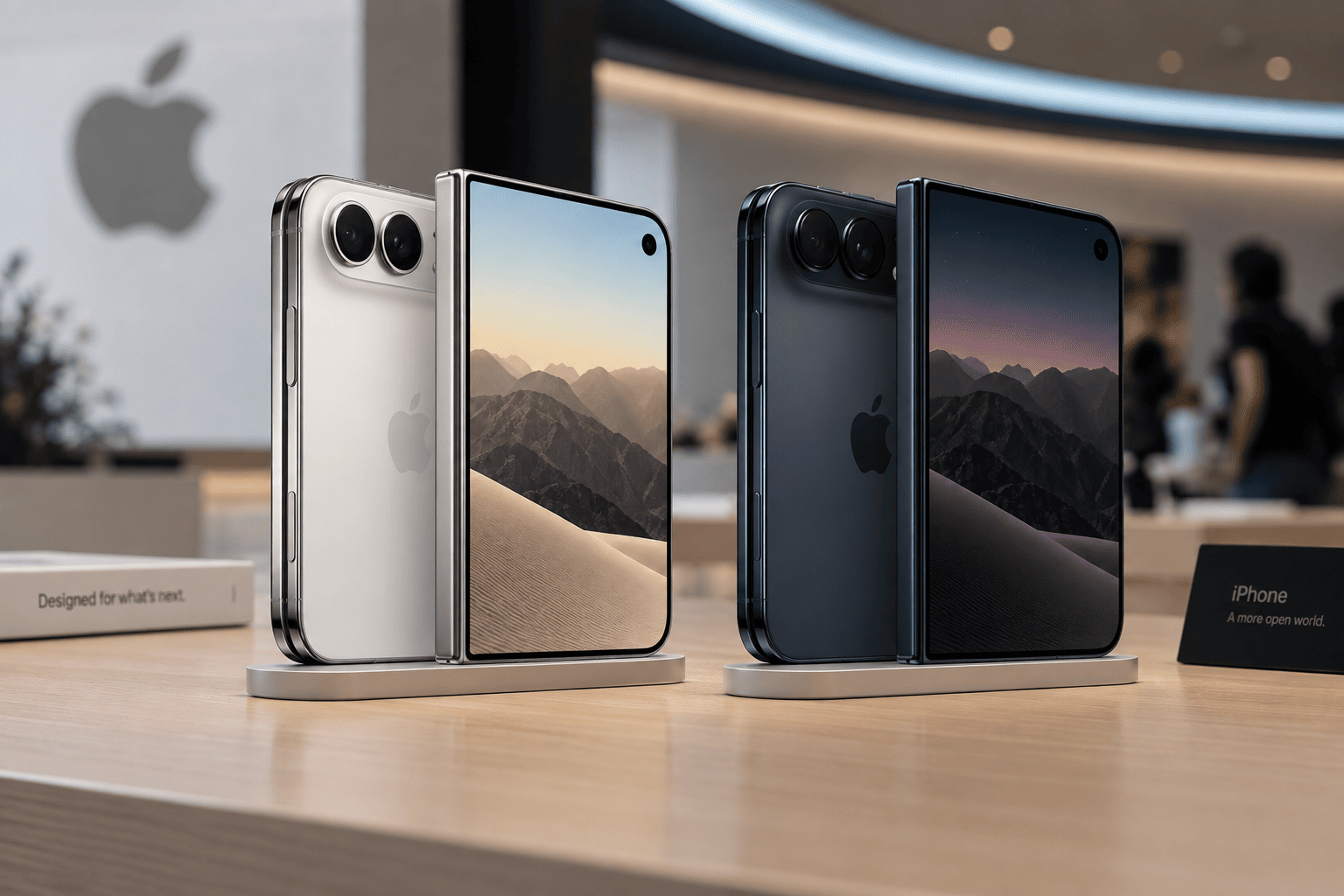
Apple Inc. (NASDAQ: AAPL) officially entered the foldable smartphone arena on Tuesday, unveiling its much-anticipated device, the iPhone Duo. Priced at $1,999, the new handset marks a significant strategic move for the tech giant, but the initial market reaction was muted, with shares trading lower following the announcement.
At the company's Cupertino launch event, CEO John Ternus positioned the Duo as a response to the growing demand for larger displays in modern smartphones. "For a device that plays such a central role in your life, a larger display would open up entirely new possibilities," Ternus said. "We think the best way to achieve that is with a foldable design."

Ternus was quick to address the criticisms that have plagued existing foldable devices, noting that many current models feel like "two phones awkwardly stuck together." Apple's approach, he argued, re-engineers the form factor entirely.
Reimagining the Foldable Form Factor
The iPhone Duo features a proprietary dynamic hinge mechanism and custom flexible glass, which Apple claims eliminates the visible panel gaps and creases that have been a common complaint in rival foldables. When closed, the device is roughly the size of a standard passport, expanding into an "ultra-thin," continuous workspace when opened.
During the keynote, Ternus highlighted how Apple's custom display architecture avoids the thick, disjointed feel of competing dual-screen handsets. Powered by Apple's next-generation silicon, the Duo delivers seamless transitions between the external cover display and the inner tablet-like screen.
Technical Innovation Meets Software Synergy
Rather than relying on brute force or raw mechanical joints, Apple focused on seamless integration between hardware engineering and custom iOS multitasking paradigms. The external display offers quick "single-handed access for daily tasks," while the expansive inner panel supports split-screen workflows, drag-and-drop workspace gestures, and professional application suites.
By engineering the battery cells, frame chassis, and display layers to distribute mass uniformly across the entire body, Apple has eliminated the top-heavy imbalance typical of rival foldable designs. This structural alignment ensures the device feels unified and ergonomic, whether closed in a pocket or fully open in hands.
Pre-orders for the iPhone Duo open on October 16, with sales beginning on October 23. The $1,999 price point places it in the premium tier of the smartphone market, a segment Apple has long dominated.
Market Reaction and Analyst Outlook
Despite the technical fanfare, institutional investors appeared unimpressed in the near term. Michael Khouw of Tidal Financial and Wamsi Mohan of Bank of America Securities had predicted the launch would be a "sell-the-news" event, and that prediction seemed to hold as shares slipped. The stock's dip mirrors the mixed reaction to the iPhone 18 Pro's price hike earlier this year.
However, Wall Street's long-term outlook on Apple remains bullish. Price targets for the stock go as high as $400, reflecting confidence in the company's ability to drive growth through new product categories. Some analysts see the foldable iPhone as a potential $14 billion revenue opportunity, though the high price tag could be a hurdle for mass adoption.
The launch also comes amid broader market dynamics, including a cooling labor market and ongoing supply chain considerations. Apple's entry into the foldable category is expected to set a new benchmark for premium mobility, but whether it will translate into immediate shareholder value remains to be seen.
This article is for informational purposes only and does not constitute financial advice.

