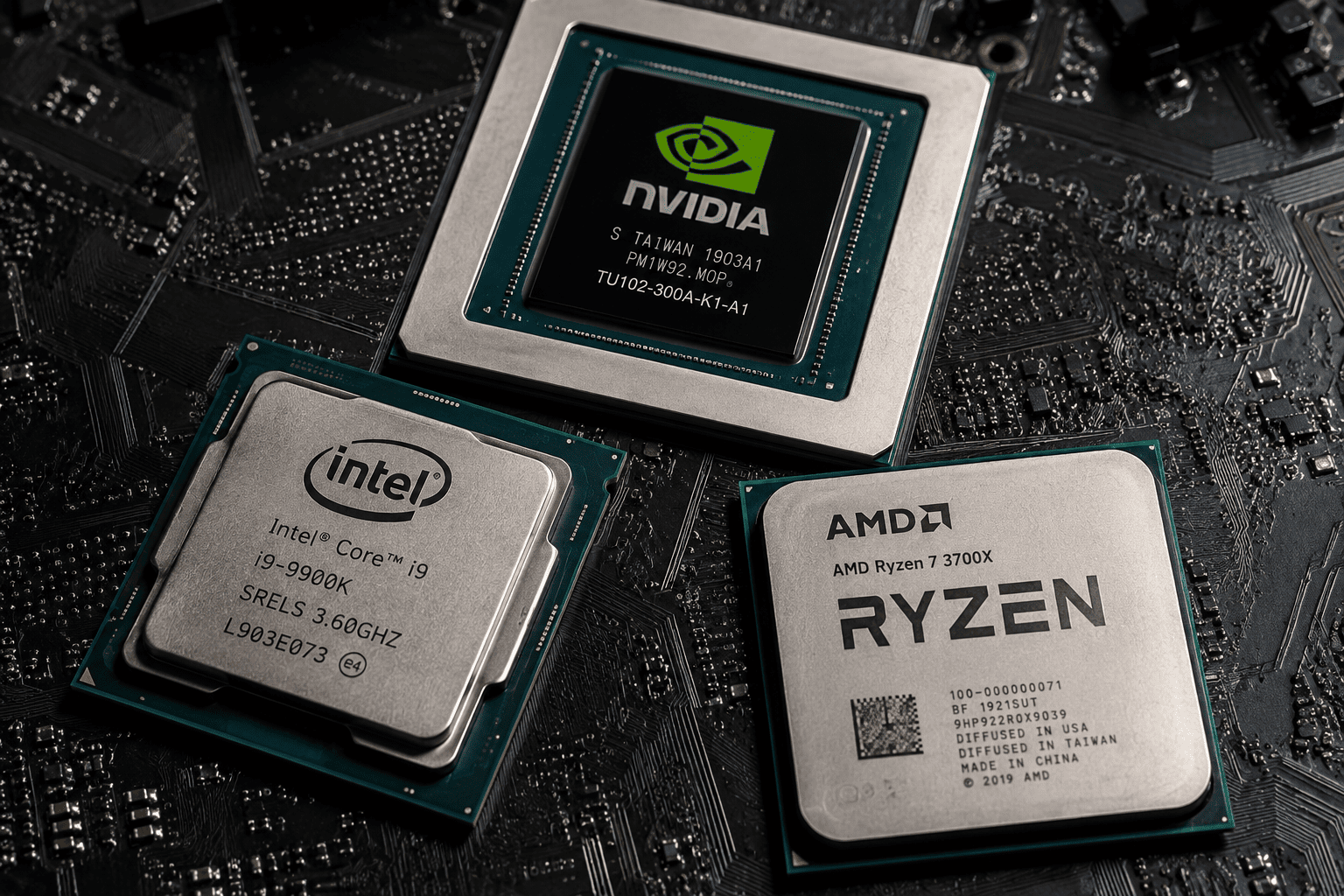
Nvidia's blockbuster earnings on Wednesday sent most semiconductor stocks higher on Thursday, but the rally masked a notable divergence between two of its biggest rivals. While Intel shares climbed more than 3%, AMD slipped about 1%, even as the broader Philadelphia Semiconductor Index advanced roughly 1.7%.
Nvidia projected 70% revenue growth for fiscal 2028 and said demand for AI infrastructure still outpaces supply, reigniting optimism that the AI investment cycle has room to run. That helped lift Marvell Technology, Arm Holdings, SK Hynix, and Broadcom, among others.

Yet the contrasting moves in Intel and AMD highlight how Nvidia's expanding footprint in CPUs is reshaping competitive dynamics across the data-center chip market.
Intel's Nvidia partnership flips the script
Intel's gains were tied to its deepening collaboration with Nvidia. Nvidia has invested $5 billion in Intel for roughly a 4% stake, and the two companies are developing multiple generations of joint products that link Intel's central processors with Nvidia's AI and graphics chips via Nvidia's proprietary NVLink interconnect technology.
That arrangement gives Intel a way to benefit from Nvidia's AI system growth by supplying the CPUs that sit alongside Nvidia GPUs, rather than trying to displace Nvidia in AI accelerators outright. As a result, Nvidia's upbeat outlook translated directly into Intel's share price rise.
Nvidia's AWS deal pressures AMD
Alongside its earnings, Nvidia announced an expanded partnership with Amazon Web Services. Amazon plans to deploy 2 million additional Nvidia GPUs across its global infrastructure, and the companies will broaden collaboration across AI factories, CPUs, networking, open models, data processing, and robotics. Nvidia CEO Jensen Huang told CNBC that Amazon could also purchase “millions of CPUs” in addition to the GPUs.
That news likely reinforced competitive pressures on AMD. Nvidia is ramping up its own CPU business with the Vera processor, putting it in direct competition with Intel and AMD in server CPUs. Gartner analyst Kevin Knox has previously said AMD is currently the company to beat in enterprise AI server CPUs, but AMD's stock remains sensitive to hyperscaler spending decisions.
Earlier this month, AMD shares fell after Elon Musk said SpaceX had selected Nvidia as its exclusive AI infrastructure partner. AMD had also benefited from Amazon's decision to raise its planned 2026 capital expenditure to about $220 billion from roughly $200 billion. The latest AWS announcement may have stoked concerns that Nvidia is capturing a growing share of hyperscaler AI budgets.
AMD's Helios platform and customer momentum
Despite the near-term pressure, AMD continues to expand its AI ambitions. Its Helios platform combines Instinct accelerators, EPYC processors, Pensando networking, and ROCm software in a rack-scale system, allowing customers to deploy complete AI infrastructure without assembling components themselves.
AMD's customer list is growing. Anthropic has committed to deploy up to 2 gigawatts of MI450-series GPUs in Helios systems. OpenAI and Meta each have agreements covering up to 6 gigawatts of AMD GPUs, while Microsoft plans large-scale Helios deployments on Azure. Oracle is also listed as a customer.
Benchmark responded by raising its AMD price target to $685 from $485, saying “the customer map is getting harder to dismiss.” Roth MKM analyst Suji Desilva was similarly “encouraged by the technical advantages” of Helios, raising the firm's target to $650 from $500.
The contrasting stock moves underscore how Nvidia's dominance in AI accelerators is now spilling into CPUs, creating new winners and losers among its rivals. While Intel's partnership with Nvidia offers a direct revenue channel, AMD's standalone AI infrastructure push may face a tougher road as hyperscalers increasingly look to Nvidia for end-to-end solutions.
This article is for informational purposes only and does not constitute financial advice.