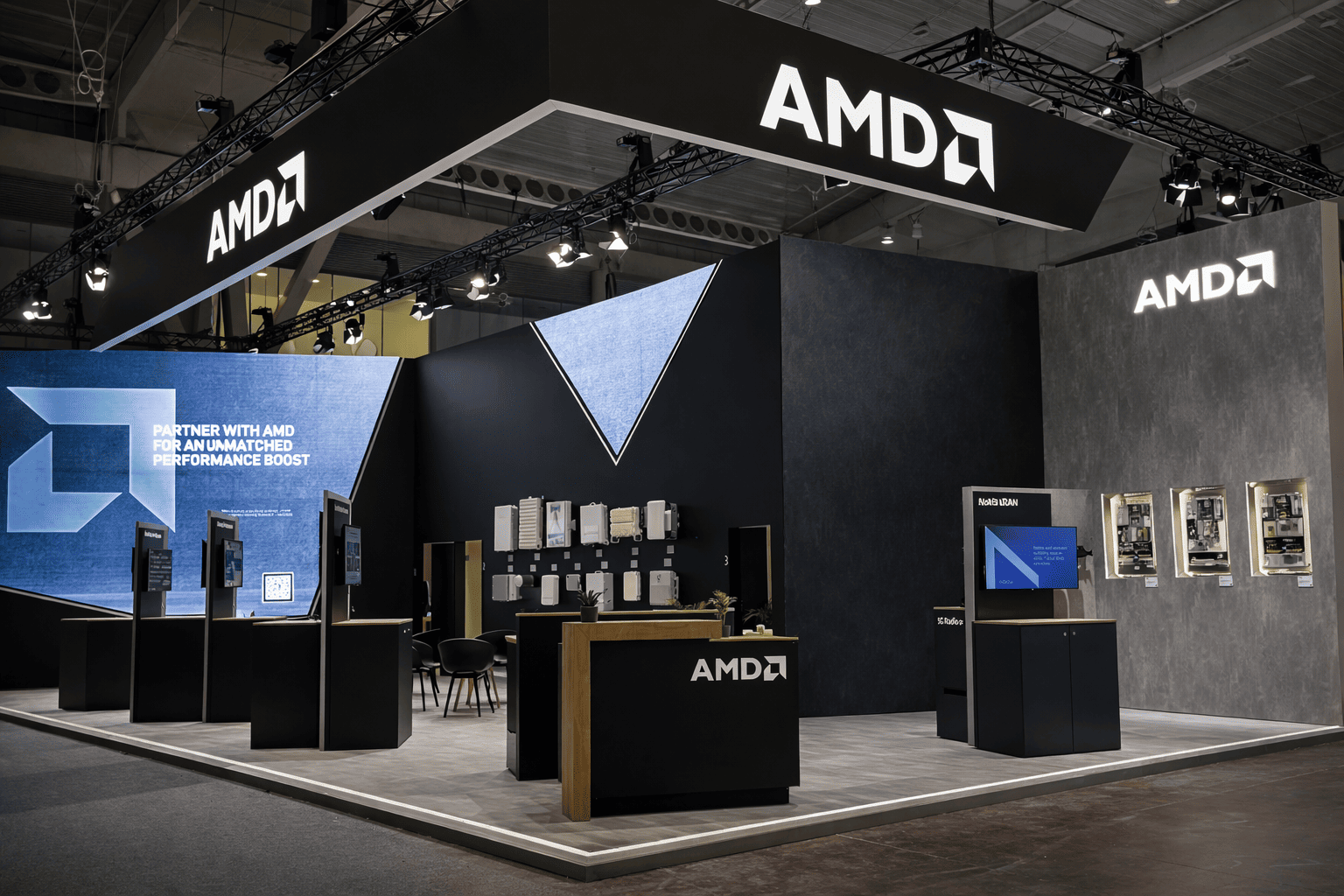
Advanced Micro Devices (AMD) shares advanced 2.7% in Thursday trading after Bank of America revised its long-term outlook for the server CPU market, pointing to the expanding role of central processing units in data centers driven by the rise of AI agents.
The brokerage lifted its 2030 server CPU total addressable market (TAM) estimate to more than $210 billion, up from roughly $170 billion. The revision reflects stronger AI compute demand and memory trends observed after second-quarter earnings across the semiconductor sector. BofA now projects the market will grow at a 36% compound annual growth rate through 2030, up from its previous 30% estimate, implying nearly fivefold growth from the expected $35 billion level in 2025.

AI agents reshape CPU demand
Analyst Vivek Arya highlighted that agentic AI is fundamentally changing the relationship between CPUs and GPUs inside data centers. The CPU-to-GPU ratio is shifting from about 1:4 during the AI training phase toward roughly 1:1 for agentic AI, as CPUs become the orchestration control plane. Consequently, BofA expects CPUs to account for about 10% of the overall $2.2 trillion data center systems market by 2030, compared with roughly 7% during the AI training era.
The firm argues that CPUs are additive to the overall system TAM, citing near-record GPU rental rates and elevated memory spot prices as evidence that shortages extend across the broader AI infrastructure ecosystem. This suggests that the expansion of AI workloads is increasing demand for all compute components, not just GPUs.
Among chipmakers, AMD remains BofA's preferred CPU investment due to its "dual leadership" in processor frequency and core count. Nvidia remains the firm's top overall semiconductor pick, while Intel's foundry business offers additional optionality and Arm continues to gain market share rapidly.
Morningstar maintains fair value
Morningstar kept its $530 fair value estimate on AMD despite the stock's strong rally over the past year. Chief US market strategist Dave Sekera noted that AMD continued to outperform expectations in the second quarter, with revenue rising 50% year over year and server CPU revenue increasing 75%. "It's really all about their server CPUs," Sekera said. "There is a shortage with the AI buildout boom. People need those CPUs in order to be able to manage all those AI workloads."
Looking ahead, Morningstar expects AMD to begin shipping its Helios AI rack solution in the fourth quarter. The research firm also forecasts server CPU revenue growth of about 70% in 2027, while its data center business could expand by more than 100%.
Sekera cautioned against reading too much into short-term share price movements, noting that the stock is still up 125% year to date. AMD had fallen 7% after its earnings report as investors were disappointed with margins, but the stock has since recovered.
Morningstar investment specialist Susan Dziubinski noted that AMD has appreciated significantly since the firm first highlighted it in early 2025. Although the stock recently pulled back, it now trades modestly below Morningstar's fair value estimate. "At this point, I would say, for lack of a better way of putting it, it's a hold," Dziubinski said, adding that Morningstar expects investors to generate returns broadly in line with the company's long-term cost of equity rather than the outsized gains seen over the past year.
For context, the broader market has been buoyed by cooling inflation data, as seen in July's flat PPI report, which reinforced expectations of a Federal Reserve pause. Meanwhile, other AI-related names have also rallied, such as IREN's surge on Microsoft's Horizon 1 launch, and Dell's record high on robust AI server demand.
This article is for informational purposes only and does not constitute financial advice.