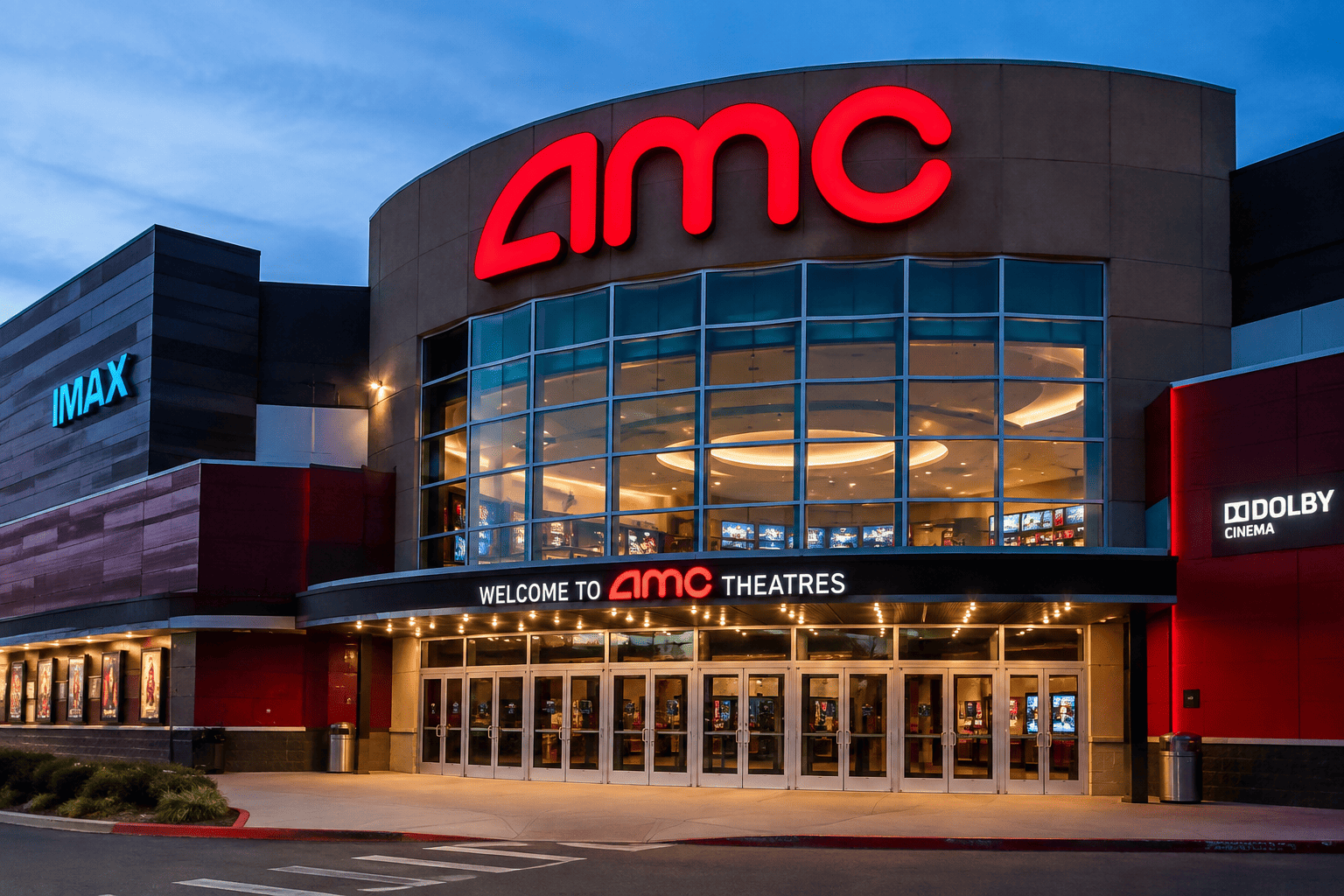
AMC Entertainment has staged a dramatic recovery in recent months, with its shares climbing from a year-to-date low of $0.9291 to around $3.30. The move has pushed the stock through a closely watched technical level and follows a pair of developments that investors have treated as supportive: a large debt refinancing and accelerating revenue growth.
Debt refinancing extends the runway
The primary driver behind the rally has been the company's announcement of a $3.9 billion debt refinancing package. The transaction extends the maturity dates on existing borrowings, giving AMC additional time to concentrate on operations rather than near-term repayment obligations.

The package consists of an $850 million first-lien term loan, a $1.1 billion second-lien term loan, and a new $2 billion first-lien loan maturing in 2031. The structure effectively grants the company roughly two additional years to manage its debt load and provides capital that can be used to repurchase existing obligations.
AMC remains a heavily leveraged business, carrying more than $3.7 billion in long-term debt along with over $3.2 billion in capital leases. Even so, total liabilities have declined to $9.4 billion from more than $12.6 billion in 2022, a reduction that reflects ongoing efforts to repair the balance sheet.
Revenue growth accelerates on strong film slate
The balance-sheet improvements are arriving alongside a rebound in theatrical revenue, supported by a slate of high-profile releases. Among the titles cited as potential drivers are Spider-Man: Brand New Day, The Odyssey, Toy Story, Michael, and Pegasus 3. Additional films expected to perform well include The Hunger Games, Street Fighter, Avengers, and Jumanji.
Analysts expect the momentum to carry into upcoming periods. The average estimate points to revenue rising 13.2% to $1.47 billion in the near term, while annual revenue is projected to increase 14.8% to $5.57 billion, following $5.8 billion last year.
The most recent quarterly results showed revenue up 14.2% to $1.59 billion, bringing the first-half total to $2.64 billion. Chief Executive Adam Aron described the period as the strongest in the company's 106-year history, noting that AMC reported higher quarterly revenue and higher quarterly adjusted EBITDA than in any quarter in more than a century.
Technical picture turns constructive
On the daily chart, AMC has rebounded forcefully since bottoming at $0.9291 in August. A golden cross formed on July 28 when the 50-day moving average crossed above the 200-day moving average, a pattern that is often read as a signal of improving medium-term momentum.
The stock has also pushed above $2.95, the upper boundary of an ascending triangle formation, and continues to trade above both the Ichimoku cloud and the Supertrend indicator. Taken together, these signals suggest the path of least resistance remains to the upside.
The next level to watch is $3.60, the stock's July 21 high. A decisive move above that point would open the door to $4.08, the May 28 peak. Conversely, a failure to hold the $2.95 breakout level would weaken the current technical setup.
This article is for informational purposes only and does not constitute financial advice.

