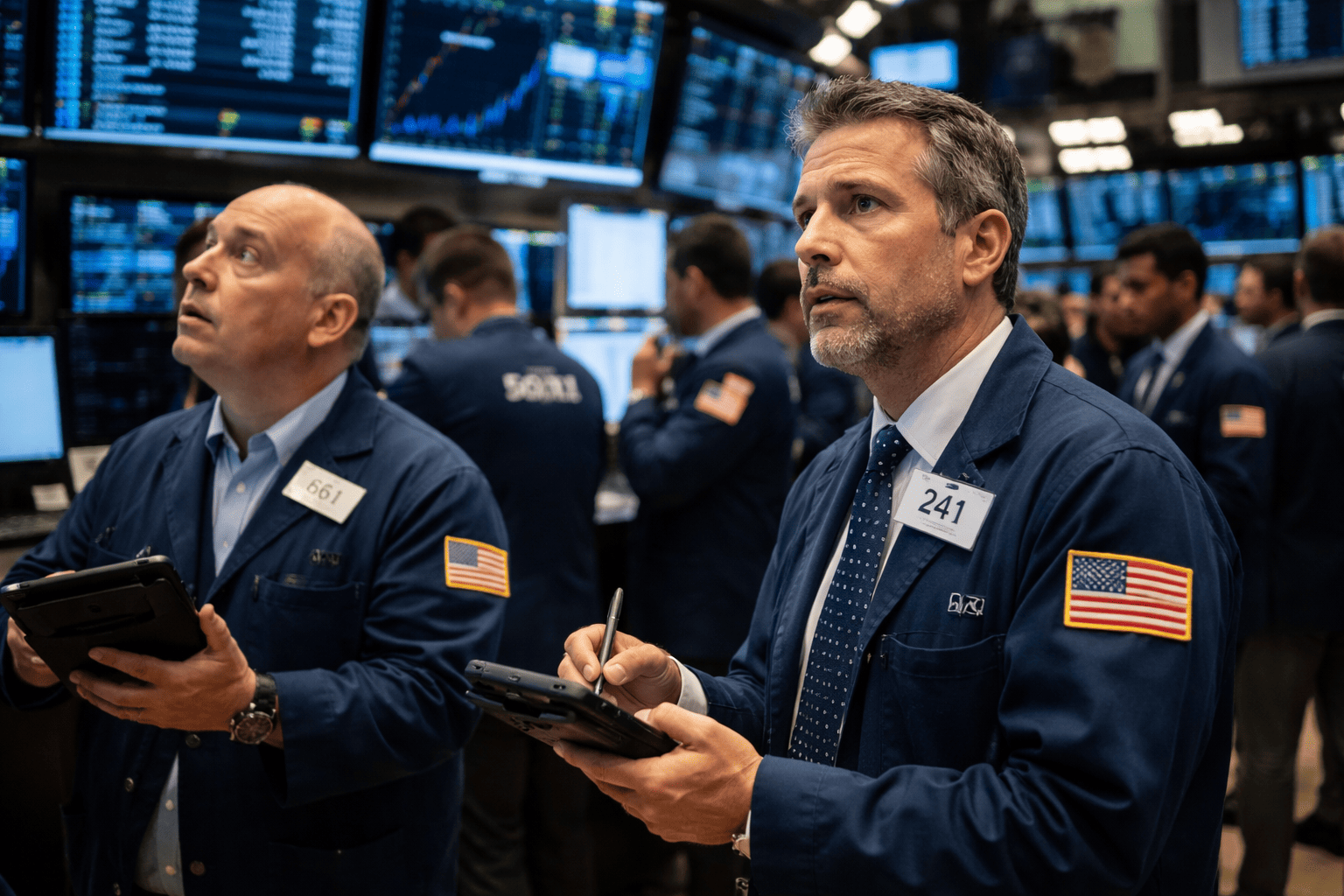
U.S. equity markets opened sharply lower on Tuesday, extending a technology-driven selloff that swept through global exchanges overnight. The Dow Jones Industrial Average fell 326 points, the Nasdaq Composite dropped 2.2%, and the S&P 500 declined 1.5%, as semiconductor and artificial intelligence stocks bore the brunt of the selling pressure.
The weakness followed Monday's session, during which the Nasdaq fell 1.3%, dragged down by Alphabet and other megacap tech names. The selloff accelerated Tuesday, with the VanEck Semiconductor ETF (SMH) sliding 6.4% and the State Street Technology Select Sector SPDR ETF (XLK) losing 3.7% in early trading.

Semiconductor and AI Stocks Lead Declines
Memory chipmaker Micron Technology dropped 12% ahead of its quarterly earnings report scheduled for Wednesday. SanDisk fell nearly 11%, and Seagate Technology shed more than 7%. Intel declined over 6.4%, while Advanced Micro Devices and Qualcomm fell more than 6% and 7%, respectively. Nvidia dropped 3.3%, and Alphabet extended Monday's losses with another 1.6% decline.
The rout quickly spread to Asian markets. South Korea's Kospi index fell nearly 10%, led by a 12% plunge in SK Hynix, a major beneficiary of the AI rally. Japan's Nikkei 225 declined 3.55%, ending an eight-session winning streak. European markets also weakened, with the pan-European Stoxx 600 falling 1% and the region's technology sector dropping 3%, as Dutch semiconductor equipment maker ASMI and chipmaker STMicroelectronics each lost more than 6%.
Investor Concerns Over AI Spending and Fed Policy
Investors are increasingly questioning whether the massive capital expenditures on AI infrastructure can be sustained, especially as many large technology companies continue to fund expansion through debt issuance. The selloff has erased more than $600 billion in market value from SpaceX over the past three sessions, with the stock falling 2.5% on Tuesday and on pace for a fourth consecutive decline.
Market participants are also adjusting to expectations of a more hawkish Federal Reserve. According to LSEG data, traders are now pricing in a second interest-rate increase by December, compared with expectations of only one 25-basis-point hike two weeks ago. Attention later Tuesday will turn to private surveys of June business activity, while investors await Thursday's release of the Personal Consumption Expenditures Index, the Fed's preferred inflation gauge.
Morgan Stanley Investment Management senior portfolio manager Andrew Slimmon described the selloff as a healthy development. "The AI beneficiaries are the sell-off, and I don't think they're expensive, but they're crowded," Slimmon said on CNBC's 'Squawk Box' Monday. "It's captured kind-of the zeitgeist of the momentum traders and when that happens, you're going to have sharp sell offs like we're having. I'd argue it's healthy."
Geopolitical developments also remain in focus after the United States waived sanctions on Iran for 60 days following the first round of talks under an emerging peace agreement. For more on related market moves, see Dow Adds 353 Points on SpaceX Debut, Iran Deal Optimism and Nikkei 225 Drops 8.4% as Iran Tensions and Global Selloff Pressure Japan Stocks.
This article is for informational purposes only and does not constitute financial advice.