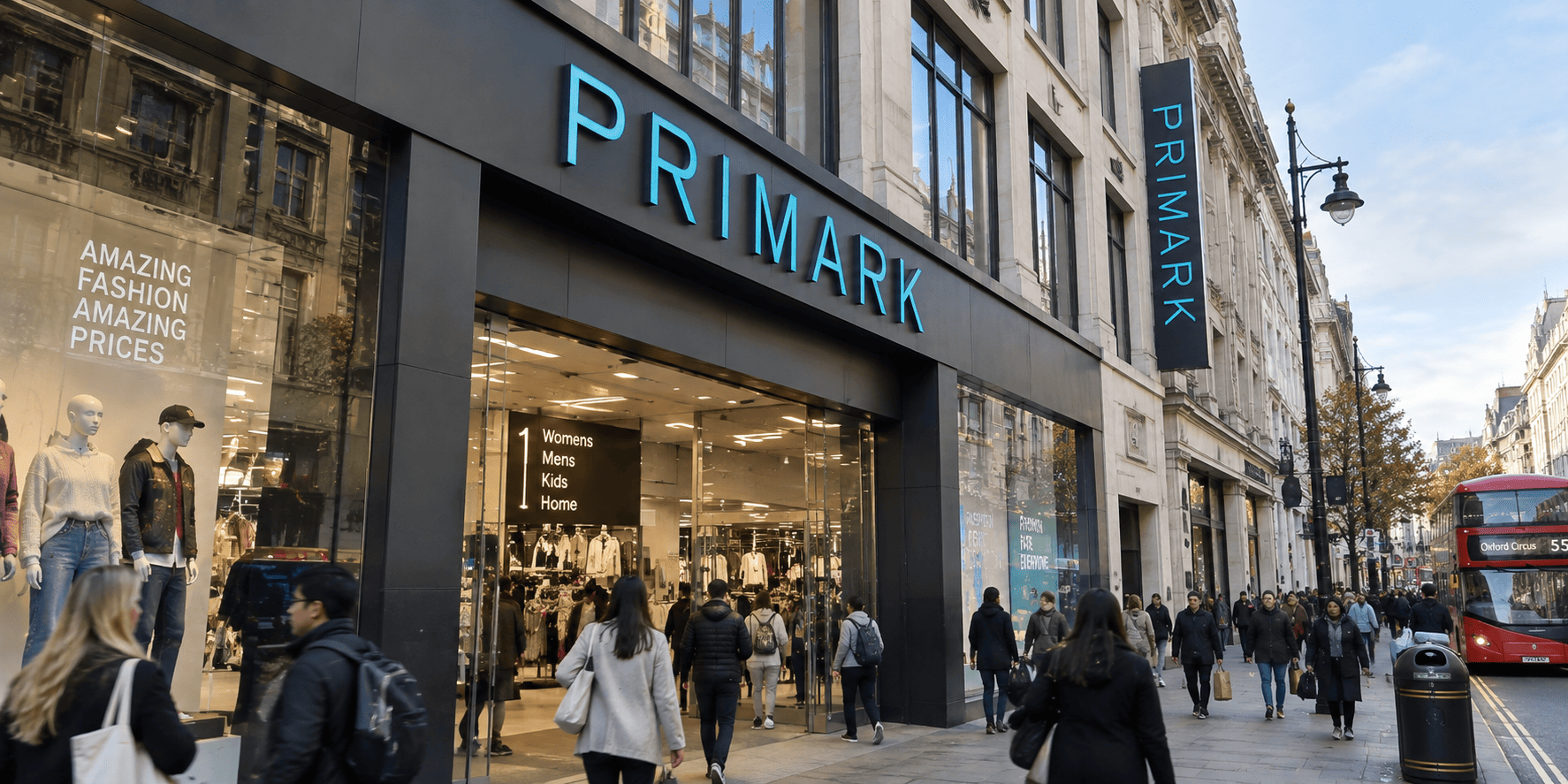
Shares of Associated British Foods (LON: ABF) tumbled more than 11% on Thursday after the company warned of weaker comparable sales at its fashion chain Primark and indicated that losses in its Sugar division would land at the upper end of its guidance. The update reignited concerns about the pace of Primark's recovery and the near-term profitability of the group, even as management reaffirmed that full-year adjusted earnings per share would come in ahead of previous expectations.
Primark's performance is a key focus for investors as AB Foods prepares to spin off the retailer from its food operations, a demerger expected to complete in December 2027. The company said like-for-like sales at Primark are projected to fall 3% in the fourth quarter ending September 12, following a 2.2% decline in the prior quarter. For the full fiscal year, comparable sales are expected to drop 2.6%.

Total sales, however, are forecast to rise 2% in both the fourth quarter and the full year, supported by the retailer's ongoing store expansion. This divergence suggests that new stores are driving overall revenue growth, but existing locations have yet to see a broad-based recovery. Chief Executive George Weston noted that actions to strengthen Primark's customer proposition have continued, with the UK and womenswear outperforming other markets, while trading in continental Europe remains challenging.
The weakness in Europe is particularly concerning, given the region's substantial share of Primark's store network. Mark Crouch, market analyst at eToro, commented that the sharp drop at the open indicates the market views Primark's turnaround as still a story, not a number.
Beyond Primark, the Sugar division added to investor worries. AB Foods now expects the unit to report an adjusted operating loss toward the upper end of its previous guidance range of £25 million to £60 million for fiscal 2026. The company attributed the deterioration to provisions for onerous contracts, weak European sugar prices, higher gas costs, and lower expectations for the UK beet crop yield.
The outlook for 2027 is even more challenging, with the Sugar division's adjusted operating loss expected to widen significantly to between £70 million and £170 million. Higher gas costs and weather-related risks in Africa are cited as key headwinds. This worsening outlook threatens to offset improvements elsewhere in the group, increasing the importance of Primark's eventual recovery and the performance of AB Foods' other food divisions.
Jefferies analysts described the update as a downbeat outlook for the stock, pointing to a muted end to the year for Primark and particularly weak sales in Europe. However, not all parts of the portfolio are struggling. Grocery sales are expected to increase in the mid-single digits in the fourth quarter, while Ingredients revenue is forecast to rise 10%. Agriculture is expected to be weaker, with sales declining in the mid-single digits.
At the group level, AB Foods said adjusted operating profit should be broadly in line with previous expectations, while adjusted earnings per share for fiscal 2026 are expected to be ahead of earlier forecasts. Still, investors are looking beyond the current year, with market forecasts for group-level underlying operating profits sitting around 13% lower than last year's £1.7 billion, suggesting a realistic view of the challenges ahead.
In a strategic move, Primark will launch home delivery in Great Britain for the first time, having acquired an automated fulfilment facility in Sheffield. The company said home delivery would be introduced in the future, leveraging its growing digital capabilities and the success of its click-and-collect service. This addresses a long-standing gap in Primark's business model, which has historically relied heavily on physical stores. While the move is seen as strategically appropriate, analysts note it will not rescue this Christmas, and the market has treated it accordingly.
For patient investors, the longer-term case remains intact, but today's update underscores the scale of the turnaround challenge ahead.
This article is for informational purposes only and does not constitute financial advice.

