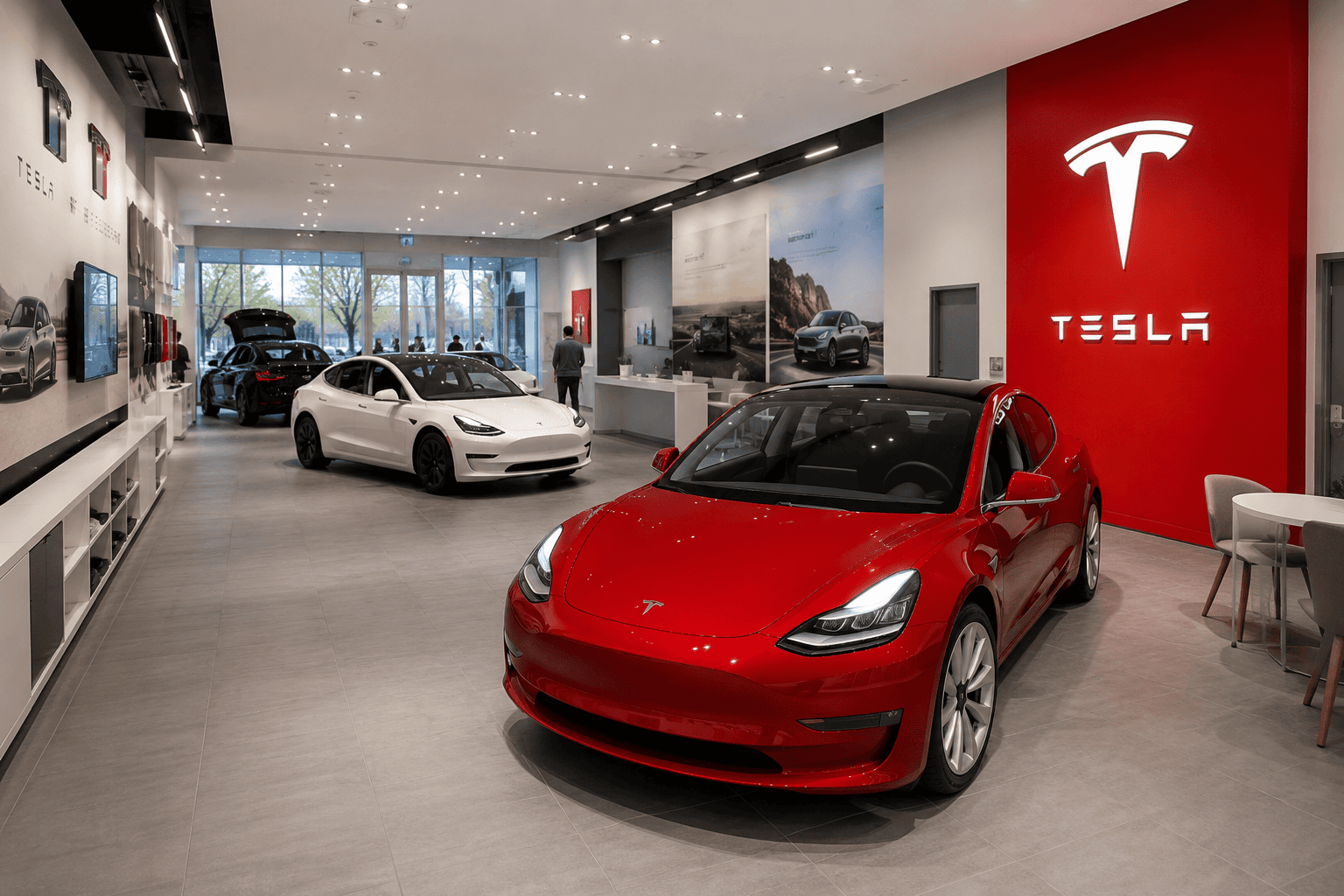
Tesla's shares declined approximately 3% during Tuesday's trading session, partially reversing the 5.5% advance from the prior day. The pullback came as market participants took a more measured view of the company's autonomous ride-hailing ambitions and assessed uneven vehicle registration figures from several European markets.
At the time of writing, Tesla was down 3.1%, while the S&P 500 and the Dow Jones Industrial Average each slipped about 0.5%. The stock's recent volatility underscores how sensitive investor sentiment remains to developments around the company's robotaxi initiative.

Robotaxi scaling questions persist
Monday's rally was largely attributed to renewed optimism about Tesla's self-driving taxi service, which launched in Austin, Texas, in June 2025 and has since expanded to cities including Miami and Dallas. However, the pace of expansion has been modest, and some analysts question whether the current scale justifies the market's enthusiasm.
Gary Black, co-founder of Future Fund, estimated that Tesla's robotaxi fleet consists of roughly 100 vehicles. By comparison, Alphabet's Waymo operates an estimated fleet of nearly 4,000 vehicles across more than a dozen U.S. cities. Black characterized Monday's surge as bulls getting ahead of themselves, highlighting the gap between expectations and the actual size of Tesla's operation.
Despite recent gains, Tesla's share price remains only a few dollars above its level from late June 2025, shortly after the robotaxi launch. This suggests that investors are still waiting for the business to demonstrate meaningful growth.
Competitive landscape intensifies
The autonomous ride-hailing market is becoming increasingly crowded. Amazon's Zoox is already offering robotaxi rides, while Waymo has expanded its footprint and is actively advertising its service. This competitive pressure adds another layer of uncertainty for Tesla as it seeks to carve out a significant share of the market.
The potential size and profitability of the robotaxi market remain unclear, making it difficult for investors to determine which company will emerge as the dominant player. The economics of autonomous ride-hailing—including vehicle costs, maintenance, and regulatory hurdles—are also key considerations.
Morgan Stanley values Tesla's autonomous driving technologies at approximately $1 trillion, roughly six times the value it assigns to the company's traditional automotive business. That valuation underscores the importance of self-driving technology to Tesla's overall investment thesis and explains why news related to the robotaxi program can move the stock.
Mixed European registration data
In Europe, Tesla's August vehicle registrations—a proxy for sales—painted a mixed picture. According to industry data, registrations surged 279% year over year in France and 104% in Denmark. However, they fell 79% in Norway and Spain, 41% in Sweden, 37% in Portugal, and 36% in Italy.
Rico Luman, senior economist at ING Research, attributed the strong performance in France and Denmark to rising electric vehicle adoption and Tesla's more competitive pricing. Matthias Schmidt, a European auto market analyst at Schmidt Automotive, noted that Norway's sharp decline partly reflects difficult comparisons with the previous year, when buyers accelerated purchases ahead of a fiscal policy change.
Tesla's European sales have rebounded this year after two consecutive annual declines, supported by easier comparisons, higher fuel prices, government incentives, and growing consumer interest in electric vehicles. Registration data from the UK and Germany—Europe's two largest car markets—is due later this week and could provide further insight into Tesla's regional performance.
For more context on Tesla's recent stock movements, see this analysis of the Cybercab event and the scaling hurdles that remain. Additionally, AI and robotaxi bets have helped offset a 25% YTD slide.
This article is for informational purposes only and does not constitute financial advice.