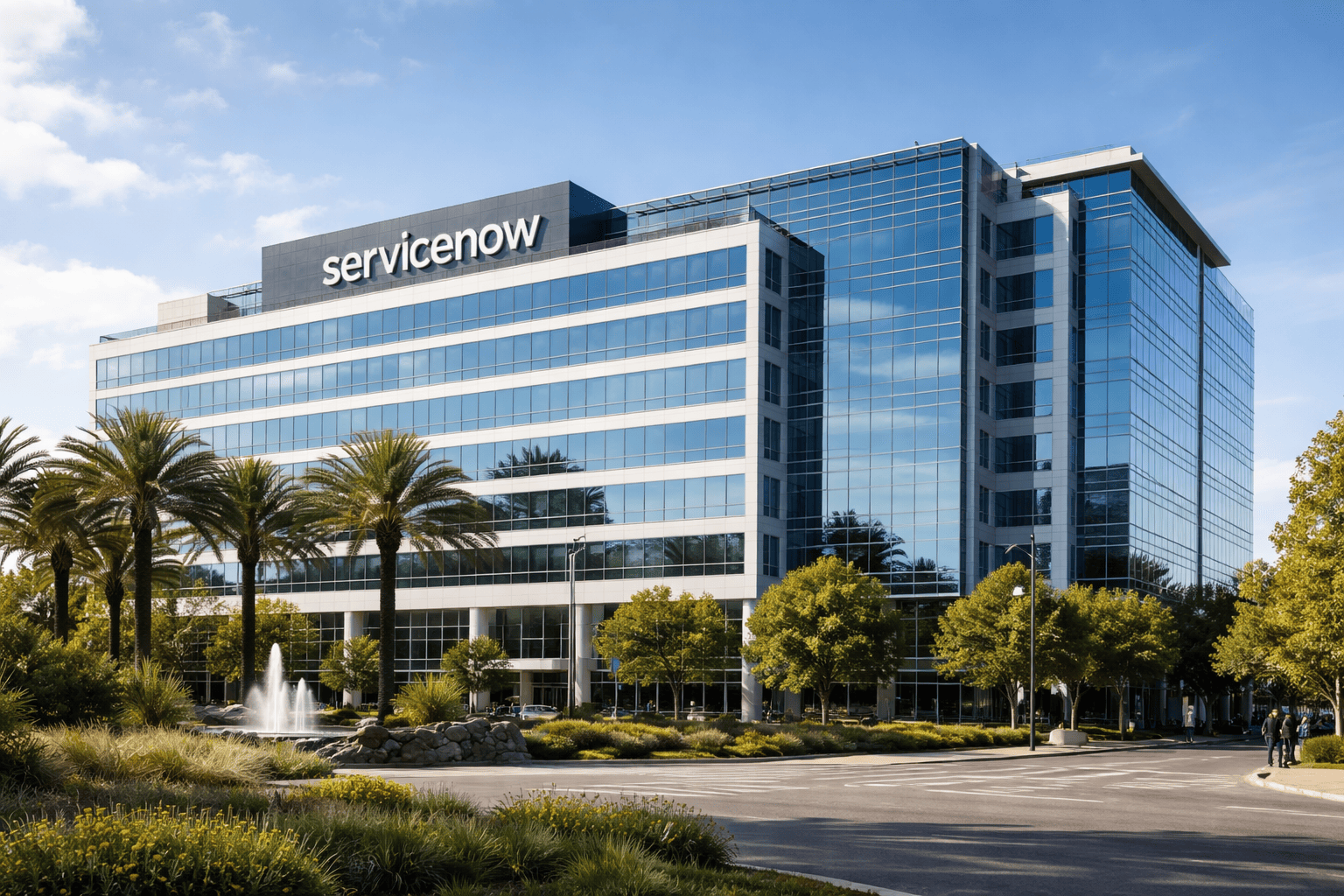
ServiceNow (NYSE:NOW) shares climbed 7.4% on Monday, closing at $142.35, as investors reassessed the potential impact of artificial intelligence on enterprise software. The rally came as the PHLX Semiconductor Index dropped 5.9% following calls from AI executives to slow the development of advanced models.
The contrasting moves highlight a growing debate about which parts of the technology stack benefit if companies become more cautious about deploying powerful AI systems. For ServiceNow, the discussion cuts both ways: slower development could reduce the risk of disruption while making AI governance more valuable.

Shift from hardware to software
During the AI boom, semiconductor companies captured investor enthusiasm as hyperscalers poured capital into computing infrastructure. Software firms faced the opposite question: what happens if autonomous agents replace traditional applications?
Monday's session challenged that assumption. ServiceNow rallied while chipmakers fell, and other enterprise software names also strengthened. Morgan Stanley strategists, led by Mike Wilson, noted the market is moving away from an "early-cycle, capital-intensive trade" toward businesses with strong free cash flow, AI adoption, and asset-light models. ServiceNow fits that profile, as it operates in the software layer through which companies manage AI.
Governance as a growth driver
The stronger argument for ServiceNow is not merely that slower AI protects incumbent software. Widespread use of autonomous agents creates new challenges around permissions, data access, security, and accountability. Needham analyst Mike Cikos raised his price target to $155 from $115 last week, maintaining a Buy rating. TipRanks reported that Needham came away from discussions with the company "incrementally more positive" on its positioning, particularly around AI governance.
ServiceNow has been building directly into that problem. Its AI Control Tower helps companies discover, govern, and monitor AI systems. AI Gateway, now generally available within AI Control Tower, adds runtime controls over connections between agents and tools. The company says it can enforce authentication and access policies, block sensitive responses, scan suspicious tools, and pause servers or tools without code changes.
That capability matters if enterprises keep deploying agents but become less willing to let them operate without oversight. In that scenario, caution strengthens the case for the control layer ServiceNow wants to sell. Recent earnings from ServiceNow and Atlassian have already eased fears of a "SaaSocalypse," suggesting investors are warming to the idea that AI will augment rather than replace software.
Growth targets still depend on AI adoption
There is an important contradiction. ServiceNow may benefit from greater concern about AI governance, but it still needs customers to adopt AI aggressively enough to support its growth targets. Bernstein, which reiterated an Outperform rating and a $248 price target, examined ServiceNow's goal of $30 billion to $32 billion in annual contract value by 2030, with about 30% expected from AI.
According to Investing.com, analyst Peter Weed noted that reaching more than $9 billion of AI-derived ACV would require more than just upgrades to AI-enabled products. Consumption-based AI would also need to become material, raising questions about whether the target "seems like a stretch."
That is the risk behind Monday's rally. A slower race toward more autonomous models may ease fears that SaaS platforms will be rapidly displaced. However, an outright slowdown in enterprise AI adoption would undermine ServiceNow's own revenue opportunity. The best outcome for ServiceNow is not an AI retreat, but continued enterprise adoption with tighter controls. As ServiceNow stock nears a golden cross, the market is watching whether AI governance can become a meaningful revenue stream.
Investors have also seen BofA lift price targets on ServiceNow and other software names amid AI optimism, reinforcing the view that governance tools could be a key differentiator. The coming quarters will test whether ServiceNow can convert its AI governance positioning into sustained growth, especially as the broader AI trade shifts from hardware to software.
This article is for informational purposes only and does not constitute financial advice.

