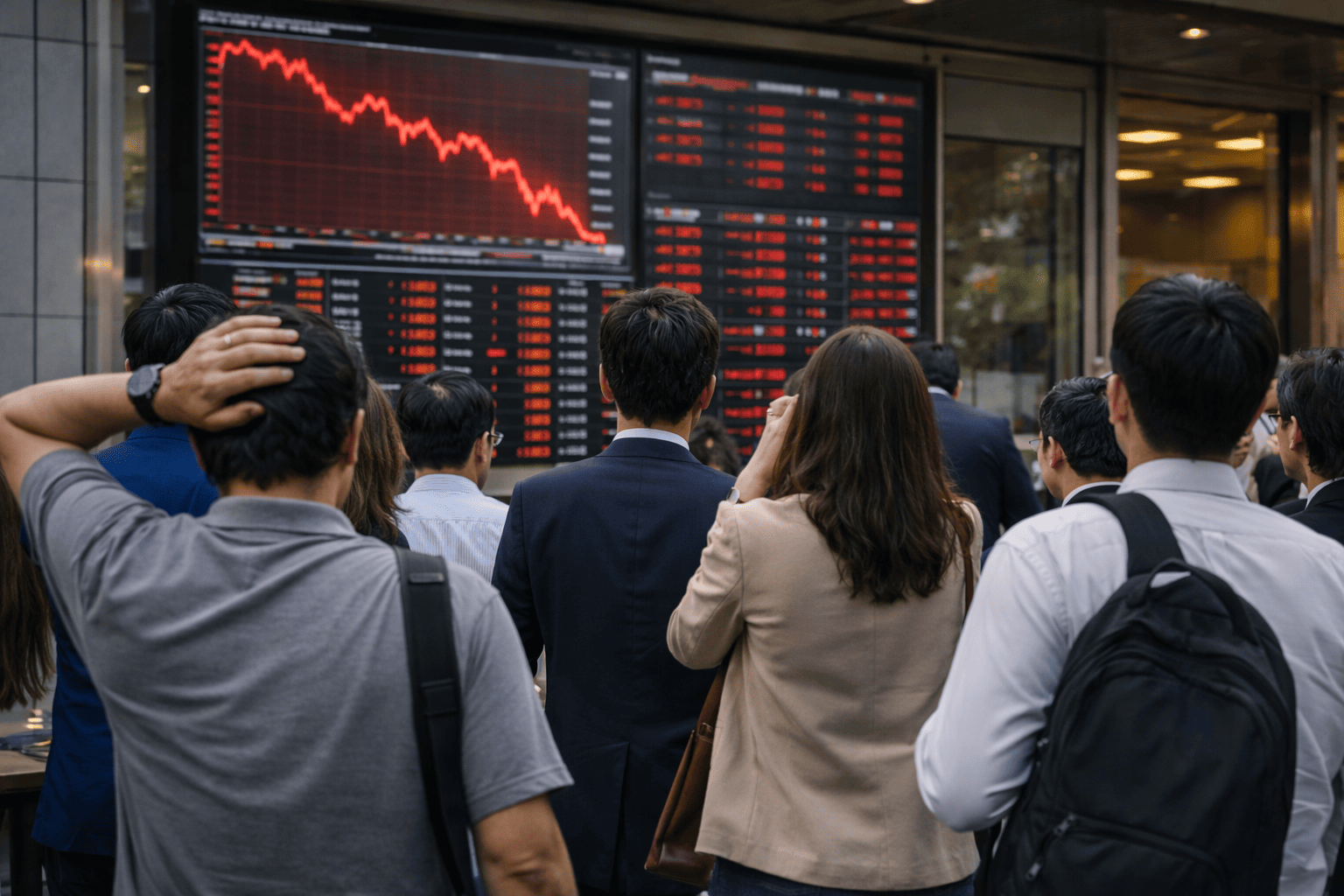
Samsung Electronics and SK Hynix saw their shares decline on Monday, bucking the expected bullish sentiment surrounding South Korea's ambitious new investment initiative. The country's government is set to announce a plan that could funnel up to 2,000 trillion won (approximately $1.3 trillion) into semiconductors, AI data centers, and robotics over the next decade. Yet, instead of rallying, Samsung dropped over 4% and SK Hynix lost more than 3%, as investors zeroed in on the mounting capital expenditure required to stay competitive in the AI race.
A Record Bet on AI Infrastructure
President Lee Jae Myung's "Three Mega Projects for the Great Leap Forward" initiative, expected to be unveiled Monday, places semiconductors, AI data centers, and robotics at its core. Local media reports indicate that Samsung Group and SK Group together could commit as much as 2,000 trillion won in investments over the next ten years. The funds are earmarked for new semiconductor fabrication plants, AI data centers, advanced packaging facilities, and other critical infrastructure to cement South Korea's role in the global AI supply chain.
Samsung is reportedly preparing a plan worth around 1,000 trillion won, encompassing chip factories, data-center investments, and regional expansion beyond the Seoul metropolitan area. SK Group is expected to outline a similar long-term push, led by SK Hynix's memory and AI-chip ambitions. On the surface, this appears to be a clear positive for the two memory-chip giants, given the booming demand for AI and the tight supply of high-bandwidth memory (HBM). However, the market's reaction tells a different story.
Investors Focus on the Cost of Staying Ahead
The irony is not lost on traders: a spending plan of this magnitude would normally be a strong catalyst for Samsung and SK Hynix. Instead, the focus has shifted to the sheer scale of capital needed to defend their positions. As AI demand continues to surge, the cost of building and maintaining cutting-edge facilities is escalating rapidly. The question on investors' minds is whether the next upcycle in the memory market will be profitable enough to justify these massive outlays.
Samsung: Playing Catch-Up in HBM
For Samsung, the investment plan is partly about closing the gap in the AI memory market. SK Hynix recently overtook Samsung to become South Korea's most valuable listed company, driven by its leadership in high-bandwidth memory (HBM), the specialized memory used alongside AI processors from companies like Nvidia. SK Hynix moved faster in HBM, establishing itself as the market leader, while Samsung has been playing catch-up. According to Reuters, Kim Sunwoo, senior analyst at Meritz Securities, noted that customized AI memory has "fundamentally changed the industry's economics" and helped SK Hynix solidify its lead. Samsung's reported spending plans include new fabs, potential capacity in Gwangju, AI data centers in Asan, and advanced packaging investments—all aimed at regaining lost ground.
SK Hynix: Defending Its AI Crown
SK Hynix, meanwhile, is in a stronger position but faces its own challenges. The company has become the defining memory winner of the AI boom, with its HBM chips central to Nvidia's AI systems. This leadership has driven a historic rally in its stock. However, the question now is whether SK Hynix can defend that crown without overspending. The company is already raising capital through a planned US listing and has committed heavily to new fabs, advanced packaging, and EUV equipment. The logic is straightforward: if AI customers want more HBM, SK Hynix must build more capacity. But the risk is the classic chip-market trap—neither Samsung nor SK Hynix can afford to fall behind, so both keep spending. If both invest aggressively at the same time, the industry could eventually face oversupply.
For context, SK Hynix's upcoming Nasdaq listing has been a major topic in the markets, with reports of strong demand and potential volatility. Related coverage includes SK Hynix's $26.5B US Listing Spurs Leveraged ETF Wave, Raising Volatility Risks and Micron, SanDisk, Marvell Slide as SK Hynix's Record $26.5B Nasdaq Listing Looms. Additionally, the broader market impact is explored in Wall Street Futures Mixed as SK Hynix Debut Tests AI Demand; Delta Earnings in Focus.
In summary, while South Korea's massive investment plan underscores the country's commitment to leading the AI era, the immediate market reaction highlights the growing concern over the escalating costs of that leadership. For Samsung and SK Hynix, the path forward is clear: spend big to stay competitive, but the risk of overinvestment looms large.
This article is for informational purposes only and does not constitute financial advice.