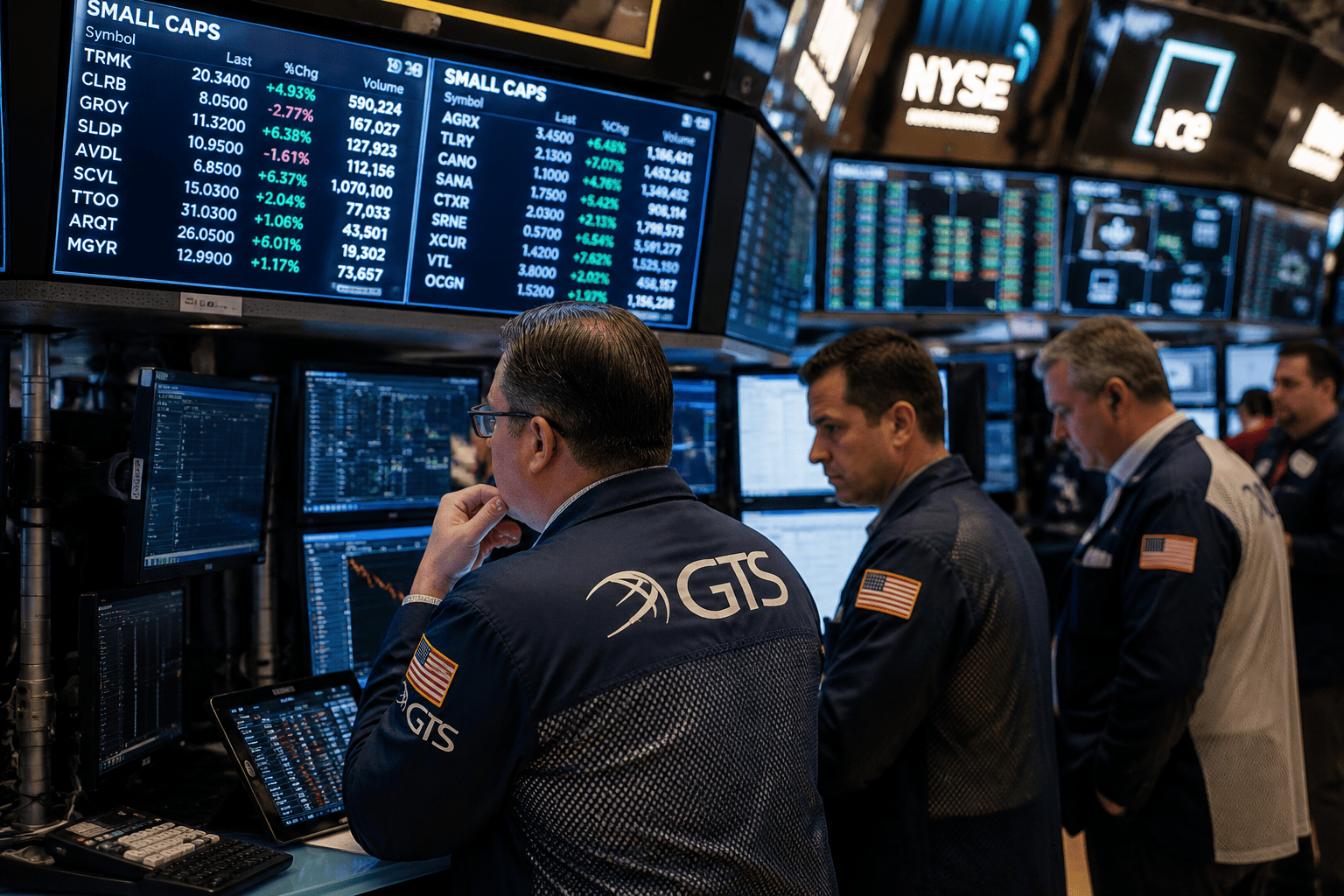
The Russell 2000 index of small-cap stocks reached a new all-time high on Wednesday, climbing 0.65% to 3,046.59, as investors continued to rotate away from mega-cap technology names. The benchmark has delivered a more than 21% return in the first half of 2026, its strongest first-half performance since 1991, outpacing the S&P 500's roughly 10% gain over the same period.
The rally reflects growing confidence that improving corporate fundamentals, easing macroeconomic concerns, and sustained spending on artificial intelligence infrastructure are broadening market leadership beyond the so-called Magnificent Seven. However, several factors suggest the rally may lose momentum in the months ahead.

AI Boom Lifts Smaller Tech Companies
Much of the Russell 2000's outperformance has been driven by technology companies, particularly those tied to semiconductors and semiconductor manufacturing equipment. Chip-related firms account for 16 of the index's 50 best-performing stocks this year. Companies including Aehr Test Systems, Ichor Holdings, and MaxLinear have each surged more than 400%, underscoring how AI-related investment has spread beyond the industry's largest players.
Nick Kalivas, Invesco's head of factor strategy for exchange-traded funds, recently argued that several factors could continue supporting smaller companies. The recent US-brokered peace agreement with Iran, which has contributed to lower oil prices, could 'accelerate the profitability recovery for the small-caps,' Kalivas told MarketWatch. 'It may be showtime for small-caps,' he said, noting that investors have grown increasingly concerned that hyperscale technology companies such as Microsoft, Meta Platforms, and Amazon are becoming more capital intensive as they spend aggressively on AI infrastructure.
Rebalancing May Reshape the Index
Despite the record-setting run, some strategists believe the Russell 2000 could face headwinds following its annual index rebalancing. As part of the latest reshuffle, 43 companies graduated from the Russell 2000 into the large-cap Russell 1000 after growing significantly in market value. Many of those departing companies were among the index's strongest performers over the past year.
'You can bet that the large majority of these names will no longer be in the Russell 2,000 when trading begins next week, meaning the index itself is going to look and act a lot different in the second half of the year,' analysts at Bespoke Investment Group said on Monday. According to Bespoke, each of the 25 best-performing Russell 2000 constituents prior to last week's rebalance had gained at least 250% over the past year, and all have now moved into the Russell 1000.
History also suggests that maintaining such momentum may prove difficult. The Russell 2000 previously recorded double-digit gains before its mid-year rebalancing in 2019 and 2021. During those years, the index rose 16% and 18%, respectively, before returning a more modest 6.5% in the second half of 2019 and falling 3.8% during the latter half of 2021.
Julian Emanuel, chief equity and quantitative strategist at Evercore, said seasonal patterns have historically worked against small-cap stocks following the annual rebalance. 'There is a pronounced tendency for small caps to give back a portion of the outperformance that they had garnered in May and June in the runup to the Russell rebalance,' Emanuel told MarketWatch. Data from Dow Jones Market Data also show July has historically been an average month for the Russell 2000, with gains averaging about 0.6%, making it only the index's eighth-best performing month.
Valuations and Rates Emerge as Key Risks
Analysts also caution that valuations are no longer as attractive as they were earlier in the rally. The Russell 2000's forward price-to-earnings ratio stood at 26.4 as of late last week, according to Dow Jones Market Data, exceeding the S&P 500's forward multiple of roughly 20, based on FactSet data.
Higher interest rates present another challenge. Smaller companies generally rely more heavily on floating-rate debt, leaving them more exposed if borrowing costs rise further. Around 40% of Russell 2000 constituents also remain unprofitable, increasing refinancing risks if financial conditions tighten.
Still, some investors believe earnings growth can continue to support the asset class despite those concerns. Wall Street has steadily upgraded earnings estimates for smaller companies throughout 2026, mirroring improvements seen among larger corporations. Francis Gannon, co-chief investment officer at Royce Investment Partners, said economic resilience could offset concerns about higher interest rates. 'To me, higher rates are reflective of the economy doing OK, if not better,' Gannon told MarketWatch. 'I think the earnings story of small caps is outweighing some of the fears of higher rates.'
For now, the Russell 2000 remains one of Wall Street's strongest-performing benchmarks. Whether the rally can extend through the remainder of the year may depend on whether earnings growth continues to broaden beyond the largest technology companies and whether investors remain willing to embrace higher valuations despite an uncertain interest-rate outlook.
For more on market dynamics, see our coverage of US Stock Funds See $17.2B Weekly Outflow and Michael Burry Shorts Micron.
This article is for informational purposes only and does not constitute financial advice.

