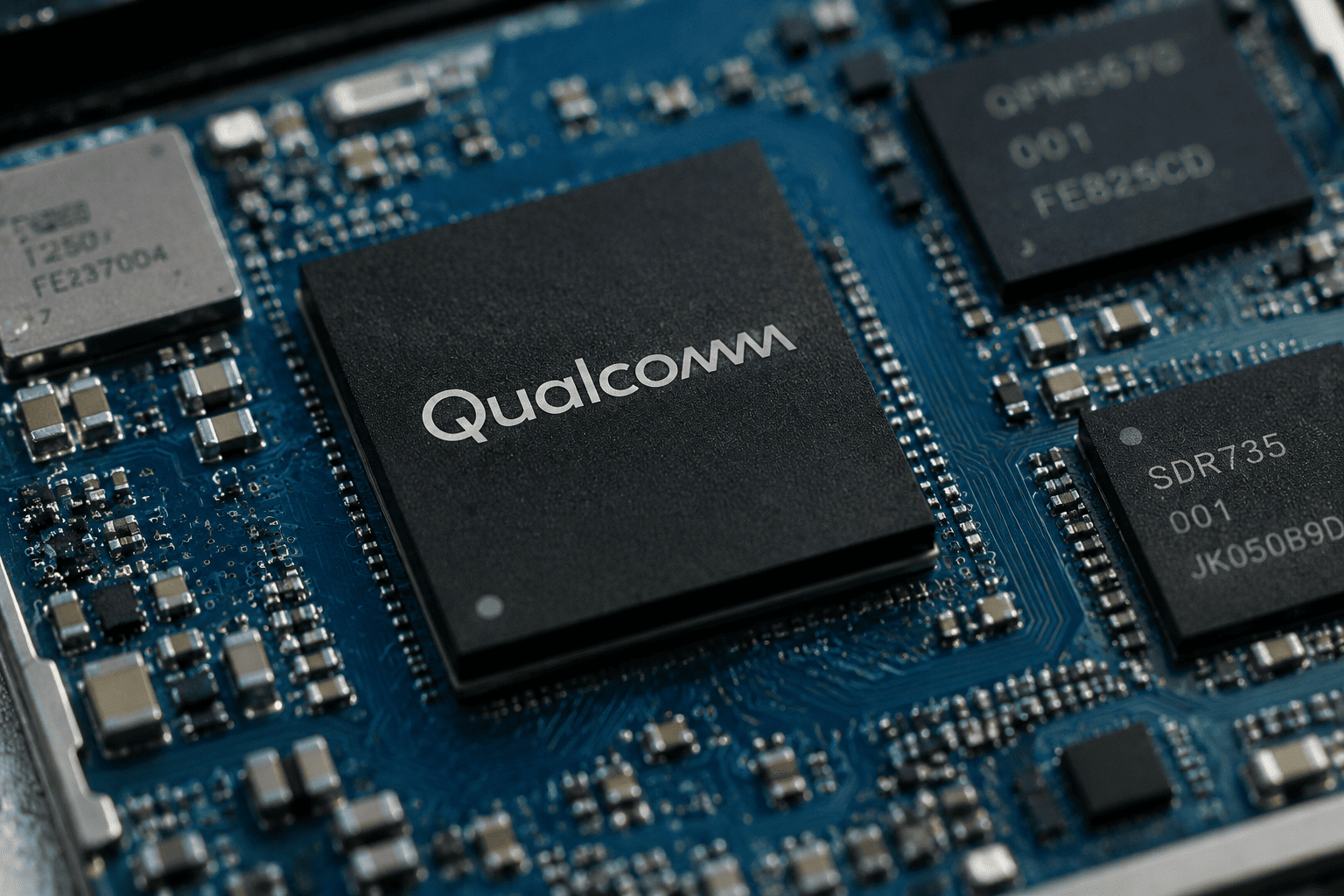
Qualcomm has unveiled an aggressive growth strategy for its data center business, projecting $15 billion in sales from the segment by fiscal 2029. The announcement marks a clear pivot from the company's traditional reliance on smartphone chips toward the rapidly expanding AI infrastructure market.
During an investor presentation, Qualcomm CFO Akash Palkhiwala outlined a near-term target of $5 billion in data center revenue for fiscal 2027. The company also raised its overall non-smartphone chip revenue forecast to $40 billion by 2029, nearly doubling a prior estimate of $22 billion. Shares of Qualcomm rose approximately 12% in premarket trading following the news.

AI Chips Gain Traction with Hyperscalers
Qualcomm confirmed that Microsoft and Meta Platforms will deploy its new AI chips, and it is developing custom silicon for two additional unnamed hyperscale cloud providers. These partnerships underscore Qualcomm's push to carve out a role in the data center AI compute market, where demand for specialized chips is surging.
The move comes as Qualcomm's core smartphone chip business faces headwinds from a memory chip shortage driven by AI infrastructure demand, as well as increasing in-house chip development by major customers like Apple and Samsung. Bank of America analysts had previously estimated Qualcomm's data center revenue could reach only $2 billion to $5 billion by fiscal 2027–2028, making the new targets a significant escalation.
Modular Acquisition Strengthens Software Layer
To support its data center ambitions, Qualcomm announced an agreement to acquire Modular Inc., a company specializing in an open, AI-native software stack. Modular's platform enables AI models to run efficiently across diverse hardware architectures—including CPUs, GPUs, NPUs, and custom ASICs—without requiring developers to rewrite code for each accelerator.
Qualcomm CEO Cristiano Amon described the acquisition as a pivotal moment for both the company and the AI industry, noting the shift toward disaggregated, multi-vendor architectures that demand a more open software foundation. Modular CEO Chris Lattner added that joining Qualcomm provides the scale needed to accelerate the mission of building efficient AI infrastructure.
The deal is expected to enhance Qualcomm's ability to optimize system-level performance in heterogeneous computing environments, a key factor as AI workloads scale and energy efficiency becomes critical to inference costs.
Broader Implications for the AI Chip Ecosystem
Qualcomm's data center push also lifted shares of Arm Holdings, which rose about 5% after the forecast. Arm's CPU designs underpin many of Qualcomm's chips, and the expansion of Qualcomm's AI chip business is seen as a tailwind for Arm's royalty revenue. However, risks remain if hyperscalers continue to develop in-house silicon or negotiate lower royalty rates.
The broader AI chip market is increasingly competitive, with companies like Broadcom and Nvidia vying for dominance. For more on the competitive landscape, see our coverage of Broadcom's Tomahawk 6 targeting Nvidia's networking stronghold and Morgan Stanley's picks for the AI trade shift.
Key Risks and Outlook
While Qualcomm's targets signal confidence, the company faces execution risks. Data center revenue may ramp slower than guided if hyperscalers accelerate in-house silicon development or delay custom-chip rollouts. The company's ability to deliver on its $15 billion goal will depend on winning and retaining major customers in a rapidly evolving market.
Qualcomm's broader diversification strategy, including the Modular acquisition, positions it to compete beyond smartphones, but investors will watch closely for signs of sustained momentum in AI infrastructure spending.
This article is for informational purposes only and does not constitute financial advice.