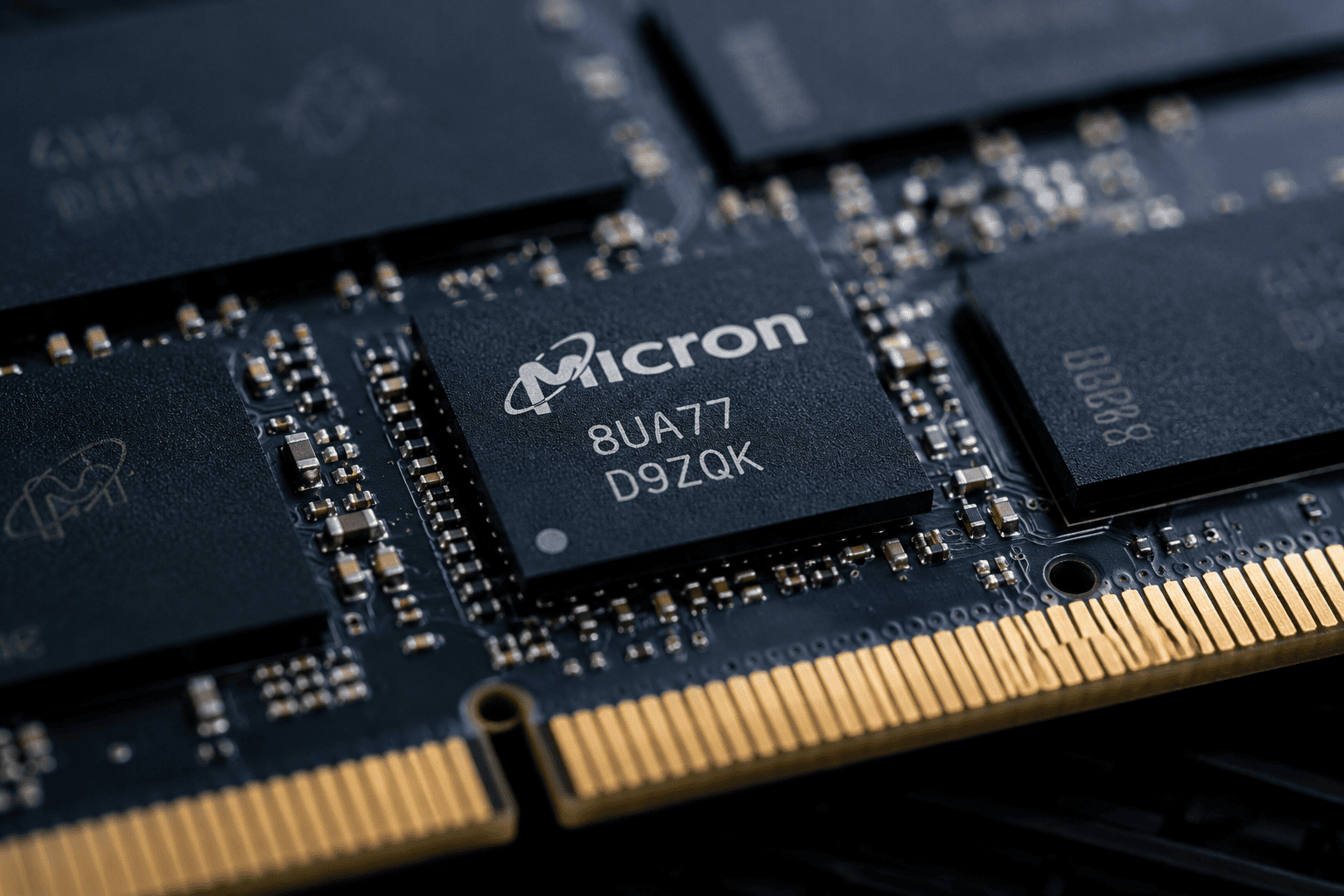
Memory chip stocks experienced a sharp selloff on Monday, driven by a confluence of factors including reports that Apple might gain access to Chinese memory suppliers, a disappointing capital-return announcement from Samsung, and broader profit-taking across the semiconductor sector.
Micron Technology (MU) fell approximately 7%, while SK Hynix dropped around 5%. SanDisk declined about 9%, and Seagate Technology and Western Digital each slipped roughly 7%. The declines were broad-based, reflecting investor anxiety over potential shifts in the memory supply chain.

Apple-China memory reports trigger selling
The selling pressure was ignited by reports from Wccftech suggesting that the Trump administration could allow Apple to procure DRAM from China's ChangXin Memory Technologies (CXMT) and NAND flash from Yangtze Memory Technologies (YMTC). This potential policy shift, reportedly tied to Chinese President Xi Jinping's expected US visit in September, could be part of a broader effort to ease US-China tensions and help Apple address supply-chain constraints.
However, analysts caution that the market's reaction may be overblown. KC Rajkumar of Lynx Equity Research noted that CXMT has only been qualified for a single, low-volume Mac product, and its production is constrained by poor yields. He argued that CXMT's LPDDR5X yields make it unlikely to supply Apple at a meaningful scale, and thus the immediate threat to Micron is limited.
Washington's stance remains uncertain
The reports also conflict with recent comments from US Commerce Secretary Howard Lutnick, who told The Wall Street Journal that the Trump administration does not want Apple to use memory chips manufactured in China. This comes as Micron has been lobbying Washington against such a move, arguing that it could undermine US semiconductor manufacturing.
The conflicting signals add another layer of uncertainty for investors trying to gauge how US technology policy could impact memory suppliers.
Samsung adds to sector pressure
Another catalyst came from South Korea, where Samsung shares fell about 9% after the company announced its 2026 shareholder-return plans. Samsung said it expects to return between 90 trillion and 110 trillion Korean won to shareholders in 2026, but investors had hoped for more immediate buybacks and share cancellations. JPMorgan analysts viewed the lack of an immediate buyback as a disappointment, given elevated expectations.
While Samsung's announcement does not fundamentally alter the demand outlook for Micron's high-bandwidth memory or SanDisk's NAND business, it provided a catalyst for profit-taking in a sector that has already seen substantial gains.
Nvidia earnings add to semiconductor caution
Memory stocks were also caught in a broader retreat ahead of Nvidia's earnings later this week. Nvidia fell about 3% on Monday, and the Philadelphia Semiconductor Index declined roughly 4%. Investors appear to be reducing exposure to semiconductor stocks ahead of one of the most closely watched earnings reports of the quarter.
The broader market was also under pressure as the Trump administration prepared new tariffs on Canadian goods and additional economic sanctions against Iran. For more context on the recent semiconductor selloff, see our coverage of chip stocks sliding ahead of Nvidia earnings and the impact of Samsung's drop on memory chip stocks.
This article is for informational purposes only and does not constitute financial advice.