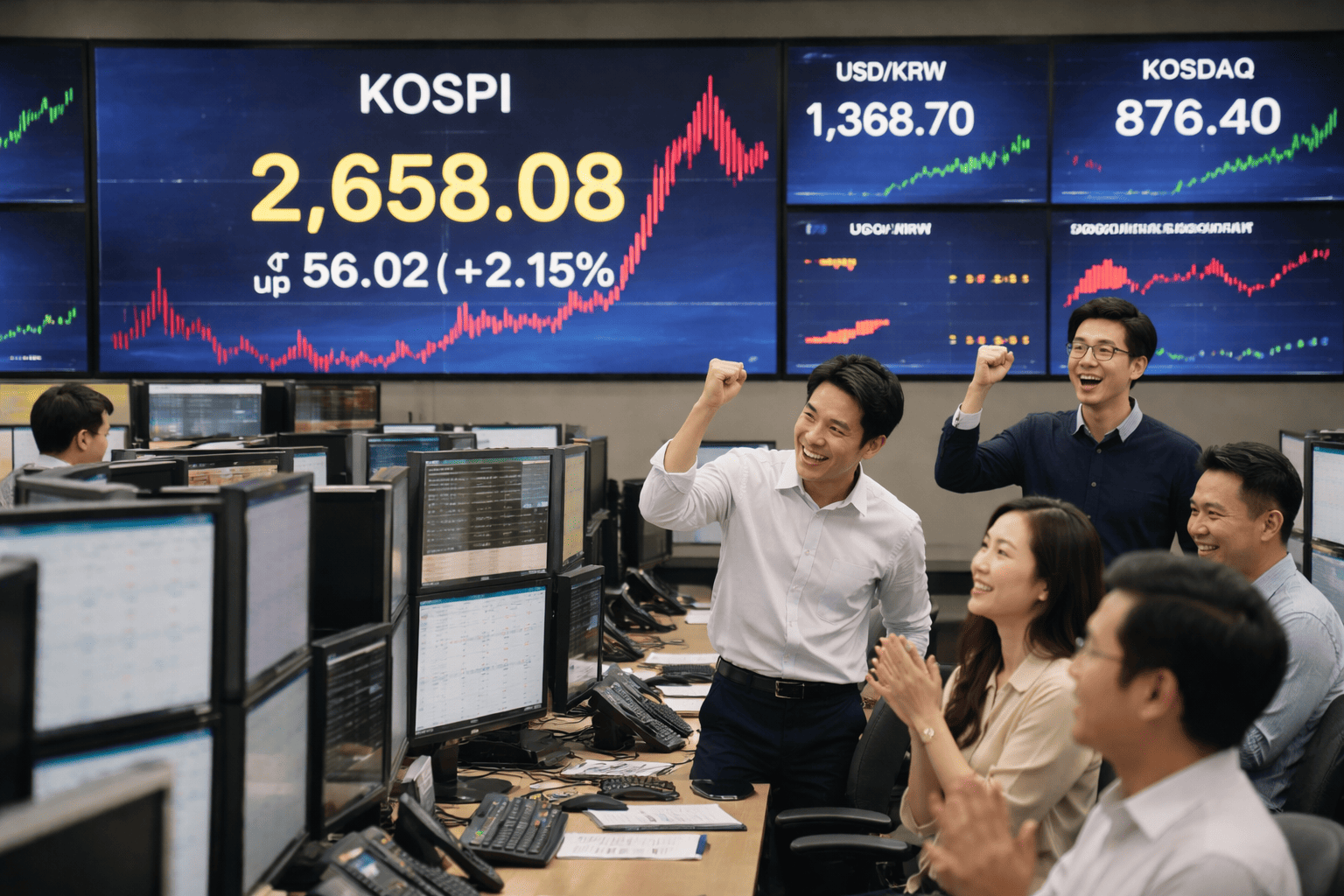
South Korea's Kospi Index surged sharply on Monday, climbing over 5% to reach 8,570 KRW—its highest level since June 4 and a significant recovery from this month's low of 7,373 KRW. The rally was fueled by a combination of geopolitical developments and a tech-driven surge in global equities.
US-Iran Deal Boosts Risk Appetite
The primary catalyst for the Kospi's jump was the announcement of a new agreement between the Trump administration and Iran. Under the deal, Iran will reopen the Strait of Hormuz without imposing tolls, a move that sent crude oil and natural gas prices plunging. For South Korea, which relies heavily on Middle Eastern oil imports and has drawn down its strategic petroleum reserves, this development is particularly bullish. Lower energy costs are expected to ease inflationary pressures, giving the Bank of Korea more flexibility to avoid rate hikes.
The broader Asian market mirrored this risk-on sentiment, with Japan's Nikkei 225 and Topix indices also posting strong gains. South Korean bonds rallied as well, with the 10-year yield falling to 4.117% from its year-to-date high of 4.4%.
Tech Stocks Lead the Rally
The Kospi's advance was also propelled by a surge in technology shares, following last Friday's SpaceX IPO. The company raised over $75 billion at a valuation of $1.7 trillion, and its stock subsequently jumped 19%, pushing its market cap above $2 trillion. This landmark listing has raised expectations that other high-flying tech firms, such as OpenAI and Anthropic, may file for IPOs later this year—a development that could benefit South Korean companies.
Leading the charge on the Kospi were heavyweights Samsung, SK Hynix, and SK Square, which rose 5.3%, 6.8%, and 7%, respectively. Their market capitalizations now stand at $1.32 trillion, $963 billion, and $116 billion. SK Square derives most of its value from its stake in SK Hynix, underscoring the concentration of tech exposure in the index. For context, recent volatility in the memory chip sector has been notable, as seen in the Kioxia stock plunge despite record demand.
Key Catalysts Ahead
Looking forward, the next major catalyst for the Kospi and other global indices will be the Federal Reserve's interest rate decision on Wednesday. Analysts widely expect the Fed to hold rates steady at 3.5%–3.75%, but markets will scrutinize the accompanying statement for hints about future policy. A dovish tone could further support risk assets, while any hawkish surprises may temper gains.
Additionally, the ongoing AI-driven demand for semiconductors continues to underpin South Korea's tech sector. The recent listing of tokenized stocks on MEXC targeting AI data center supply chains highlights the growing investor interest in this theme.
Technical Analysis: Next Target at 8,925
From a technical perspective, the Kospi Composite Index has been one of the best-performing indices globally in recent months. It remains above an ascending trendline connecting lows since May 20 and has climbed above both the 50-day and 100-day exponential moving averages (EMAs). The Relative Strength Index (RSI) has crossed above the neutral 50 level and is pointing upward, signaling bullish momentum.
The immediate resistance level to watch is the all-time high of 8,925. A decisive break above that could open the door to further upside. Conversely, any pullback may find support near the 8,200–8,300 zone, where the EMAs converge.
Investors should also monitor broader market dynamics, such as the performance of other major indices like the FTSE 100, which could provide clues about global risk appetite.
This article is for informational purposes only and does not constitute financial advice.