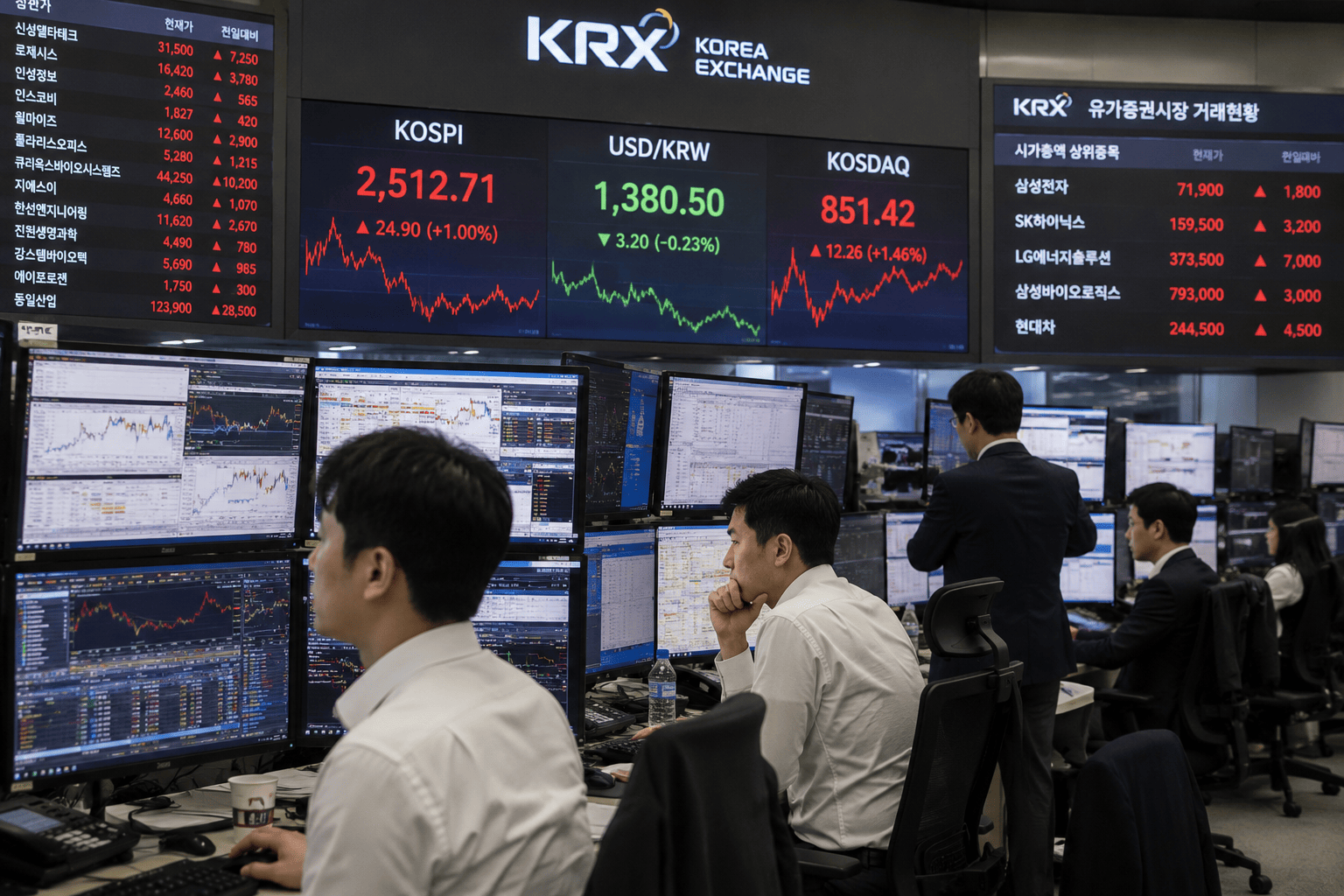
South Korea's benchmark KOSPI index closed down 5.81% on Friday at 8,411.21, capping its worst weekly performance since early March. The index tumbled as much as 9% during the session, triggering circuit breakers for the second time this week and marking the fifth such halt in 2026. The weekly loss of 6% follows an extraordinary rally that saw the KOSPI nearly double in value year-to-date, making it the world's best-performing major stock market.
Concentration in Semiconductors Amplifies Swings
The volatility is largely attributed to the outsized influence of Samsung Electronics and SK Hynix, which now account for nearly 60% of the KOSPI's market capitalization. This heavy concentration means that shifts in investor sentiment toward artificial intelligence and memory chips can move the entire index. Analysts note that while worries about declining memory demand may be overblown, the market's narrow base makes it highly sensitive to any news affecting the semiconductor sector.
“Today's slump can be mostly explained by high volatility amid concentration in the chip sector, while worries about memory demand declining are a bit excessive,” said Han Ji-young, an analyst at Kiwoom Securities.
Retail Investors and Leveraged ETFs Fuel Meme-Like Behavior
Another key driver of the recent turbulence is the surge in retail investor participation. Morgan Stanley noted that the KOSPI's strong rally has attracted a new wave of retail traders, boosting liquidity but also increasing volatility. The index has closed up or down by at least 5% on 20 occasions this year, compared with just two instances in all of 2025.
Single-stock leveraged exchange-traded funds have become a focal point, as their mechanical rebalancing amplifies market moves. According to Goldman Sachs, a 5% move in the Korean market can trigger approximately $4.7 billion in ETF rebalancing flows, roughly one-eighth of average daily trading volumes. South Korea's financial watchdog has expressed regret over approving such products, raising concerns that recent gains may be driven more by technical flows than fundamentals.
“The Kospi in 2026 is starting to trade with meme-like muscle,” said Hebe Chen, a market analyst at Vantage Global Prime, in a Bloomberg report. “With Samsung and SK Hynix carrying outsized influence, and leveraged products mechanically amplifying every move in a market with too few obvious targets for that money to chase, each swing in AI sentiment can quickly become an index-level event.”
Context and Outlook
The recent pullback comes after an extraordinary run that saw the KOSPI surge 76% in 2025 and nearly double in 2026. The index's volatility has drawn comparisons to the meme-stock frenzy of 2021, with sharp intraday swings and frequent circuit breaker activations. For context, the KOSPI has triggered trading curbs only 11 times in its history, with five of those occurring this year.
Investors are now watching for signs of stabilization. A brief rally earlier in the week, fueled by strong earnings from US memory-chip maker Micron, quickly fizzled, underscoring the market's sensitivity to AI-related news. As retail investors shift from broad index bets to selective trades, the market may continue to experience heightened volatility.
The AI chip boom has reshaped South Korea's economy, but it has also widened wealth gaps and created a market structure prone to sharp moves. With leveraged ETFs amplifying every swing, the KOSPI's near-term direction may depend more on technical flows than on underlying fundamentals.
This article is for informational purposes only and does not constitute financial advice.