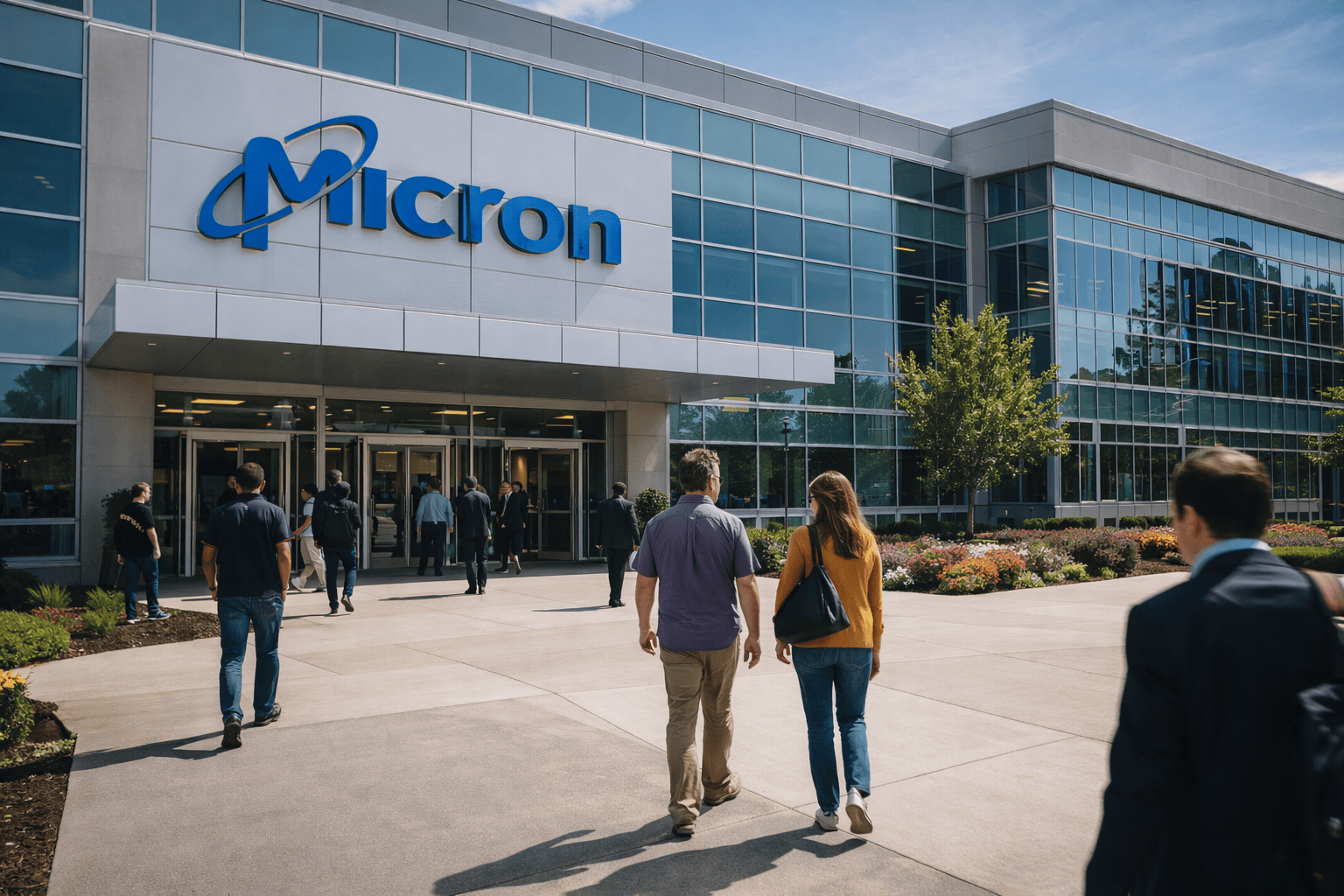
Micron Technology (NASDAQ:MU) has regained investor attention following South Korea's announcement of a massive semiconductor expansion led by Samsung Electronics and SK Hynix. The $518 billion plan, while not an immediate competitive threat, underscores the strategic importance of AI memory and raises questions about future supply dynamics.
Micron's Bull Case: AI Memory Scarcity Drives Demand
Micron recently reported strong quarterly results, driven by robust AI demand, high-bandwidth memory (HBM) shortages, and favorable pricing. The company has secured $22 billion in strategic customer commitments, including take-or-pay agreements, cash deposits, and pricing floors. These arrangements indicate that customers view memory as a critical component for AI infrastructure, not just a routine input.

Daniel Newman, CEO of Futurum Group, noted that the scale of AI buildout has been underestimated, and memory should continue to command premium pricing while supply remains constrained. This forms the core of Micron's bull case: AI demand is outpacing supply, and Micron is one of the few players capable of serving that market at scale.
Korea's Chip Blitz: A Supply Overhang?
South Korea's investment plan, tied to President Lee Jae Myung's industrial strategy, aims to cement the country's lead in AI memory. Samsung and SK Hynix are preparing to invest 800 trillion won ($518 billion) in new fabrication sites. For Samsung, this is partly a comeback strategy, as SK Hynix and Micron have moved faster in HBM, the high-margin chip category used alongside AI processors.
Analysts at KB Securities-Jefferies suggest that if Samsung successfully qualifies for next-generation HBM, the supplier structure could shift toward Samsung and SK Hynix due to Samsung's manufacturing capacity. SK Hynix, meanwhile, is defending its AI-memory crown built through Nvidia-linked HBM demand, with analysts noting that its customized AI memory has fundamentally changed industry economics.
Implications for Micron Stock
For Micron investors, Korea's chip blitz is not an immediate sell signal. New fabs will take years to build, and HBM qualification is difficult. Customers do not switch suppliers overnight, and AI demand continues to outpace supply, as evidenced by Micron's long-term commitments and pricing protections.
However, the risk lies in expectations. Micron's valuation has expanded on the belief that memory scarcity will persist longer than in past cycles. If Samsung and SK Hynix convince the market that a credible wave of new DRAM and HBM supply is coming after 2027, investors may begin discounting weaker pricing power before the capacity actually arrives.
Related reading: Retail Investors Shift from Broad Index Bets to Selective Trades Amid Market Rotation and AI Chip Boom Reshapes South Korea's Economy and Widens Wealth Gap.
This article is for informational purposes only and does not constitute financial advice.