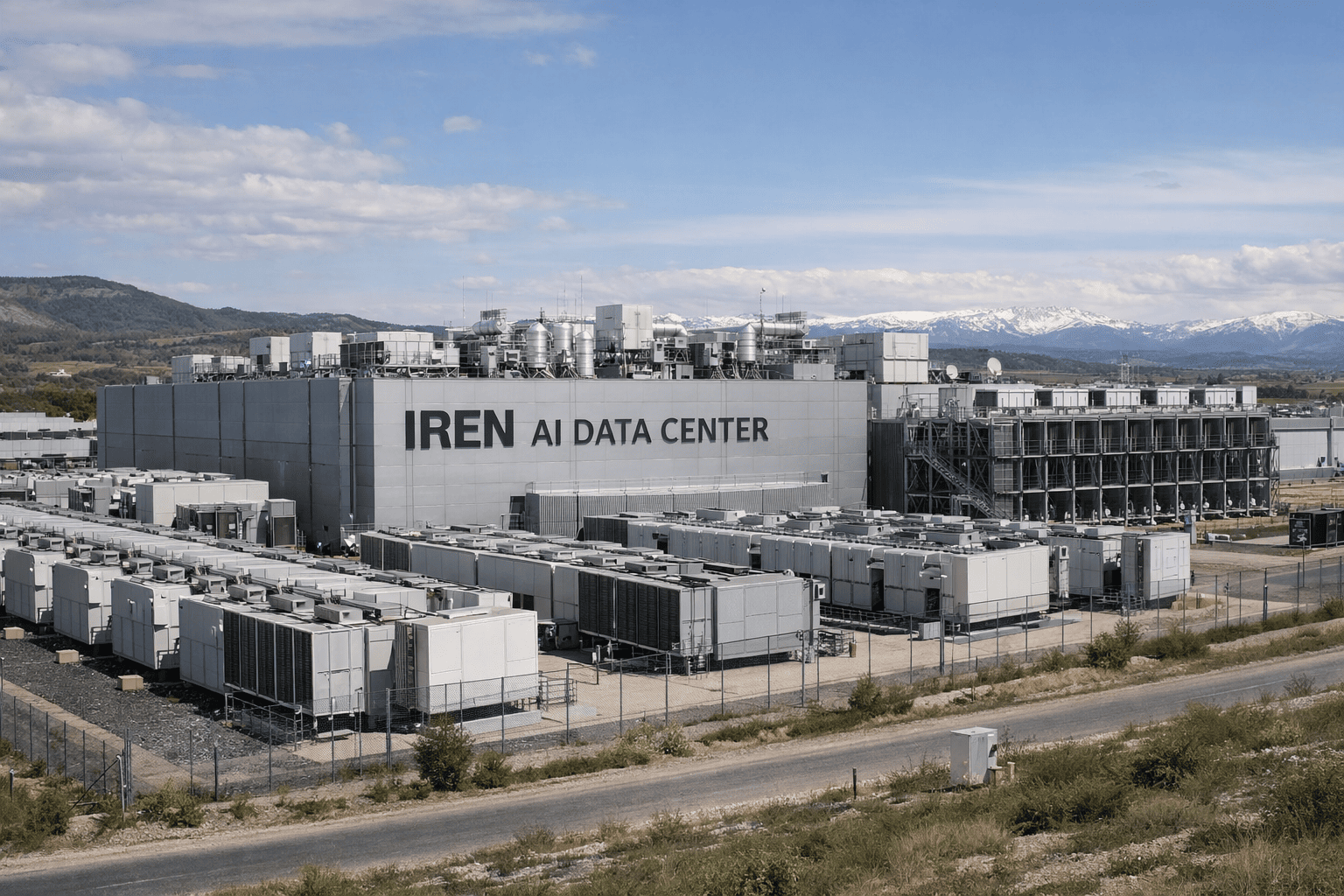
IREN (NASDAQ: IREN) has seen its share price slide significantly over the past few months, even as the company accelerates its transition from Bitcoin mining to AI cloud services. The stock traded around $38.70 on Wednesday, down from a September high of $49.60 and roughly 50% below its all-time peak.
The decline mirrors weakness in other neocloud operators such as CoreWeave and Nebius, as market participants grow increasingly cautious about the sustainability of AI infrastructure spending. Concerns have been amplified by recent warnings from prominent investors like Ray Dalio, who has suggested that the AI bubble could burst, citing elevated interest rates and the ten-year Treasury yield trading at multi-decade highs.

AI cloud revenue grows, but overall revenue dips
IREN's latest quarterly results showed a company in transition. Total revenue fell to $137.2 million from $144.8 million in the prior quarter, even as AI cloud service revenue jumped from $33 million to $70.5 million. The decline in total revenue reflects the ongoing reduction in Bitcoin mining operations, which still contribute a significant portion of the company's top line.
Despite the mixed financials, IREN has secured notable contracts, including a $9.7 billion agreement with Microsoft and deals with AI firms like Perplexity and Reflection AI. Management has indicated that demand for its data center capacity remains strong.
Depreciation and debt raise red flags
Investors are also focusing on the company's rising depreciation expenses. IREN's depreciation and amortization exceeded $112 million in the latest quarter, a substantial figure relative to its $137.2 million in revenue. The company assumes its GPUs have a useful life of over six years, but some analysts, including Michael Burry, argue that the actual lifespan is likely less than three years, given the rapid pace of new GPU releases from Nvidia.
Debt levels have also climbed sharply. IREN's total debt now stands at over $7.4 billion, up from approximately $965 million in June of the previous year. The company has been borrowing heavily to fund its expansion, and its outstanding share count has risen to 380 million from 331 million in January, raising concerns about further shareholder dilution.
Technical outlook remains bearish
From a technical perspective, IREN stock has broken below its 50-day and 100-day moving averages, indicating that sellers are in control. The price action has formed an ascending channel that is part of a bearish flag pattern, and the stock is now testing the lower boundary of that channel. The Relative Strength Index (RSI) and MACD indicators continue to trend downward, suggesting that further losses are possible.
The next key support level is seen at $28.74, the stock's lowest point in July. A break below that level could open the door to additional downside.
While IREN's AI cloud pivot has generated significant revenue growth, the market is clearly weighing the risks associated with high debt, aggressive depreciation assumptions, and the broader AI investment cycle. Investors will be watching closely to see whether the company can execute on its contracts and manage its balance sheet effectively.
This article is for informational purposes only and does not constitute financial advice.

