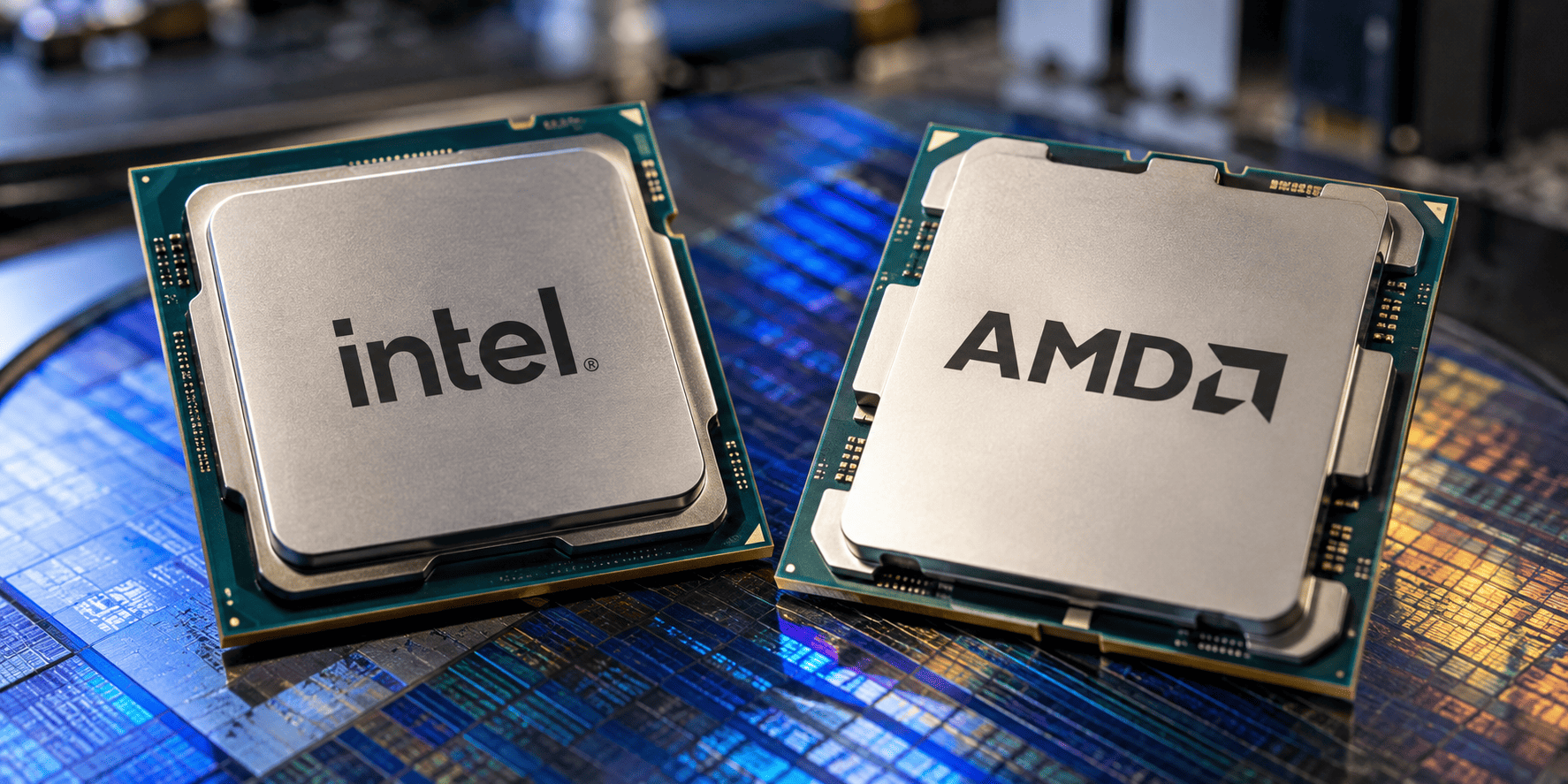
Shares of Intel and Advanced Micro Devices advanced on Thursday, diverging from a broadly flat market and a semiconductor sector that spent much of the session under pressure. The catalyst was renewed investor interest in the CPU demand outlook, tied to Meta Platforms' expanding Muse AI assistant.
The S&P 500 and Nasdaq Composite were little changed, slipping 0.03% and 0.02% respectively, as Treasury yields continued their climb. The 30-year Treasury yield reached 5.446%, its highest since June 2004, while the benchmark 10-year yield rose to 5.15%, near levels last seen in July 2007.

Meta shares gained more than 3.5% after several analysts raised price targets following the company's Meta Connect event.
Muse strengthens the CPU demand narrative
Meta's increasing emphasis on agentic AI has become an unexpected tailwind for Intel, AMD and Arm. Investors are evaluating whether increasingly autonomous AI systems will require more computing power from central processing units alongside graphics processors.
Intel shares have risen more than 13% over the last five trading sessions, while AMD crossed the $1 trillion market-capitalisation threshold for the first time on Monday and remains 14% higher over the same period.
The thesis holds that AI agents performing tasks independently could lift demand for general-purpose computing, potentially benefiting the server CPU market. Meta has previously stated that as its agentic AI efforts advance, "compute requirements are evolving to demand more CPU."
That could expand the addressable market for Intel, AMD and Arm, all of which have server CPU exposure. "The market has interpreted Muse as a boon for the already significantly bottlenecked CPU market," said Michael O'Rourke, chief market strategist at JonesTrading.
Meta pushes Muse across its hardware ecosystem
The thesis gained further support at Meta Connect on Wednesday, where the company outlined plans to make Muse a central component of its hardware lineup. Meta introduced Meta Charm, a small handheld device designed to give users direct access to Muse. The device is slated to ship during the December holiday period, though pricing was not disclosed.
The move reflects Meta's broader effort to make its AI assistant accessible through hardware it controls, reducing reliance on smartphone operating systems from Apple and Google. Users will be able to reach Muse directly through Charm rather than through AI applications running on their smartphones.
"It is actually quite clear personal superintelligence will not only come first; it will be much bigger and more important," CEO Mark Zuckerberg said at the conference. "So we have shifted our focus to building the best devices for personal superintelligence." He added that Muse would soon be available across Meta's smart glasses lineup.
Meta is also broadening Muse's capabilities through partnerships with Walmart, Best Buy, Sephora, Wayfair, Dick's Sporting Goods and Gap. Analysts at JPMorgan, Citizens, KeyBanc and others raised their targets on Meta.
Intel's valuation remains in focus
While Meta's announcements have reinforced the broader AI hardware narrative, Intel's valuation is drawing scrutiny after its sharp run. TD Cowen reiterated a Hold rating with a $115 price target, below the stock's current level. The firm used a sum-of-the-parts framework and said progress in Intel's foundry business remains important, though the Products division is still the most important driver of value.
TD Cowen noted that investors need greater visibility into a path toward more than $100 billion in Products revenue and more than $20 billion in Foundry revenue.
This article is for informational purposes only and does not constitute financial advice.

