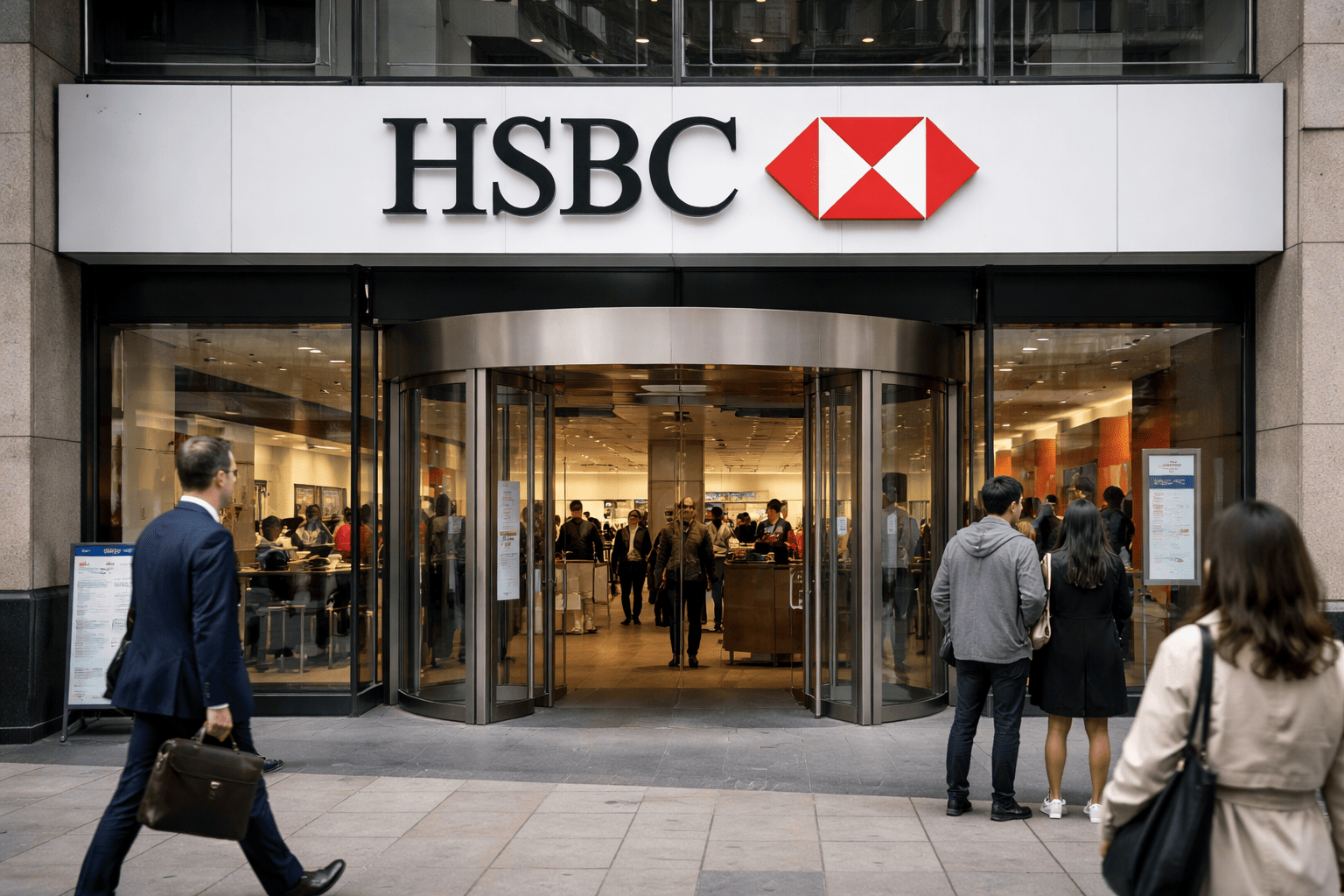
HSBC Holdings has seen its share price tumble over the past few months, with the stock now trading around 1,365p after peaking at 1,608p in August. The decline, which has erased billions in market value, mirrors a broader sell-off across European banks. As the lender prepares to release its third-quarter earnings, investors are weighing whether the recent weakness will persist or if a fresh $1 billion share repurchase can spark a rebound.
The bank's financial performance remains solid. Revenue climbed to $18.6 billion in the third quarter, up from $17.8 billion a year earlier. Pretax profit rose 32% to $9.6 billion, slightly below the $9.69 billion analysts had expected. The profit jump was aided by the absence of $1.4 billion in legal provisions recorded last year, along with lower legal fees and credit losses.
Net interest income increased 6%, while corporate and institutional banking fees continued to grow. The wealth management division also remained a key growth driver. Management expects banking net interest income to reach at least $46 billion this year and targets an average tangible equity of 17% or higher for 2026 through 2028.
CEO Georges Elhedery said in a statement: "Our performance shows that in a more complex world clients continue to turn to us to navigate uncertainty and seize new opportunities. It also reflects consistent execution of our strategic priorities with pace, precision, and discipline."
The newly announced $1 billion buyback is part of HSBC's ongoing capital return program, reducing outstanding shares in the UK and Hong Kong. Share repurchases typically boost earnings per share over time, which can support the stock price.
Beyond the buyback, HSBC benefits from several structural tailwinds. Interest rates in its key markets have remained stable, supporting interest income. The bank has also been cutting costs aggressively, including plans to eliminate about half of management and specialist roles in its UK wealth business, as reported by Reuters. Thousands of jobs have been shed in recent months.
Additionally, HSBC is positioning itself to capitalize on China's wealth management boom, a market where it has a significant presence.
From a technical perspective, the daily chart shows the stock has fallen below its August high but remains above an ascending trendline that has been in place since October last year. The price is also above the 200-day exponential moving average. However, the Average Directional Index (ADX) has risen to 31.52, its highest level since July, indicating that the downward trend is gaining momentum. The Relative Strength Index (RSI) is also declining, suggesting further downside risk.
If the selling pressure continues, the stock could test the psychological support at 1,200p. A bounce may follow as investors rotate back into European banks, but the immediate outlook remains cautious.
This article is for informational purposes only and does not constitute financial advice.