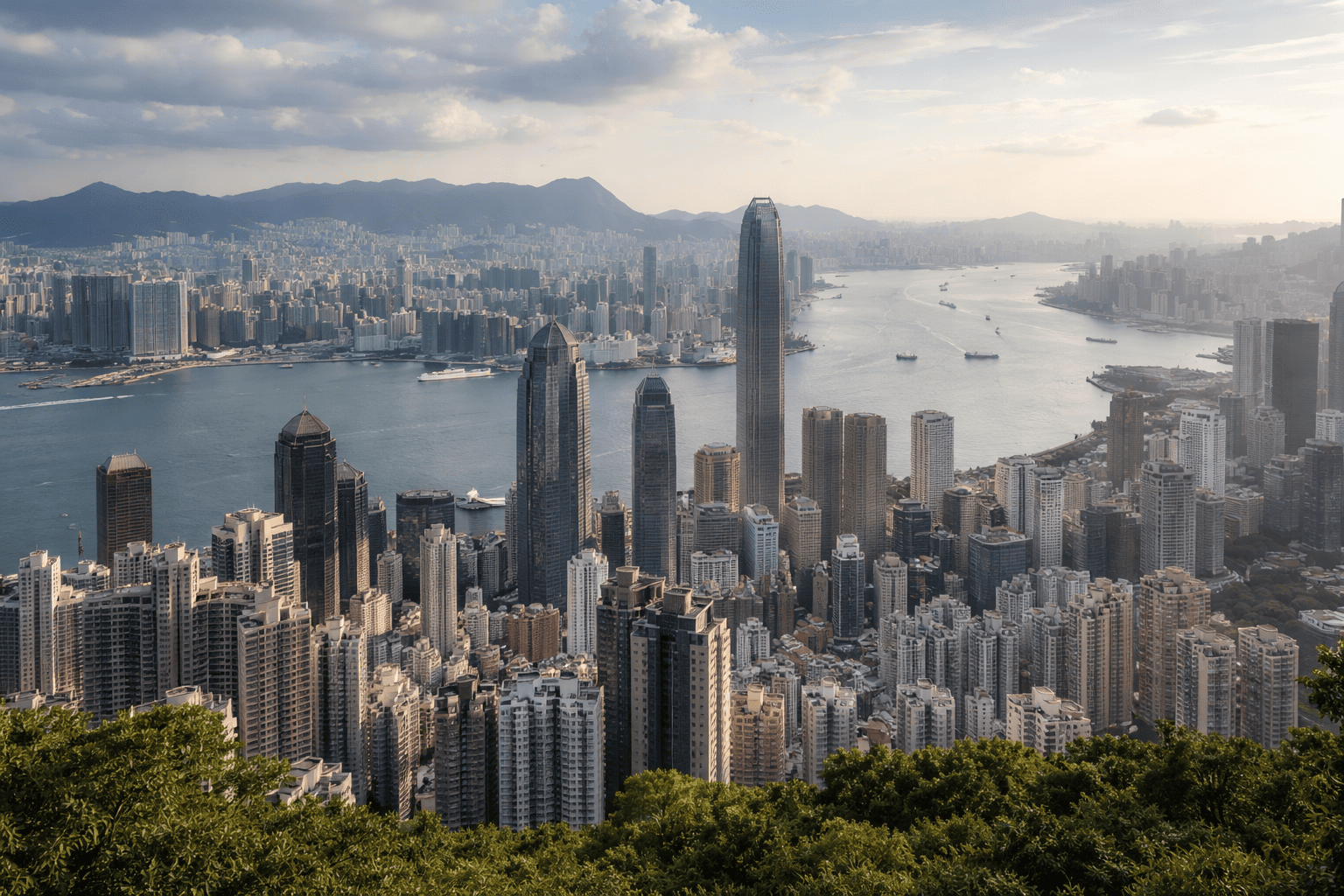
The Hang Seng Index (HSI) has flashed a death cross, a bearish technical signal, as it continues to diverge sharply from surging global peers. On June 22, the index fell to 23,445, its lowest level since June of the previous year and 16% below its all-time high. In contrast, South Korea's Kospi, Japan's Nikkei 225, and the U.S. Nasdaq 100 have all reached record highs, fueled by the artificial intelligence supercycle.
Technical Breakdown: Death Cross and Head-and-Shoulders
The HSI has exhibited multiple bearish patterns in recent months. A prominent head-and-shoulders formation has now broken below its neckline at 25,158, confirming the pattern. The distance from the head to the neckline is approximately 2,858 points, projecting a potential target of 22,300—still below current levels. Additionally, the index has just formed a death cross, where the 50-day moving average crossed below the 200-day moving average, a signal that often precedes further declines. The index remains below the Ichimoku cloud and Supertrend indicators, and the Average Directional Index (ADX) is rising, indicating a strengthening downtrend.
AI Supercycle Drives Divergence
The divergence is largely attributed to the AI boom. In South Korea, the Kospi's rally is led by SK Hynix and Samsung, while Japan's Nikkei 225 and Topix are propelled by Softbank, Kioxia, Furukawa Electric, and Taiyo Yuden. Kioxia has surged over 850% year-to-date and more than 5,000% over the past 12 months. In the U.S., companies like Micron, Sandisk, and Western Digital are also benefiting as AI suppliers. These firms are capitalizing on soaring demand for memory chips and other AI infrastructure components.
Conversely, the Hang Seng Index's major AI-related constituents are primarily on the demand side, including Alibaba, Tencent, Xiaomi, and Kuaishou Technology. These companies face rising costs for semiconductors and other inputs as they ramp up AI spending. For instance, Alibaba's profits plummeted over 80% last quarter, while Xiaomi has been squeezed by higher memory prices. Lenovo, a server and storage solutions provider, has been the HSI's best performer, gaining 153% this year, but it has not been enough to offset broader weakness.
Broader Weakness in Chinese Equities
The HSI's decline is also driven by slumps in other key sectors. Electric vehicle makers like BYD and Li Auto have fallen 30% and 23%, respectively, after China scaled back industry subsidies. This retreat underscores the challenges facing Chinese markets amid a global AI-driven rally. For context, the IBM Shares Surge 5% Premarket After JPMorgan Upgrade on AI and Software Momentum highlights how AI is lifting stocks elsewhere, while the Caterpillar Hits $1,000 as AI Power Demand Drives 70% Gain; GE Vernova and Bloom Energy Surge shows the breadth of AI-related gains.
Outlook
With the HSI's technical indicators pointing to further downside and the fundamental gap in AI exposure widening, the index may continue to underperform. Investors are watching for any policy shifts or earnings catalysts that could reverse the trend, but for now, the divergence between the HSI and its global peers remains stark. The SMCI Surges 70% from YTD Low After Unveiling DCBBS Blueprint for Nvidia Vera Rubin at ISC 2026 further illustrates the AI momentum outside China.
This article is for informational purposes only and does not constitute financial advice.