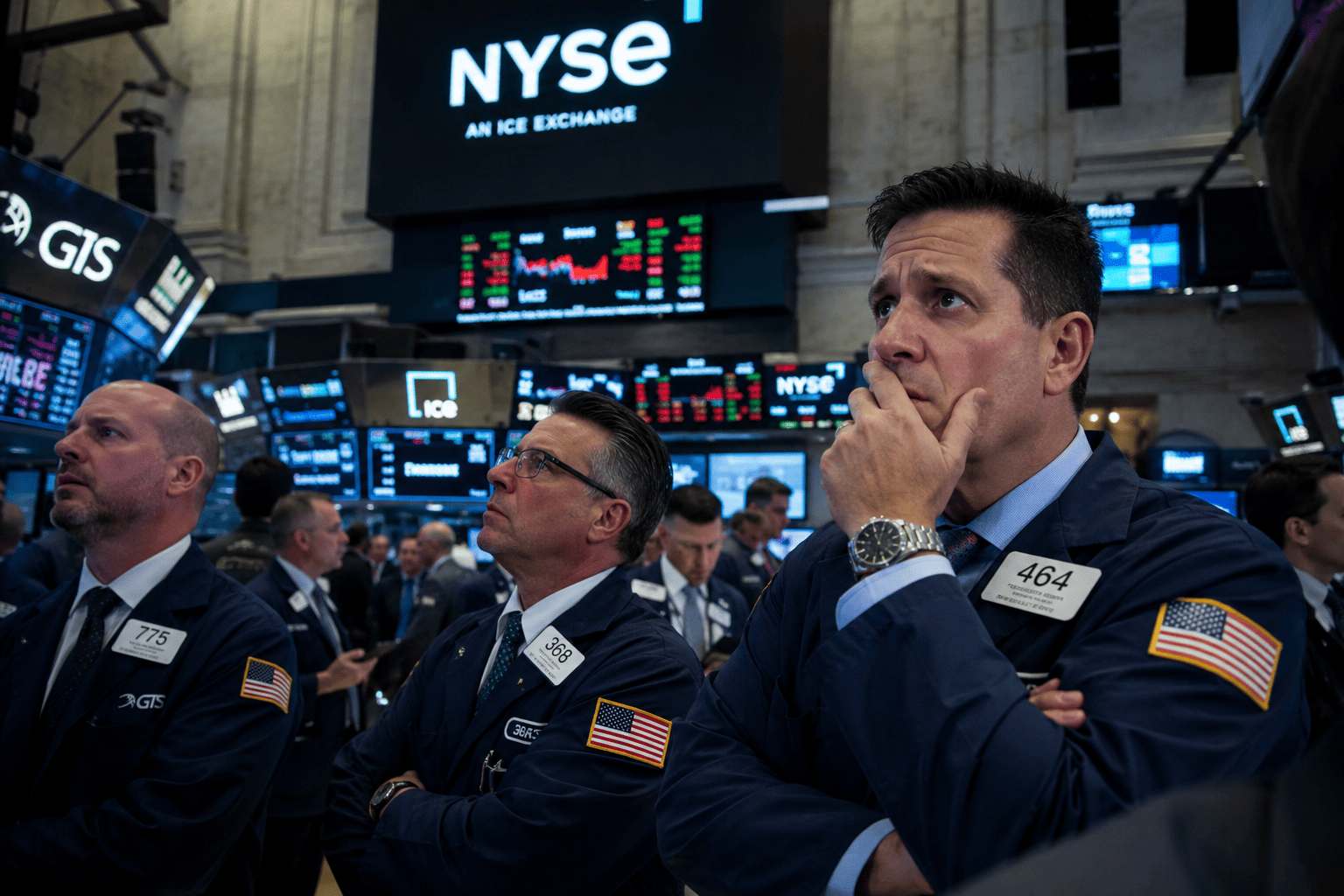
US equities opened lower on Thursday, extending a week dominated by a historic bond market selloff. The 30-year Treasury yield touched 5.44%, its highest level since July 2004, while the 10-year yield reached 5.098%, a level not seen since before the 2008 financial crisis. The surge in long-term borrowing costs weighed heavily on stock valuations, with the Dow Jones Industrial Average dropping 179.66 points, or 0.35%, to 51,331.93 shortly after the opening bell.
The broader market followed suit: the S&P 500 fell 0.48% to 7,669.46, and the Nasdaq Composite declined 0.74% to 26,737.60. The small-cap Russell 2000 slipped 0.21%, while the CBOE Volatility Index jumped 4.55% to 15.87, signaling growing investor unease. The moves came as every point on the Treasury curve except the two-year now trades above 5%, a threshold last seen broadly during the 2007-08 crisis.

Bond market takes center stage
The bond market's dramatic repricing was fueled by stronger-than-expected economic data. S&P Global's flash PMI showed manufacturing at 57.0 against a forecast of 53.6, and services at 58.7 versus an expected 55.8, both indicating the fastest pace of expansion in more than five years. This resilience in the economy has led investors to price in a more prolonged period of high interest rates, pushing yields to multi-decade highs.
A Treasury buyback of up to $6 billion in 20- and 30-year bonds, announced Wednesday, failed to slow the move. The reversal caps a dramatic 40-year arc for bond markets. After Federal Reserve Chair Paul Volcker pushed the 30-year Treasury yield above 15% in the early 1980s to break inflation, yields spent four decades in decline, creating a tailwind that shaped entire investment strategies. That trend reversed in 2022, the worst year for Treasuries in six decades, and has now accelerated to levels unseen in more than 20 years.
Equities under pressure
Rising yields are pressuring equities directly, since higher borrowing costs weigh on company valuations and consumer spending alike. Chip stocks were among the hardest hit, with Micron falling 2.18% to $1,048.51 ahead of its fiscal fourth-quarter earnings report due September 30. Nvidia slipped 1.23% to $222.74, and SanDisk dropped 2.30% to $1,774.73, both consolidating after a strong recent run.
Meta Platforms rose 1.34% to $754.11, continuing to outperform as investors awaited the second day of its Meta Connect developer conference. Apple slipped 0.50% to $335.34, Amazon fell 1.31% to $246.00, and Alphabet dipped 0.34% to $336.70.
Oil and gold diverge
Crude oil moved sharply higher even as bond yields spiked, an unusual combination. WTI crude rose 2.08% to $94.08, and Brent climbed 2.23% to $105.38, as the market continued digesting supply-side developments in the Middle East. In contrast, gold fell 0.16% to $4,311.47, and silver dropped 1.70%, pressured by the same rising-yield dynamic hitting equities, since higher yields increase the opportunity cost of holding non-yielding assets.
Thursday's session underscores how completely the bond market has taken over as the market's central story this week, overshadowing individual earnings and stock-specific catalysts. With yields at multi-year highs, investors are likely to remain focused on the trajectory of interest rates and its implications for corporate profitability and economic growth.
This article is for informational purposes only and does not constitute financial advice.

