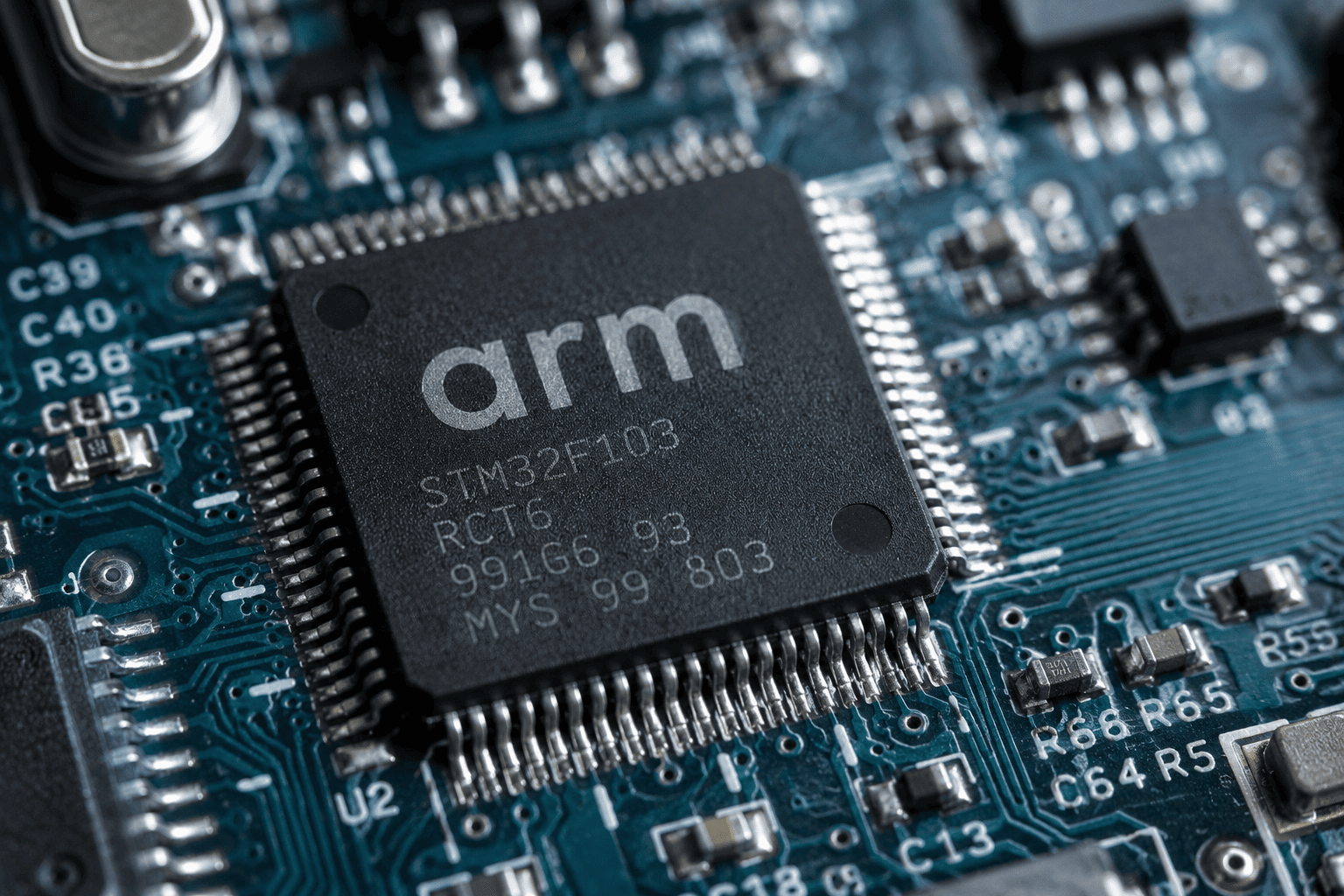
Arm Holdings (ARM) shares continued their downward trajectory on Wednesday, falling 4.7% to $349.03, extending a week-to-date decline of approximately 19%. The selloff comes amid a broader reassessment of valuations across high-flying artificial intelligence names, even as Wall Street analysts maintain a bullish long-term outlook on the chip designer.
Despite the recent weakness, Arm remains one of the semiconductor sector's strongest performers, with a 227% gain year-to-date and a 127% increase over the past 12 months, according to Dow Jones Market Data. The stock's decline this week reflects investor rotation out of AI-related equities, but analysts at UBS and TD Cowen see significant upside driven by the company's evolving role in AI infrastructure.

Analysts Raise Price Targets on CPU and Agentic AI Optimism
UBS raised its price target on Arm to $470 from $260, maintaining a Buy rating. The new target implies roughly 33% upside from Wednesday's trading levels. Analyst Timothy Arcuri noted that investor focus is increasingly on the revenue potential of Arm's internally developed central processing units (CPUs).
“The real investor debate, in our view, is revenue potential for Arm’s standalone CPU,” Arcuri wrote. The UBS team projects Arm's internal CPU revenue could reach around $14 billion by 2030, though the company has indicated its internal chip business will not become financially material until fiscal 2028.
TD Cowen also raised its price target to $475 from $265, reiterating a Buy rating and implying roughly 35% upside. The brokerage highlighted the shifting nature of AI workloads, stating, “The Doing Behind The Thinking: As agentic AI shifts more work from the thinking GPUs do to the doing CPUs handle, CPUs are becoming an AI beneficiary.” TD Cowen views Arm's target of $15 billion in annualized AGI CPU revenue by fiscal 2031 as reasonable, with GPU-to-CPU attachment rates and pricing per core as key factors.
Internal Chip Ambitions Reshape Investment Case
Traditionally, Arm generates revenue by licensing its instruction-set architecture and collecting royalties from customers such as Apple, Nvidia, Samsung, and Qualcomm. The company's architecture serves as the primary alternative to the x86 architecture used by Intel and Advanced Micro Devices. However, Arm is increasingly moving beyond intellectual property licensing into full-scale chip production, creating a new investment debate around the size of its future semiconductor business.
TD Cowen suggested the market may be applying a 15% share estimate too mechanically to Nvidia's estimated $200 billion CPU total addressable market, while maintaining a more constructive view on Arm's intellectual property opportunities. Bank of America also raised its target on Arm earlier this week to $460 from $335, reiterating a Neutral rating. Analyst Vivek Arya wrote, “We see Arm as one of the most prominent beneficiaries of the rising server CPU tide,” but added that Arm at $420 is “fairly valued.”
The broader market context includes a rotation out of high-flying AI names as investors reassess valuations. For related coverage, see Evening Digest: Oil Jumps on Hormuz Toll Plan; SpaceX Slides 4% and SK Hynix Seoul Shares Tumble 10% After Record $26.5B Nasdaq Debut.
Arm's core competency in latency and efficiency aligns well with hyperscaler needs, according to UBS. As agentic AI drives demand for CPUs, Arm's internal chip ambitions could unlock substantial revenue streams, though investors remain cautious on near-term valuation.
This article is for informational purposes only and does not constitute financial advice.