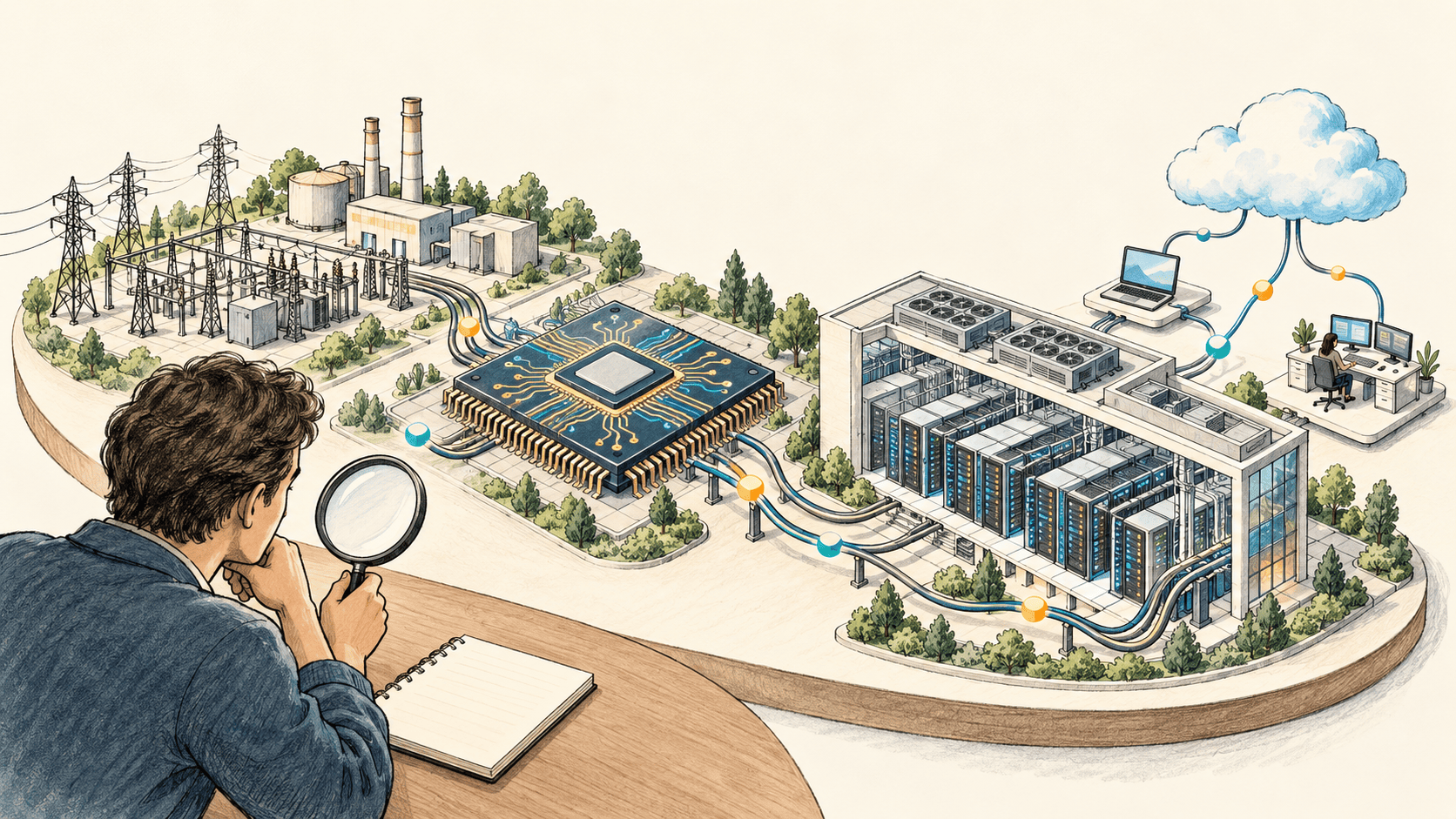
When a cloud provider announces increased AI spending, it often triggers interest in chipmakers, electrical suppliers, and data center operators. However, the same announcement means different things for each: one receives equipment orders, another funds construction, and another must attract paying customers. Understanding how demand becomes orders, revenue, and cash is crucial when researching AI investments in 2026.
Follow the money through an AI project
A cloud provider may purchase equipment, secure data center capacity, and fund electrical systems. Customers must then use and pay for services. Procurement, construction, and contracts can overlap, with different revenue-recognition timelines. These illustrate business models, not a ranked list of stocks to buy.

1. NVIDIA and Microsoft: selling AI equipment and earning from AI services
NVIDIA’s data center platform includes GPUs, networking, and supporting hardware and software. Microsoft purchases and develops infrastructure while delivering Azure and software services. One company’s capital spending can become another’s revenue. Equipment purchases create opportunities for suppliers, but for the buyer, that spending needs to earn a return. If servers become operational before paying usage develops sufficiently, suppliers and service providers may experience different business conditions. Cheaper AI services do not automatically mean higher profits; lower prices may encourage adoption, but revenue grows only if additional activity offsets the price reduction. Profit also depends on delivery costs. Valuation adds another variable: a growing company’s stock can fall if results disappoint expectations already reflected in its price.
2. Eaton and GE Vernova: why power demand affects businesses differently
Lists of AI energy stocks often combine electricity generators and equipment suppliers. Eaton provides power distribution, protection, and management systems. GE Vernova operates across generation, electrification, and related businesses; AI is only one influence on its operations. Selling electricity differs from selling electrical equipment. Electricity producers consider power prices, generation costs, and supply contracts. Equipment suppliers face orders, manufacturing constraints, delivery schedules, and production costs. Higher electricity consumption does not establish proportionate profit growth. Demand must become purchases, equipment must be delivered, and costs controlled. After orders arrive, execution matters: a growing backlog can coexist with substantial spending on capacity, materials, and staff. Backlog, revenue, profit, and cash collection describe different stages.
3. Equinix and Digital Realty: when does signed demand become revenue?
Data center value extends beyond floor space to power, connectivity, location, and delivery timing. Equinix provides colocation and interconnection; Digital Realty offers capacity, colocation, and related services. Their businesses overlap, although connections and capacity delivery provide useful perspectives. Connections can be part of what customers pay for, and access to cloud platforms, networks, and partners can influence customer decisions. Growth can therefore come from connections and service usage alongside additional buildings. Planned, contracted, delivered, and billing are different stages. A signed agreement may precede completed construction or power availability. Meanwhile, land, equipment, and financing expenses accumulate. Contracts improve visibility, but operators still need to deliver capacity on time and at a sustainable cost.
Three scenarios that explain why AI stocks can diverge
These are analytical scenarios, not price forecasts. Owning several AI businesses may still leave exposure to the same large customers’ spending decisions.
Can AI ETFs simplify the choice?
AI ETFs can reduce individual stock selection work, but exposure depends on holdings rather than names. Narrow funds may concentrate risk, and multiple funds can overlap. Examine leading positions, business models, fees, and duplication with existing holdings. ETFs simplify portfolio ownership without removing valuation or industry risks.
Participating in AI infrastructure through 51AIpower
51AIpower’s Power Plans support electricity and GPU computing for AI factories without users managing equipment. After registering, users can explore activation and reward records through the Starter Plan. Under platform-supplied rules, new users receive up to 200 free Starter Plan purchases, limited to one per day. Rewards are credited to accounts; withdrawals remain subject to applicable conditions. Review paid-plan duration, reward calculations, financial restrictions, and withdrawal requirements. Participation does not establish ownership of listed shares or a specific GPU. Trial results do not guarantee paid-plan performance. Inclusion of the listed companies does not imply a partnership with or endorsement of 51AIpower.
How to start researching an AI investment in 2026
Explain whom the business serves and how it earns revenue. Examine stock valuations, fund holdings, or participation-plan rights. Consider what could undermine the case: slower spending, delays, higher costs, or competitive pressure. Track whether demand is translating into orders, revenue, and cash flow. The AI investment landscape in 2026 rewards investors who look beyond headlines and understand the specific mechanics of each business model.
This article is for informational purposes only and does not constitute financial advice.

