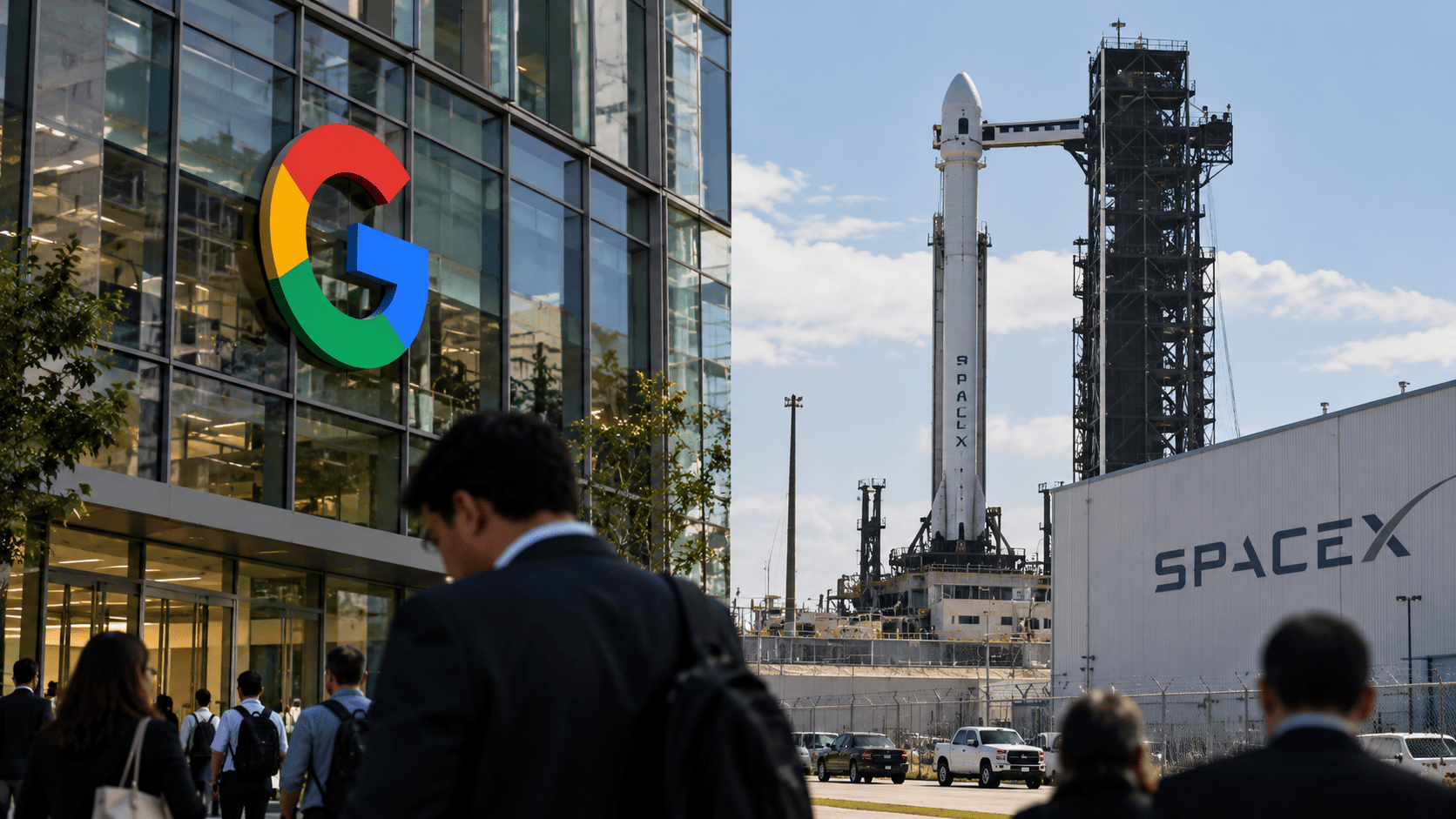
Alphabet's third-quarter earnings took a significant hit from its investment in Elon Musk's SpaceX, with an estimated $11 billion unrealized loss dragging net income down 25% year over year to $26.17 billion. The paper loss, stemming from a decline in SpaceX's share price, overshadowed otherwise strong operational performance, including a doubling of Google Cloud revenue and a 30% jump in operating profit.
SpaceX stake triggers accounting loss
Alphabet holds approximately 550 million shares in SpaceX, making it a major non-core investment. During the September quarter, the value of those shares fell from roughly $171 to $151 each, translating into an estimated $11 billion pre-tax reduction. This adjustment is an accounting requirement, not a cash outflow or a sale of shares, but it still weighed heavily on the bottom line.
Chief Financial Officer Anat Ashkenazi explained on the earnings call that "other income and expenses were negative $8.2 billion due primarily to unrealized loss from our investment in SpaceX." Alphabet also recorded an $8.66 billion net loss on equity securities across its portfolio, contributing to a total other-expense figure of $8.22 billion.
Core businesses grew despite profit decline
Revenue for the quarter rose 25% to $127.6 billion, while operating income climbed 30% to $40.6 billion. Google Cloud was the standout performer, with sales surging 103% to $30.7 billion, driven by demand for AI infrastructure. However, net income fell from $34.98 billion to $26.17 billion, with the equity-securities loss reducing after-tax earnings by about $6.7 billion, or $0.55 per diluted share.
Analysts were quick to characterize the SpaceX-related hit as "accounting noise," noting that fluctuations in investment value do not reflect customer demand for Google's products. Yet the earnings miss was not solely due to SpaceX. Advertising revenue came in below forecasts, and search growth slowed as Alphabet shifts toward AI-powered results, where monetization is still developing.
AI spending raises longer-term concerns
Alphabet's capital expenditures reached $51.4 billion in the quarter, more than double the $24 billion spent a year earlier. This pushed free cash flow to negative $9.07 billion, compared with negative $5.9 billion in the prior quarter. Management guided 2026 capital expenditure to $195 billion to $205 billion and indicated spending will rise significantly next year, though no 2027 figure was provided.
Investors are increasingly worried about the sustainability of such heavy AI investment. As one analyst noted, "A $300-billion (capex) number could potentially scare the market because free cash flow now is finally negative." The combination of a profit miss and escalating spending has put pressure on Alphabet's stock.
The contrast between robust operational growth and a disappointing bottom line leaves investors weighing an unusual accounting setback against the mounting costs of Alphabet's AI expansion. While the SpaceX loss is a one-time paper adjustment, the trajectory of AI spending poses a more lasting challenge to the company's financial profile.
This article is for informational purposes only and does not constitute financial advice.