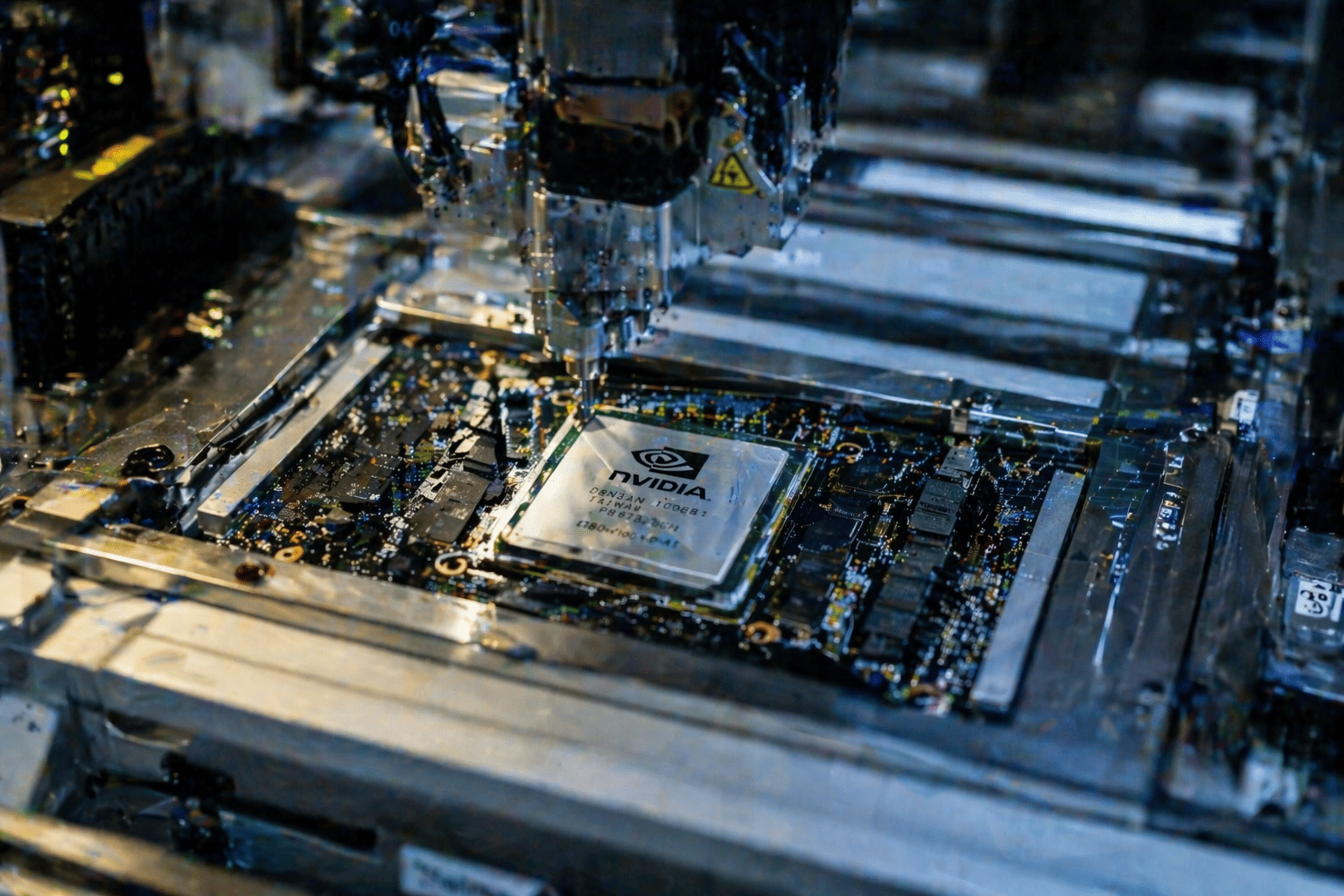
Nvidia enters the second half of 2026 under pressure to reassert its market leadership after a sluggish first half. While the company remains the world's most valuable listed firm with a $4.72 trillion market capitalization, its stock has gained only 3% year-to-date, trailing many semiconductor peers. Apple, with a $4.53 trillion valuation and a 13% gain in 2026, is narrowing the gap.
Market Cap Streak at Risk
Nvidia has held the top spot by market cap for 258 consecutive days, reclaiming it from Microsoft in late June 2025. However, this streak is far shorter than Apple's record 1,344-day run from 2013 to 2018. The narrowing valuation gap underscores investor rotation within the AI supply chain.
Vera Rubin and Consumer Expansion
Nvidia's core business remains strong. The company expects volume shipments of its next-generation Vera Rubin AI processors in H2 2026, maintaining its annual upgrade cadence. It has also announced a processor for the consumer PC market, signaling a push beyond data centers. Longer-term, robotics represents a potential growth avenue, though faster commercial adoption would help reassure investors about the AI cycle's longevity.
On the manufacturing side, Nvidia has avoided major disruptions, securing long-term agreements for memory chips and investing in key suppliers. CEO Jensen Huang has balanced U.S. investment demands with maintaining manufacturing capacity at Taiwan Semiconductor Manufacturing Co.
Shareholder Returns and Software Moat
Nvidia is increasingly mirroring Apple's capital return strategy. The company plans to return roughly 50% of free cash flow through dividends and buybacks this year, with management signaling potential increases. This reflects confidence in cash generation and rewards long-term shareholders.
Beyond hardware, Nvidia's CUDA software platform remains a competitive advantage in AI training. The next challenge is proving CUDA's effectiveness in AI inference, where rivals like Cerebras Systems claim faster performance. Meanwhile, major customers Alphabet and Amazon are developing custom AI chips for external customers while continuing to buy Nvidia processors for their own infrastructure, creating a complex competitive dynamic.
Consumer Ecosystem as a Growth Driver
To replicate Apple's durability, Nvidia may need to extend its ecosystem beyond enterprise AI. Expansion into consumer PCs and robotics could build a more integrated hardware-software ecosystem, fostering customer loyalty and opening new revenue streams beyond data centers.
Near-Term Stock Pressure and Sector Rotation
Nvidia shares extended recent weakness on Thursday, briefly trading above $200 before reversing. The VanEck Semiconductor ETF surged over 70% in H1 2026, its best first-half performance since 2000, but profit-taking has followed. Investor interest has rotated to memory chip makers like Micron, benefiting from supply constraints, and CPU specialists like AMD and Intel, as next-generation agentic AI systems are expected to demand more computing resources.
Despite Nvidia's modest 3% gain, some investors believe the stock could deliver a stronger H2 if AI spending accelerates into 2027. For now, the company must navigate a more competitive investment landscape while defending its technological lead.
This article is for informational purposes only and does not constitute financial advice.