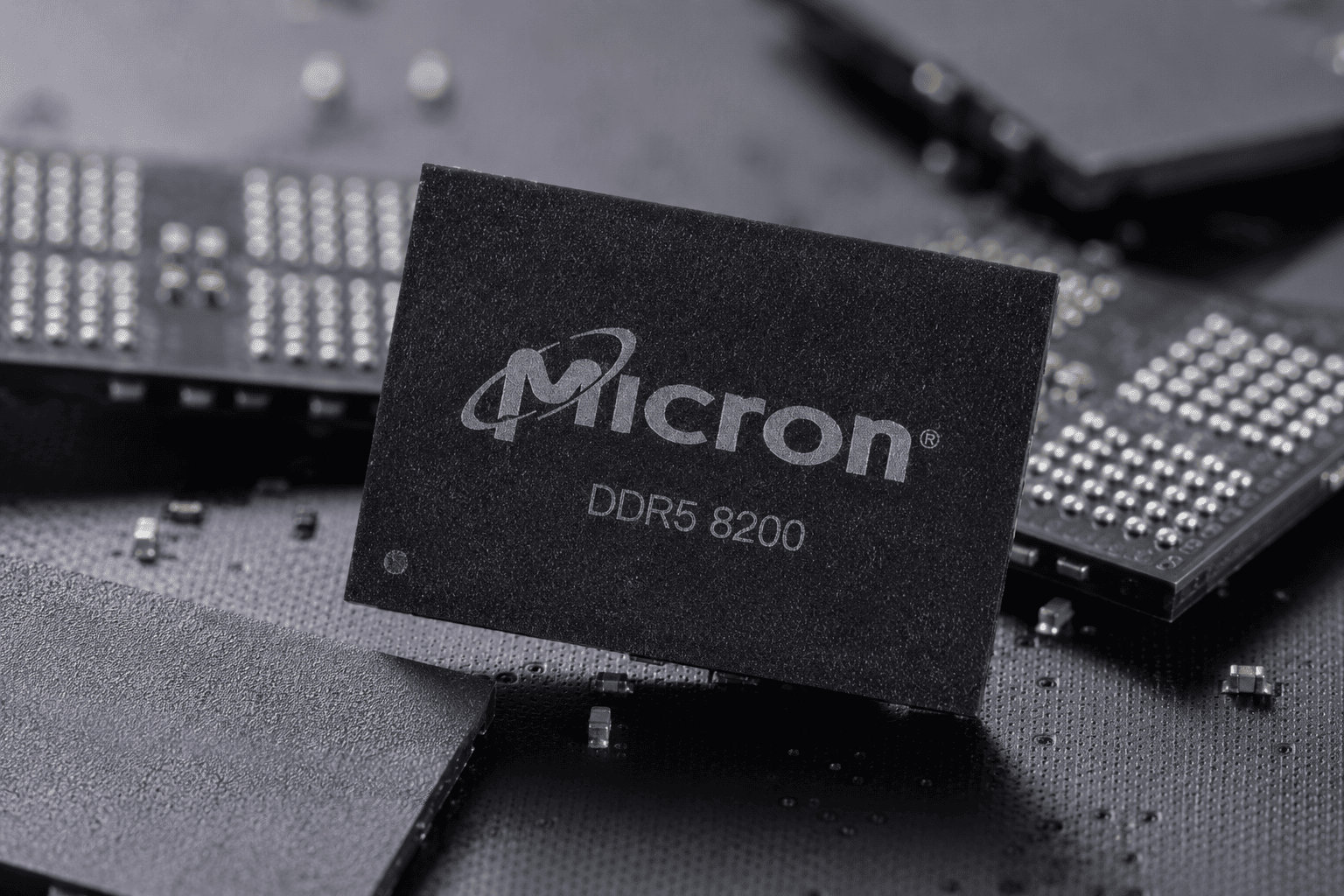
Micron Technology (MU) shares declined 5.5% on Thursday, reversing the prior session's 2% gain, as investors reassessed the durability of artificial intelligence-related capital expenditures. The selloff extended across the memory chip sector, with SK Hynix's U.S.-listed shares falling 6%, while SanDisk and Western Digital dropped more than 8% and 7%, respectively.
The market reaction came despite Nvidia CEO Jensen Huang's comments that memory demand is unlikely to ease by 2029. "One of the things that's really great about memory is that you can always use more of it," Huang told CNBC, underscoring the critical role of memory chips in AI infrastructure, which requires increasing memory capacity and bandwidth.

D.A. Davidson managing director and technology research head Gil Luria reiterated a Buy rating and a $3,000 price target for Micron, implying the stock could more than triple from its Wednesday close near $914. In a note, Luria highlighted Micron's leadership in memory technology, stating, "We see Micron as having a leadership position in memory technology, with far wider moats than are implied by the current valuation." He added that "memory is integral to the AI product," and that greater memory content and bandwidth could enable AI systems to operate at higher levels.
The analyst also pointed to Micron's strong positioning across three key memory technologies: DRAM, NAND, and high-bandwidth memory (HBM). However, uncertainty about the sustainability of AI spending continues to weigh on semiconductor stocks, as evidenced by Thursday's broad decline.
Separately, Micron announced on Thursday that it will introduce quarterly employee payments linked to company performance starting in fiscal 2027. The new scheme will supplement the existing annual incentive program and apply to all employees globally. The quarterly bonus pool will be calculated using profit after tax minus projected capital spending for the following quarter, with fiscal 2026 serving as the baseline. Half of the payment will be made in cash after results, while the remainder will be distributed in shares that vest after one year.
Micron did not disclose a fixed percentage of earnings allocated to employees or the total amount reserved for the program. The announcement followed an agreement reached on Wednesday with a union at its larger Taichung operations in Taiwan. Talks with a separate union in Taoyuan remained ongoing on Thursday, with that union calling for a transparent arrangement allocating 15% of Micron's operating profit to employees worldwide, arguing that workers should receive a greater share of gains from AI demand.
In response, Micron said it would continue discussions with the Taoyuan union while increasing the maximum payment available under its annual incentive plan. For Taiwan employees, the company will raise employer retirement contributions to 10% from 8%, provide three additional paid days off, increase shift allowances, and make structural salary adjustments. Starting December 1, 2026, the monthly allowance for day-shift workers will increase to NT$4,500 (approximately $138) from NT$1,500 (about $46).
Micron said these Taiwan-specific changes are intended to strengthen its competitiveness in the local market. The company's approach differs from South Korean rivals Samsung Electronics and SK Hynix. SK Hynix has agreed to allocate 10% of annual operating profit to an employee bonus pool, while Samsung agreed to reserve 10.5% of its semiconductor division's operating profit for special bonuses, subject to profitability targets.
Micron's quarterly payments will be affected by capital spending, potentially limiting bonuses while the company invests in expanding production capacity. This factor adds another layer of complexity to the company's compensation strategy as it navigates the cyclical memory market and the demands of the AI era.
This article is for informational purposes only and does not constitute financial advice.