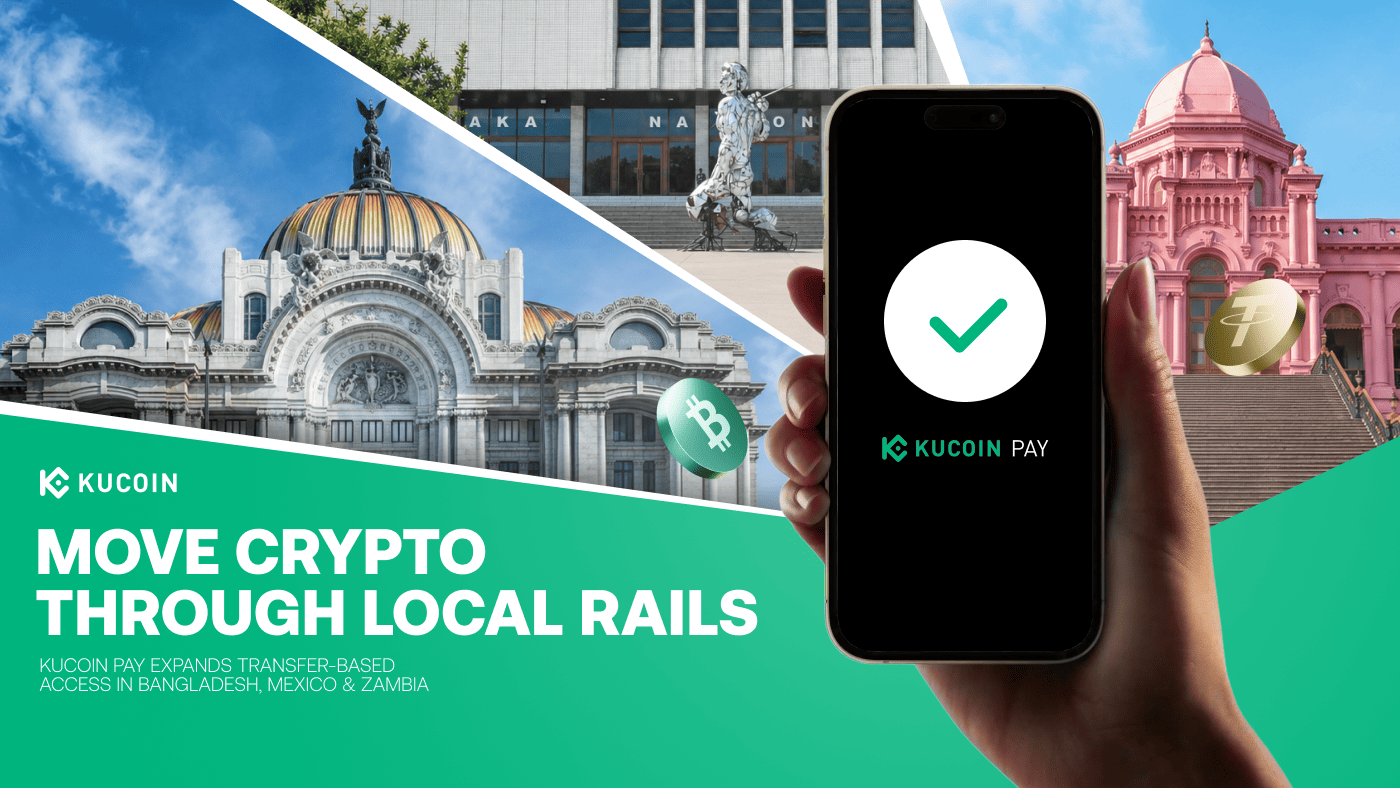
KuCoin Pay, the cryptocurrency payment arm of the KuCoin exchange, has broadened its transfer-based payment capabilities to include Bangladesh, Mexico, and Zambia. This strategic expansion aims to bridge digital assets with widely used local financial infrastructures in emerging markets, facilitating more practical applications of cryptocurrencies.
Integration with Local Payment Systems
The platform now connects cryptocurrencies and stablecoins with established banking and mobile money networks in these three countries. In Bangladesh, users can transact via bKash and Nagad mobile payment platforms. Mexico sees integration with SPEI-compatible bank transfer routes, while Zambia benefits from mobile money services provided by MTN Group and Airtel Africa.

This move underscores the growing reliance on local bank transfers and mobile money in emerging economies, where these systems are increasingly used for salary payments, remittances, merchant transactions, and peer-to-peer transfers. By linking digital assets to these familiar rails, KuCoin Pay aims to reduce the complexity often associated with moving cryptocurrencies into everyday financial activity.
Simplifying Crypto Transactions
KuCoin Pay's technology supports localized payment routing through deep integration with local banking and payment systems. Instead of requiring users to navigate complex backend processes, the platform identifies appropriate payment routes via a unified technical interface. This approach allows digital asset transactions to function more like traditional e-wallets, mobile money services, or local bank transfer tools.
According to the company, this integration makes digital assets more practical for real-world use cases while reducing friction and simplifying the transfer process. The expansion reflects a broader industry trend toward integrating digital assets with existing financial infrastructure, particularly in high-growth markets where mobile money and local transfer networks play a central role in commerce and financial inclusion.
Focus on Real-World Utility
KuCoin executives emphasized that payments are a key pathway for digital assets to gain broader utility in the real economy. Alicia Kao, Managing Director of KuCoin, stated, “Crypto is emerging as a new asset class with growing relevance in the real economy, and payments are one of the most important ways for this value to reach users. Through KuCoin Pay, we are building trusted and localized connections between digital assets and existing banking, mobile money and transfer rails.”
Kao added that the initiative aims to help digital assets move beyond holding and trading into practical financial activity, supporting more inclusive and future-ready financial ecosystems in high-growth markets. The company plans to continue expanding compatibility with local banking and payment systems in additional markets, improve technical response speeds, and broaden practical cryptocurrency payment applications globally.
This development aligns with ongoing efforts by other crypto firms to enhance real-world utility. For instance, WhiteBIT EU Obtains MiCA License from Austrian FMA, Expanding Regulated Crypto Services Across EEA and BDIC Expands MGA Network, Targets Institutional Crypto Insurance Growth highlight the industry's push for broader adoption and regulatory compliance.
As digital assets continue to integrate with traditional financial systems, the expansion of KuCoin Pay into these emerging markets signals a growing emphasis on practical, everyday use cases for cryptocurrencies beyond speculative trading.
This article is for informational purposes only and does not constitute financial advice.