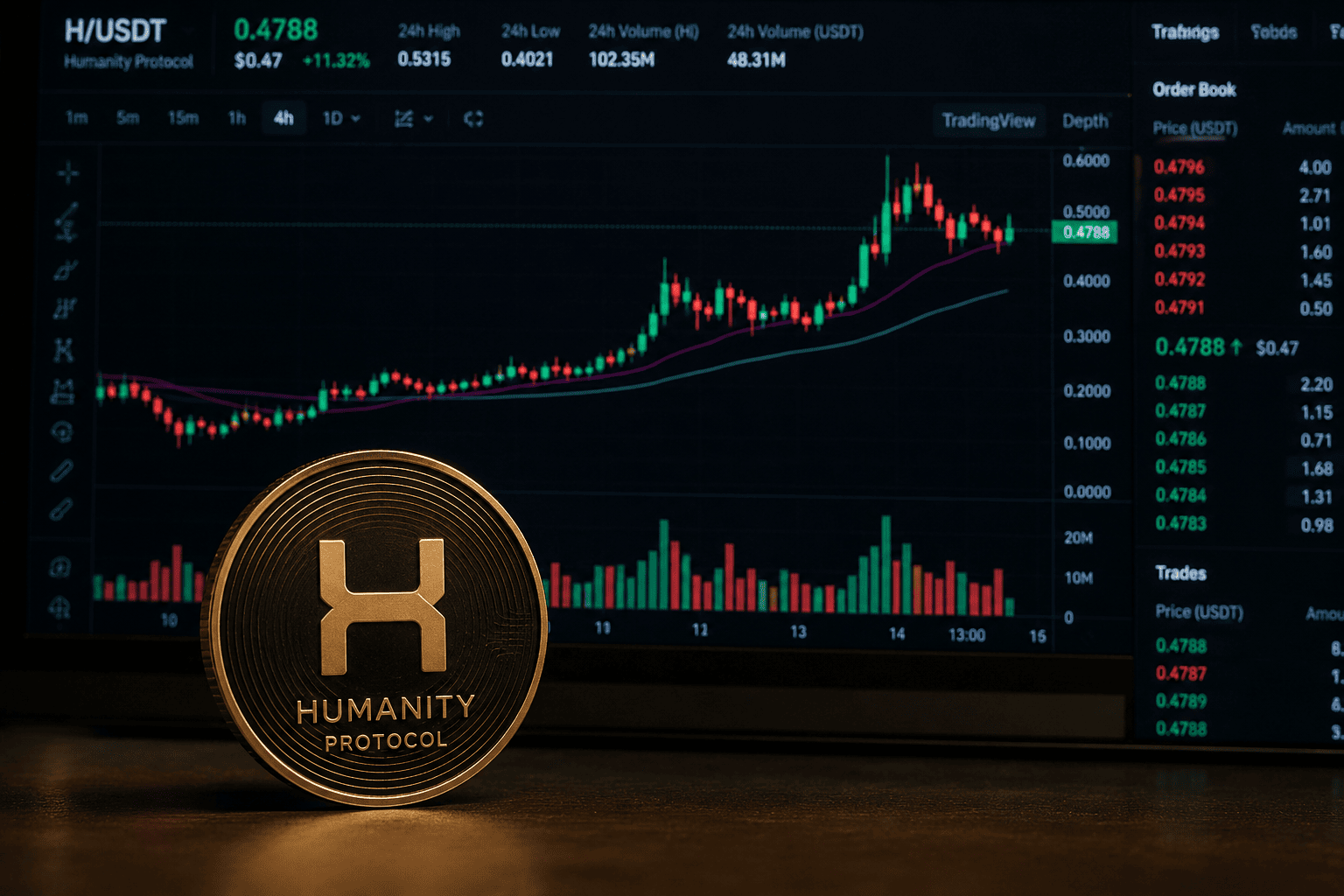
Humanity Protocol's H token has staged a sharp recovery, climbing more than 300% from its post-exploit low, as investors reassess the damage from last week's security breach. The token now faces a critical test: can it reclaim the $0.80 level it traded at before the incident?
According to CoinGecko data, H fell from around $0.70 to below $0.10 between June 8 and June 9 after an attacker exploited the protocol's cross-chain infrastructure. The breach resulted in the theft of 141.2 million H tokens from the Ethereum bridge and the minting of an additional 300 million tokens on BNB Smart Chain, flooding the market with roughly 447 million tokens.
Recovery Fueled by Forensic Report
The rebound began after blockchain security firm Quantstamp published a detailed forensic analysis. The report confirmed that the protocol's zkEVM smart contracts and palm-scan biometric identity system were not compromised. Instead, the breach originated from a phishing email that infected a developer's machine, exposing sensitive private keys.
This finding helped shift market sentiment, with traders treating the event as an operational security failure rather than a fundamental flaw in Humanity Protocol's technology. The project's team also implemented containment measures, including a public wallet tracker, blacklisting of exploit-linked addresses on exchanges, and a $1 million USDT bounty for information leading to asset recovery.
Price Action and Key Levels
H has rebounded from lows near $0.08 to trade above $0.50 during several recovery attempts. However, repeated rejections between $0.55 and $0.65 have established a significant resistance zone where sellers continue to emerge. On the daily chart, the token remains above its 20-, 50-, 100-, and 200-day exponential moving averages, suggesting the longer-term trend has not completely broken down.
Volume profile data on the 4-hour chart identifies the $0.22 to $0.25 region as the strongest support area formed after the exploit. Holding above that zone is critical for preserving the recovery structure, while a move toward $0.60 could test whether demand is sufficient to challenge higher resistance.
Momentum and Capital Flow Signals
Momentum indicators present a mixed picture. The 4-hour Relative Strength Index (RSI) remains near 55, indicating that bullish momentum has cooled after the initial rebound but has not turned decisively bearish. However, the Chaikin Money Flow (CMF) indicator remains negative on the daily timeframe, suggesting that some market participants may still be selling into rallies despite the price recovery.
Upcoming Token Unlock Adds Uncertainty
A key factor hanging over the market is Humanity Protocol's scheduled token unlock on June 25. Speculative buying has intensified partly because investors expect the project's recovery measures, including potential buybacks funded through recovered assets, to offset some of the supply pressure created by the exploit. Whether that expectation holds will likely determine the next phase of price action.
A sustained move above $0.65 could open the door to another attempt at the $0.80 region. However, current chart data suggests buyers must first absorb persistent selling pressure around the $0.55 to $0.65 range before a full recovery becomes realistic.
For context, other tokens have faced similar challenges after security incidents. For example, Hedera HBAR experienced a price drop after the Bonzo exploit but later stabilized amid adoption news. Meanwhile, Chainlink rebounded 5% as broader market sentiment improved, highlighting how external factors can influence recovery trajectories.
As the June 25 unlock approaches, traders are closely watching whether H can hold above key support levels and break through resistance. The recovery has erased a substantial portion of the exploit-driven collapse, but market data indicate that investors are still reassessing the project's value.
This article is for informational purposes only and does not constitute financial advice.