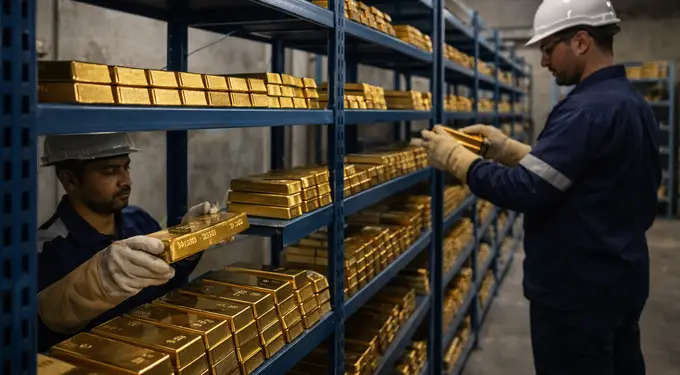
Gold's 2026 rally has been marked by sharp swings, with prices recently rebounding to test the $4,500 per ounce level after a steep correction. The recovery is set against a backdrop of shifting Fed rate expectations, Treasury buyback announcements, and ongoing geopolitical tensions. Investors are now asking whether this rebound can sustain a breakout or if renewed dollar strength could trigger another pullback.
In an interview with Invezz, Rick Kanda, Managing Director at The Gold Bullion Company, outlined the key factors that could drive gold's next major move. He emphasized that a sustainable break above $4,500 would require a combination of falling or stable real yields, a weaker US dollar, and strong investment demand. "Concerns around fiscal policy and debt will also support gold," Kanda noted, pointing to recent Treasury buyback announcements that have raised questions about long-term borrowing costs.

Kanda cautioned against attributing the entire rally to Treasury buybacks, calling them "an important factor" that accelerated a move already supported by other fundamentals. "If the several other factors weren't already in place, a policy announcement like this would be much less powerful," he said. He highlighted ongoing central bank purchases and geopolitical uncertainty as structural supports.
The Federal Reserve's next moves are seen as a critical swing factor. Gold, being a non-yielding asset, is highly sensitive to real yields and the dollar. "If the Fed is willing to tolerate some inflation and keep rates down, this would support gold," Kanda explained. Conversely, if the Fed is forced into further rate hikes, gold could face pressure as investors shift to income-producing assets. Recent hawkish remarks from Fed Governor Kevin Warsh at Jackson Hole have raised expectations for a near-term hike, adding to the uncertainty.
A rebound in the US dollar from recent weakness is identified as a clear risk. Kanda noted that the reason behind the dollar's rebound matters most. "If the dollar rebounds because US economic data improves and markets price out rate cuts, then gold could come under pressure," he said. However, if the rebound is driven by risk aversion, safe-haven demand could offset some of that pressure, leading to increased volatility.
Central bank buying, which surged to 289 tonnes in Q2 after a weak Q1, is seen as a crucial support but not the sole driver. Kanda views this as part of a longer-term diversification strategy rather than a reaction to current prices. "It wasn't simply reactive to today's price; rather, it was part of a longer-term diversification strategy for central banks," he said.
Institutional investors, who pulled back from US gold ETFs in Q2, may return with stronger momentum and a more supportive economic backdrop. Kanda believes that clearer signals on Fed policy and sustained price strength could encourage renewed ETF inflows. He also reiterated his bull case, suggesting gold could reach as high as $6,000 per ounce by the end of 2026 if supportive conditions persist.
For investors tracking the broader market, the dynamics in gold are intertwined with other assets. For instance, bitcoin's recent breakout and solana's rally on ETF inflows highlight the search for alternative stores of value. Meanwhile, affirm's consolidation ahead of earnings shows how rate expectations are impacting growth stocks.
As gold navigates these crosscurrents, the path forward will depend on the interplay between Fed policy, dollar strength, and investor sentiment. Kanda's analysis underscores the complexity of the current environment, where both risks and opportunities abound.
This article is for informational purposes only and does not constitute financial advice.