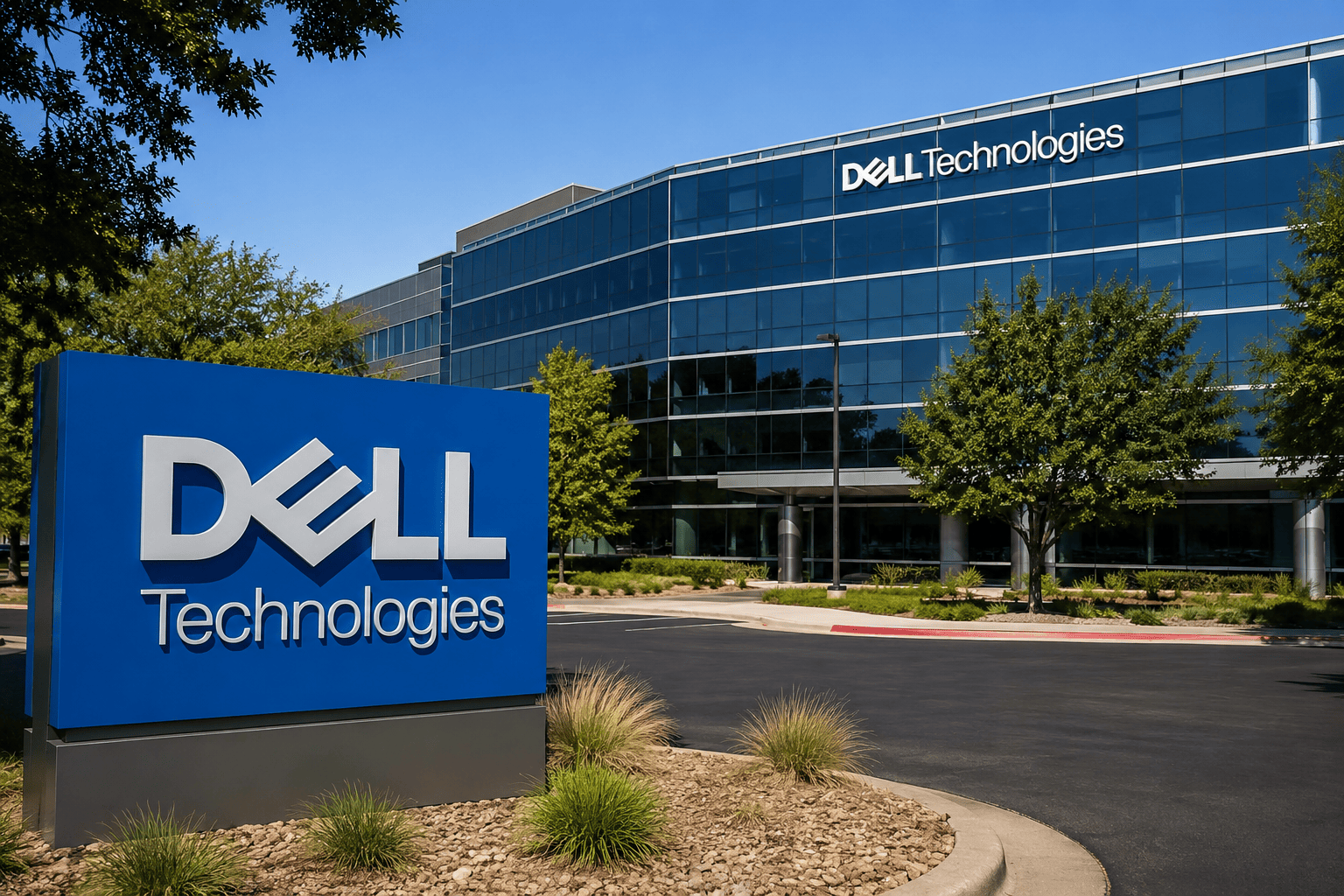
Dell Technologies delivered a blockbuster second-quarter report that sent its shares up 8% in extended trading, as the company's AI infrastructure business continued to scale at a pace that far exceeded Wall Street's expectations. The company also raised its full-year revenue and profit forecasts, signaling that the AI-driven demand cycle is far from peaking.
For the quarter ended July 31, Dell reported adjusted earnings of $7.04 per share, crushing the $4.92 consensus from LSEG analysts. Revenue came in at $46.97 billion, up roughly 58% year over year and well above the $44.92 billion expected. Net income surged to $4.13 billion, or $6.34 per share, from $1.16 billion, or $1.70 per share, in the same period last year.

The company also raised its fiscal 2027 revenue outlook to $192 billion from $167 billion, and lifted its adjusted earnings-per-share forecast to $25.50 from $17.90. That marks the second major upward revision to its profit outlook this year. Analysts had been modeling $172.67 billion in revenue and $18.92 in adjusted EPS for the full year, making the scale of the upgrade particularly striking.
AI servers: the growth engine
The Infrastructure Solutions Group, which houses Dell's data-center hardware business, generated $31.78 billion in revenue during the quarter, an 89% increase from a year earlier and above the $29.61 billion analyst consensus. AI-optimized servers accounted for $16.40 billion of that revenue, slightly ahead of the $16.07 billion expected by StreetAccount and double the year-ago figure.
More importantly, Dell said AI server orders reached $60.9 billion during the quarter, and the company exited the period with an AI-related backlog of $95 billion—nearly double the $51.3 billion reported in its previous earnings release. The company also raised its fiscal 2027 revenue forecast for AI-optimized servers to $74 billion from $60 billion, a move that analysts say underscores the durability of the AI infrastructure boom.
“This is an absolute demolition of Wall Street's consensus expectations,” said Nicholas Mugalli, founder and CEO of World Trade Securities. “The crown jewel is adjusted operating income hitting $5.93 billion against the $4.18 billion estimate—a massive 41.8% beat that shatters the lazy bear thesis of margin compression.”
Beyond GPUs: traditional infrastructure benefits
One of the more notable aspects of Dell's results is that growth is no longer confined to GPU-centric AI servers. Traditional servers and networking generated $10.5 billion in revenue, up 122% year over year, as organizations refresh their entire data-center stacks to support AI workloads.
“In just the past two quarters, we have generated almost as much revenue from traditional servers and networking as we have in any prior full year in company history,” said Jeffrey Clarke, Dell's chief operating officer, on the earnings call.
Steven Dickens, CEO of HyperFRAME Research, noted that the AI build-out is dragging conventional infrastructure along with it. “Organisations are not just bolting GPU racks onto ageing estates. They are refreshing the entire stack. Networking has to scale to handle data movement. CPU-based compute still runs the workloads around the AI models,” he wrote on X.
Backlog and customer diversification
Dell said it had booked more than $130 billion in AI server orders over the past 12 months, with its customer base expanding across neocloud operators, sovereign governments, and enterprises. The company now counts more than 6,500 AI customers, up from a smaller base earlier in the cycle.
“Demand is broadening across neoclouds, sovereigns, and enterprise customers, and our customer count has surpassed 6,500,” Clarke said on a post-earnings call that was briefly disrupted by a technical issue.
This diversification is a key part of the investment thesis. Earlier in the AI cycle, much of the spending came from a relatively small group of hyperscalers and specialist cloud providers. Dell is now seeing demand from a wider range of customers, which reduces concentration risk.
Dickens said this changes the narrative for Dell. “The market spent years debating whether Dell could participate meaningfully in the AI cycle or get squeezed between NVIDIA and the hyperscalers. This quarter answers that with data. The AI hardware opportunity is real, but what makes Dell's position distinctive is that it extends across the full infrastructure stack, not just the GPU slot.”
Margins and supply chain remain key tests
Investors will now focus on whether Dell can sustain this growth while protecting profitability. The company has faced a memory chip shortage that could pressure margins in the coming quarters. However, the strong adjusted operating income beat suggests Dell is managing costs effectively.
Dell's results also come amid a broader AI trade that has seen mixed signals. Dell shares had slipped earlier on concerns about supply constraints, but today's report appears to have alleviated those fears. The company's raised guidance and robust backlog provide visibility that many peers lack.
Analysts see the potential for a major rerating of Dell's stock, as the market begins to price in a more durable AI growth trajectory. The company's ability to grow profits alongside AI server revenue challenges the traditional view of Dell as a low-margin hardware vendor.
With AI expected to account for 75% of data-center demand by the end of the decade, and a more than $1 trillion opportunity across neocloud, sovereign, and enterprise compute deployments, Dell appears well-positioned to capitalize. The company's execution over the next few quarters will be critical in determining whether the stock can hold its gains.
This article is for informational purposes only and does not constitute financial advice.