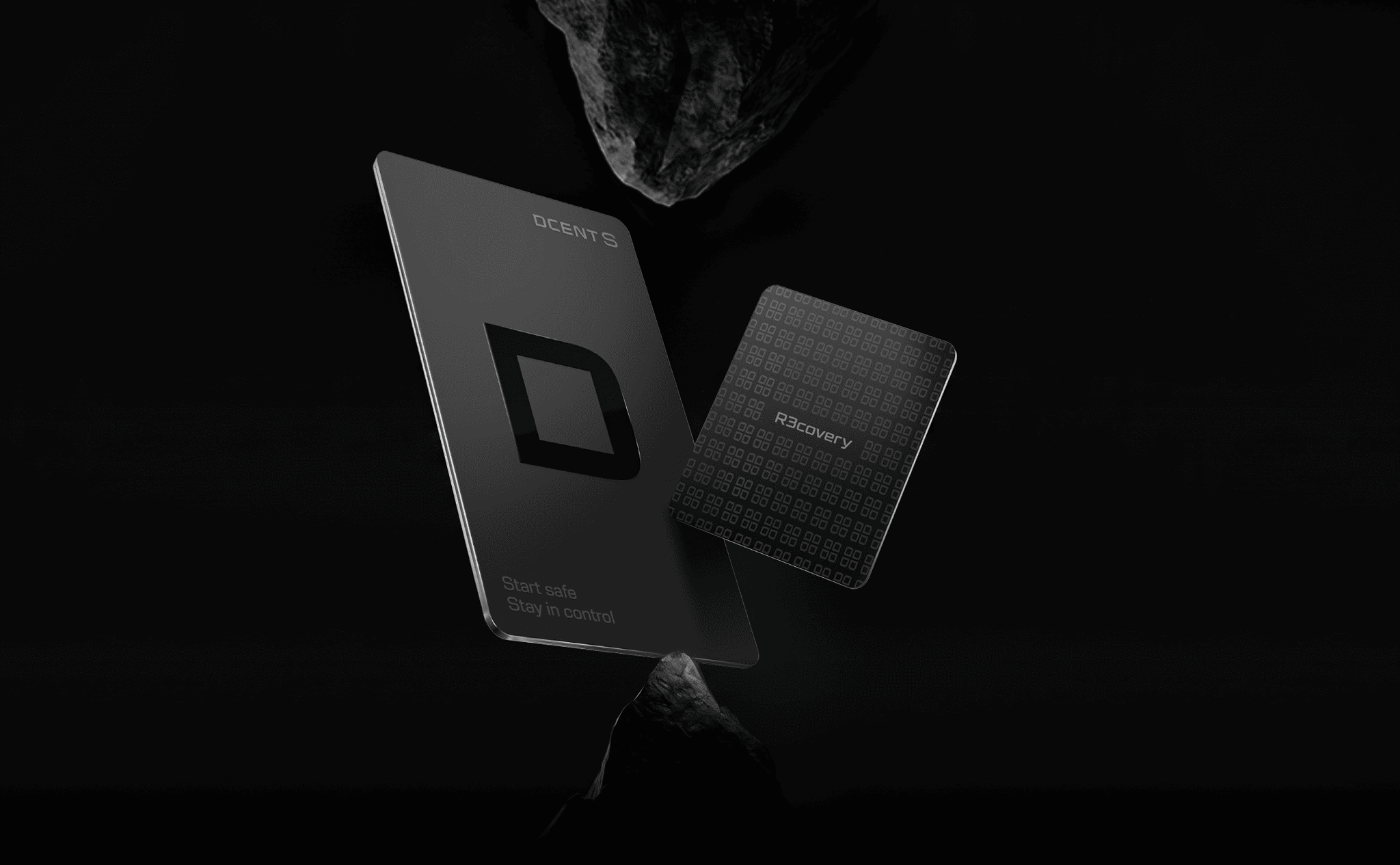
D'CENT, a South Korean hardware wallet brand serving over one million users across 220+ countries, has globally launched the DCENT S, a card-format cold wallet that addresses a persistent pain point in self-custody: backup and recovery. Unlike traditional hardware wallets that rely on paper seed phrases, the DCENT S includes a dedicated backup card in every package, shifting recovery from a user-managed task to a built-in hardware feature.
Hardware Backup Replaces Paper Seed Phrases
The DCENT S consists of two cards. The main card is used for daily transactions, tapped against a smartphone to sign transfers. The second card, called the R3covery card, remains stored securely at home or in a safe. During initial setup, the main card generates the private key inside its Common Criteria EAL6+ certified secure element and passes an encrypted backup to the R3covery card, which stores it in a separate secure element. The seed phrase never appears as readable text on a screen or on paper, eliminating the risk of loss or theft of a paper backup.

If the main card is lost, stolen, or damaged, users can restore their wallet in under five minutes by tapping the R3covery card with the D'CENT mobile app. No support ticket or reissue request is needed. This design directly addresses a common failure point: according to D'CENT CEO Sangsu Baek, many users lose access to their crypto not due to hacking, but because they misplace the paper containing their seed phrase. “That is not a user mistake. It is an unsolved design problem, and we took it as ours to solve,” Baek said.
Exchange-Grade Security in a Slim Form Factor
The DCENT S generates and protects private keys inside a Common Criteria EAL6+ certified secure element, with signing occurring within that same element. The private key is never exposed to the smartphone or app. Anti-tamper protections lock the card automatically if the secure element is tampered with or extracted, and repeated incorrect PIN attempts also trigger a lock. The card requires no cable, pairing, or battery charging; users simply hold it against the back of their smartphone to sign transactions after reviewing details in the D'CENT app.
Card-format wallets have emerged as a segment of the hardware wallet market aimed at users who find USB-style devices cumbersome for regular use. Brands such as Tangem, Ledger, and Trezor now offer similar form factors, but D'CENT claims the DCENT S avoids the typical trade-off between portability and robust backup. “Card-format wallets have usually been a trade-off, where you accept a weaker recovery story in exchange for something you can actually carry,” Baek said. “We designed and manufactured DCENT S in Korea so we would not have to make that trade.”
Broad Blockchain Support and Market Context
At launch, the DCENT S supports over 100 blockchain networks, including Bitcoin, Ethereum, XRP, and ERC-20 tokens. This broad compatibility allows long-term holders to move assets off centralized exchanges into self-custody on a single card. The move comes amid growing interest in self-custody solutions, as seen in recent trends like Ethereum exchange outflows surging and whale accumulation tightening exchange supply for CRV.
The DCENT S is available worldwide. Full specifications, durability ratings, a complete list of supported networks and tokens, purchasing information, and setup guides are available on the D'CENT website. D'CENT is a brand of IoTrust Co., Ltd., a South Korean company specializing in hardware wallets and next-generation authentication systems.
This article is for informational purposes only and does not constitute financial advice.