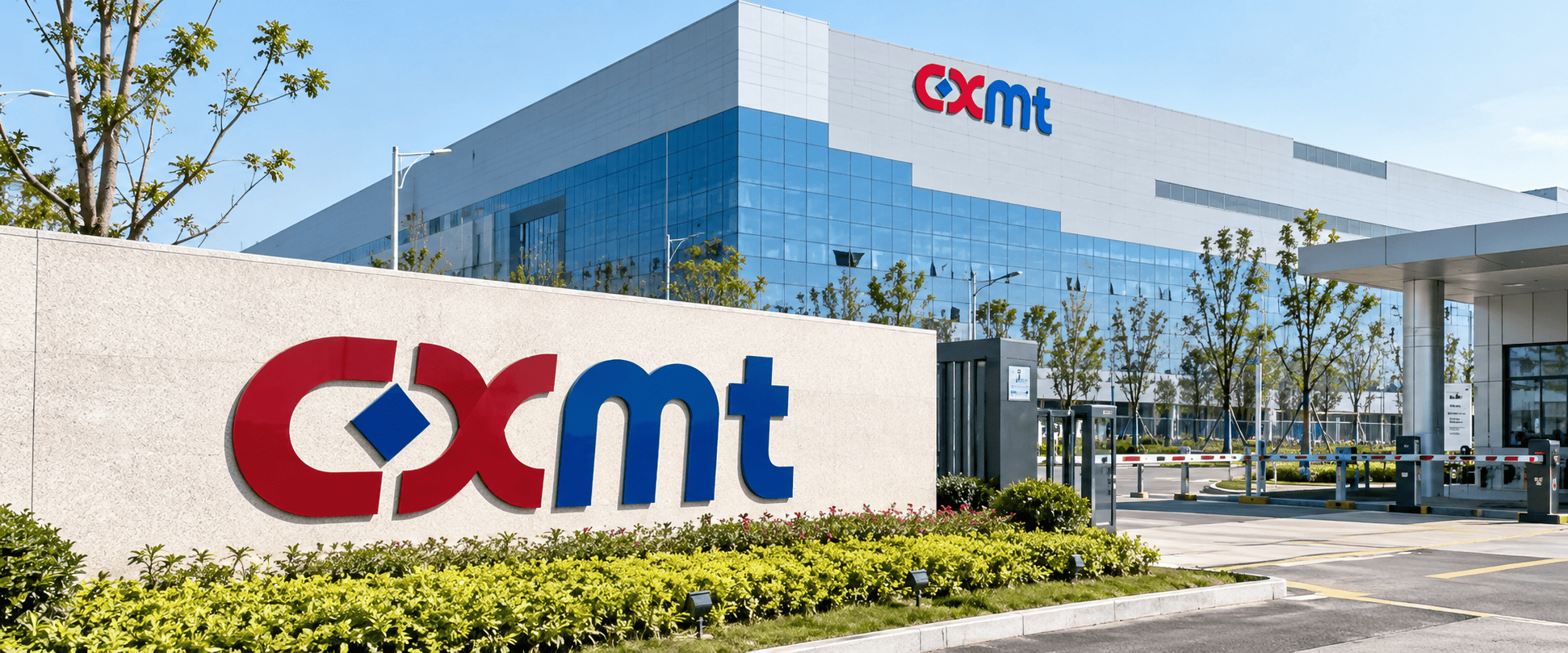
Memory chip stocks, including Micron Technology, Samsung Electronics, and SK Hynix, have faced repeated sell-offs this year on reports of technological progress at China's ChangXin Memory Technologies (CXMT). Investors worry that the Chinese chipmaker could eventually undermine the competitive edge of the industry's dominant players, whose shares have surged amid the artificial intelligence boom.
The concern is straightforward: memory chipmakers have benefited from AI-driven demand, a limited number of suppliers, and the difficulty of quickly expanding production. This supply-demand imbalance has supported prices and boosted earnings expectations. If CXMT can ramp up output and close the technology gap, additional supply could pressure memory prices and erode the gains from the memory trade.

The latest trigger came when CXMT President Cao Kanyu announced a breakthrough in a next-generation memory cell architecture known as 4F-squared. This design allows more memory cells to fit on a chip of the same size than the existing 6F-squared structure. The company plans to introduce a new server-memory product based on this technology by the end of 2026, according to a company statement. The announcement sent shares of Samsung, SK Hynix, and Micron sharply lower on Monday and Tuesday, also weighing on other technology stocks globally.
Morningstar equity analyst Jing Jie Yu said CXMT's announcement disrupted investor expectations around technology development timelines and heightened concerns about the accelerating pace of lower-cost Chinese technologies that could disrupt leading AI firms. "If the company can commercialize this technology ahead of its peers, it speaks volumes to China's DRAM technological competitiveness and raises risks of oversupply longer term given the country's rapid expansion in DRAM capacity," he said.
What is 4F-squared technology?
Most memory chips today use a 6F-squared structure, which refers to the space occupied by each memory cell. A smaller structure allows cells to be packed more tightly, increasing data storage capacity. The 4F-squared architecture is a new chip-design approach aimed at improving storage density by fitting more cells into the same area. Samsung and SK Hynix are also pursuing 4F-squared designs as an upgrade to the widely used 6F-squared structure. The investor concern is that CXMT could introduce the technology sooner than expected.
CXMT has already established itself as a significant player in the global memory industry. The company staged a blockbuster initial public offering on Shanghai's Star market in July, briefly becoming China's most valuable company. It is now the world's fourth-largest DRAM chipmaker. A Counterpoint Research report published last month showed that CXMT captured 10% of the global DRAM market in the second quarter of 2026, up from 4% a year earlier and 8% in the first quarter. Samsung held a 38% share, followed by SK Hynix at 25% and Micron at 24%.
CXMT has given memory investors more reasons to worry
Despite its rapid growth, CXMT faces significant obstacles in expanding its technological capabilities. US export controls have restricted China's access to advanced chipmaking equipment, including ASML's extreme ultraviolet (EUV) lithography machines, which are considered essential for manufacturing the most advanced semiconductors efficiently. Nevertheless, recent developments have raised concerns that the company could become a more formidable competitor.
In August, reports emerged that Apple had been testing CXMT memory chips across product lines, including iPhones and MacBooks, as it sought to address the memory crunch affecting the industry. "While US government is unlikely to allow made in China memory sales to US, sales to data centers in other regions like Europe could indirectly impact Micron," Citi analysts said in a note from August. CXMT was also reported to be considering the construction of a second memory-chip fabrication plant in Beijing as it sought to expand production during a global semiconductor shortage fuelled by artificial intelligence spending.
Its progress in manufacturing technology has added to investor concerns. Last month, CXMT moved its latest DRAM technology into mass production. The company said its fifth-generation process could produce at least 50% more dies per wafer than its previous platform, while improving power efficiency and manufacturing economics. These developments suggest CXMT is making progress in narrowing the technological gap with established memory suppliers.
Why analysts are not sounding the alarm yet
However, analysts remain cautious about treating it as an immediate competitive threat, citing its manufacturing limitations and the difficulty of producing advanced chips at scale. "First, announcing a new memory architecture and successfully manufacturing it at scale are two completely different things," Milk Road analyst Melvin said on X, adding that CXMT still needs to prove it can deliver competitive yields, pricing, reliability, and production volumes.
The sell-off in memory stocks may be overdone, as CXMT's 4F-squared technology is still in the development phase, and mass production at competitive yields remains a significant hurdle. The company's ability to challenge the incumbents will depend on overcoming these manufacturing challenges, which could take years. For now, investors are weighing the long-term risk of oversupply against the near-term realities of production constraints.
This article is for informational purposes only and does not constitute financial advice.