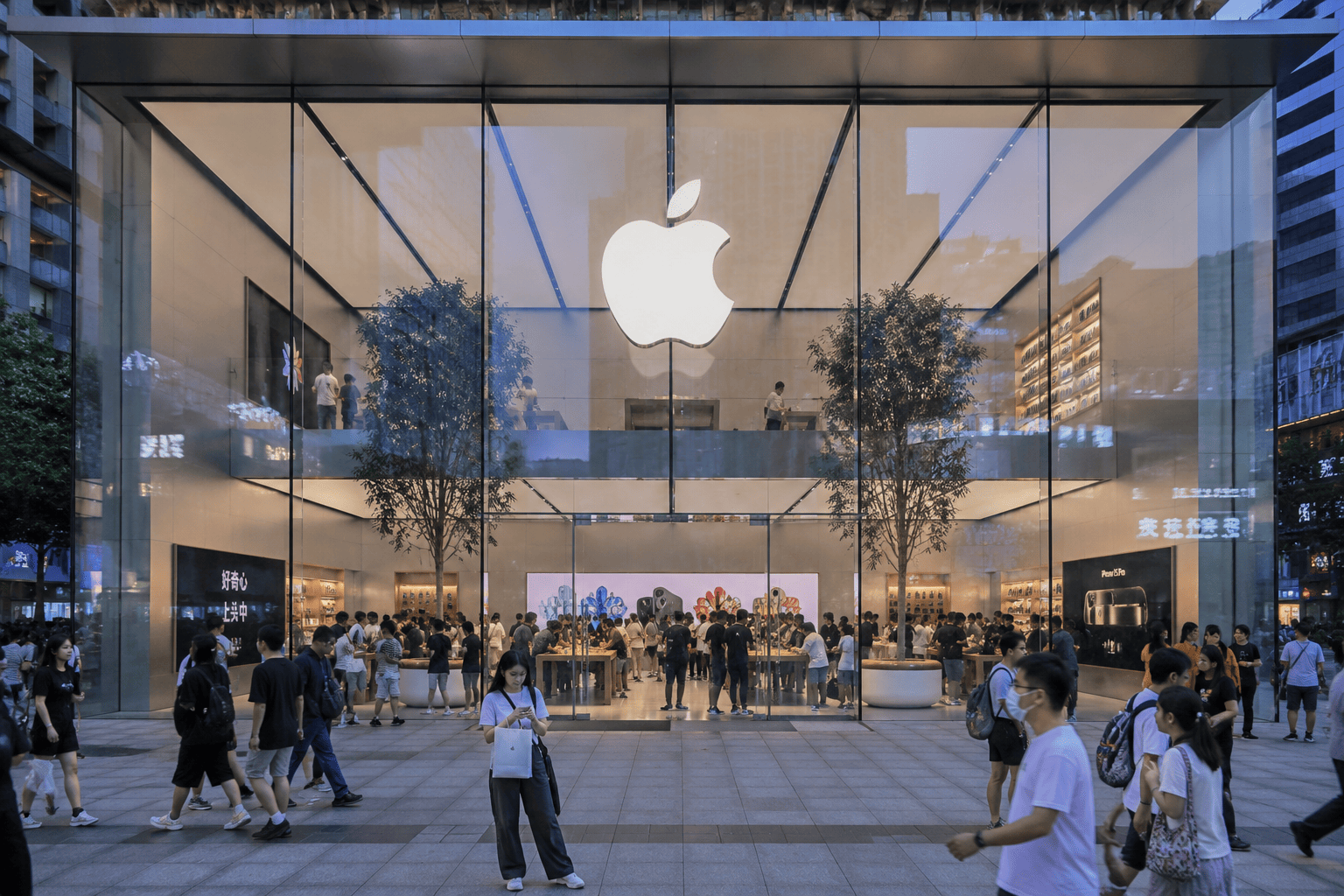
Apple's stock rose approximately 3% on Tuesday as John Ternus officially assumed the role of chief executive, marking the company's first leadership transition since 2011. The move ushers in a new era for the world's most valuable tech firm, which now faces the dual challenge of sustaining growth and navigating a rapidly evolving AI landscape.
Leadership Transition at a Pivotal Moment
Ternus, a 25-year Apple veteran who previously led hardware engineering for the iPhone, Mac, and iPad, takes the helm as the company contends with intensifying competition in artificial intelligence and questions about whether its valuation leaves room for further upside. Tim Cook, who succeeded Steve Jobs in 2011, becomes executive chairman after growing Apple from a roughly $350 billion company to one valued at over $4.5 trillion.

Investors appear to view the transition as an orderly succession rather than a disruptive event. Ternus's deep product and engineering background could prove advantageous as Apple prepares for a potentially significant hardware cycle.
Strong Financials, High Expectations
Ternus inherits a company with formidable financial strength and a massive installed user base, but also one facing lofty expectations. Apple shares have gained about 21% this year, adding to the substantial wealth creation during Cook's tenure. Since Cook became CEO, the stock has risen 2,258%, with total return including dividends climbing 2,716%, according to Bloomberg data. In comparison, the S&P 500 gained 757% on a total-return basis, while the Nasdaq 100 rose 1,499%.
“Under Tim Cook, Apple has created market cap growth at a rate of roughly $32 million an hour, every hour, for nearly 15 years,” noted Bank of America analyst Wamsi Mohan in a recent report. Apple's weighting in the S&P 500 has grown to about 7%, up from less than 3.3% in 2011.
Services and Capital Returns Under Cook
Cook's legacy includes a significant shift toward services, which generated more than $109 billion in fiscal 2025, accounting for over a quarter of total revenue, compared to just 9.4% in fiscal 2013. This expansion has provided Apple with a growing stream of recurring, high-margin revenue. Additionally, Apple has returned over $840 billion to shareholders through buybacks since fiscal 2012, reducing its share count by nearly 45% from its 2012 peak.
The question now is whether Ternus will maintain Cook's disciplined capital allocation or deploy Apple's resources more aggressively to catch up in AI.
AI: The Immediate Strategic Test
Artificial intelligence is arguably the biggest strategic challenge facing Ternus. Apple has faced criticism for lagging rivals like Microsoft, Alphabet, and Amazon in generative AI development. Ternus's engineering background may allow him to push a more aggressive product strategy, but investors will seek tangible evidence that Apple can turn AI into a competitive advantage.
“AI is the single biggest challenge for Ternus. Apple needs to demonstrate that AI will be more than an app on the iPhone, more than Siri,” said Brian Mulberry, chief market strategist at Zacks Investment Management, which owns Apple stock. He also highlighted the pressure to move manufacturing out of China without squeezing margins.
Apple's AI opportunity is amplified by its distribution advantage of billions of active devices. The challenge lies in converting that installed base into a stronger AI ecosystem without compromising the simplicity and privacy that differentiate its products.
Foldable iPhone as a Potential Catalyst
Ternus won't have long to wait for his first major test. Apple's September 9 product event, his first as CEO, is widely expected to feature the iPhone 18 lineup, potentially including the company's first foldable iPhone. This launch could signal how aggressively Apple plans to refresh its hardware portfolio under new leadership.
Apple has already shown product momentum, unveiling new Mac mini models powered by its first 2-nanometer M6 chip in late August. A successful premium foldable could provide another growth avenue and help Apple compete in a category where rivals have established products. Rothschild & Co. Redburn upgraded Apple from “Neutral” to “Buy” on Aug. 17, raising its price target to $400 from $260, citing confidence in the next product cycle and a revamped AI strategy.
For more on Apple's recent stock movement, see Apple shares dip as Ternus takes helm. Also, check our analysis on Nvidia's growth and buybacks for context on tech valuations.
This article is for informational purposes only and does not constitute financial advice.